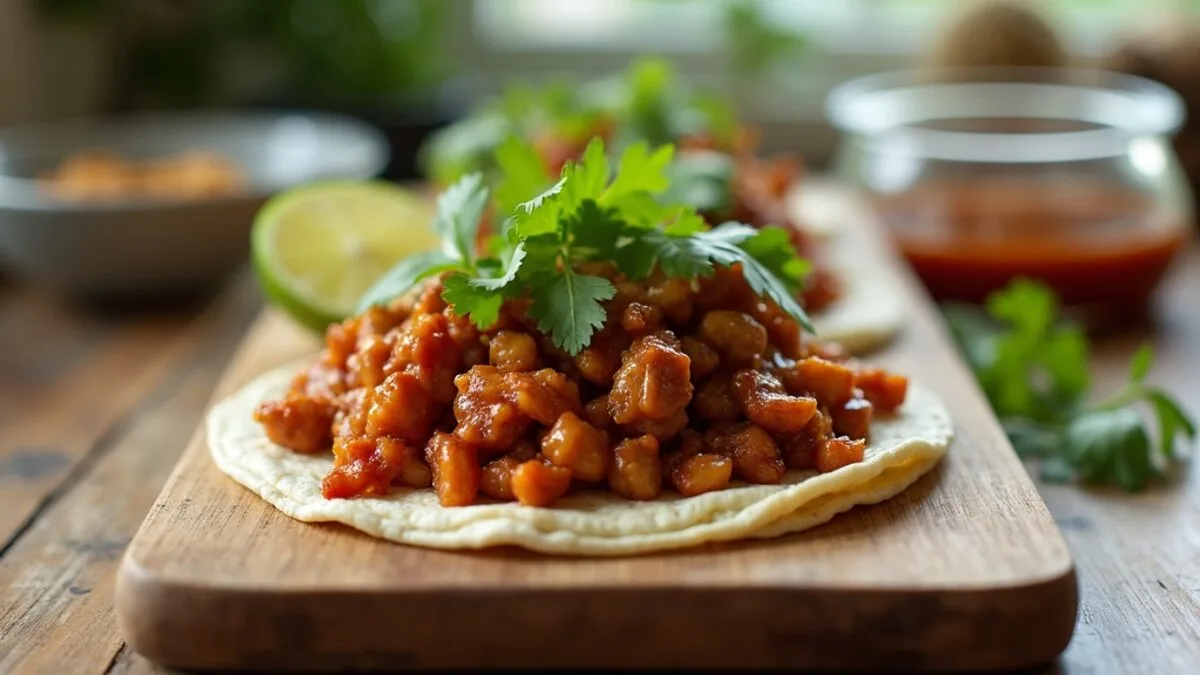
Vegan pulled jackfruit is young green jackfruit, simmered until its fibres shred into soft, savoury strands that stand in for pulled pork. You cook it in one pan with onion, garlic, smoked paprika and a quick barbecue-style sauce, and it is ready in under an hour.
What vegan pulled jackfruit actually is
Vegan pulled jackfruit is young, unripe jackfruit that you simmer in a savoury sauce until its fibres pull apart into soft strands, much like slow-cooked meat. That is the whole trick. The fruit itself tastes of almost nothing when it's green, which is exactly why it works. It carries flavour the way a sponge carries water, and it shreds into that loose, ragged texture we love in a pulled-pork sandwich.
I came to it sideways. A friend served me jackfruit tacos years ago and refused to tell me what was in them until I'd finished. I was sure I was eating something braised for hours. I wasn't. I was eating a tin, an onion, and twenty-odd minutes of attention.
That dinner stuck with me. I'd been plant-based for a while by then, and I'd made peace with the things I didn't eat anymore. What I hadn't expected was to feel that specific, almost nostalgic pleasure again, the one that comes from a messy, saucy, hands-on plate of food. Jackfruit gave it back to me without asking me to pretend it was something it wasn't.
The plant is worth a moment of curiosity. Jackfruit is the largest fruit that grows on a tree, and when it ripens it turns sweet and golden, nothing like the dish I make here. You can read more about the jackfruit plant and its many uses if the botany interests you. For cooking, the only thing that matters is the word "young" or "green" on the tin.
So this is not a fake-meat product in a packet. It's a whole food that happens to behave like one. That distinction matters to me, and it might matter to you too. There's no long ingredient list I can't pronounce, no ultra-processed binder doing the heavy lifting. There's a fruit, a pan, and some spices I already own.
Why it works so well
Texture is the answer. Young jackfruit is full of long, stringy fibres held together by a firm core. Heat and a little liquid relax those fibres until they let go of each other, and what you're left with looks uncannily like shredded meat. That's not marketing. It's just how the fruit is built.
The neutral flavour is the second gift. Because green jackfruit barely tastes of anything, it takes on whatever you cook it in without a fight. Smoky, sweet, spicy, tangy: it says yes to all of them. I think of it less as an ingredient with opinions and more as a vehicle for the ones I have.
And honestly, there's a small thrill in serving it. People lean in, take a bite, and pause. Then they ask what it is. That little moment of surprise is half the reason I keep a few tins in the cupboard at all times.
For a savoury, ready-to-eat protein, I keep coming back to my smoked tofu recipes.
The tins to buy, and the ones to leave
This is where most disappointing jackfruit starts, so I want to be clear before you cook anything. I have served sweet, syrupy jackfruit in a savoury sauce exactly once, early on, and I still wince at the memory. Buying the right tin is ninety percent of the battle.
You want young green jackfruit packed in brine or water. Not syrup. Not "jackfruit in syrup," not "ripe jackfruit," not the dried sweet chips. If you simmer the sweet kind in a savoury sauce, you'll end up with something cloying and strange, and you'll quietly decide jackfruit isn't for you. It is. You just bought the wrong tin.
What the label should say
- Young green jackfruit, sometimes written as "young jackfruit" or "tender jackfruit."
- Packed in brine or water, with salt or citric acid as the only extras.
- A drained weight around 200 to 280 g per 400 g tin, so two tins feed four people comfortably.
A quick comparison
- Brine vs water: brine-packed jackfruit needs a good rinse and a little less added salt. Water-packed is milder and forgiving. Either works.
- Tinned vs fresh: fresh young jackfruit is wonderful but messy and rare outside Asian grocers. For a weeknight, tins win every time.
- Pre-seasoned pouches vs plain tins: the pouches are convenient, but they cost more and you lose control of the sauce. I'd rather build my own.
If you only remember one line from all of this, make it the label. Young and green, packed in brine or water. Everything good downstream depends on that one small choice at the shelf, and everything disappointing tends to trace back to ignoring it.
If your shop only stocks the syrup kind, wait. A plain tin is the difference between a dish you make once and one you make every fortnight.
Where I find it
For years I only saw jackfruit in Asian grocers, usually a few brands stacked together near the bamboo shoots and water chestnuts. Those tins are often the cheapest and the best, and the shopkeepers know exactly what you mean if you ask for young green jackfruit. It's worth a trip.
These days my regular supermarket carries it too, sometimes in the world-foods aisle, sometimes near the tinned pulses. The big plant-based brands have made it easy. Just read the label twice, because the same shelf often holds both the savoury tins and the sweet ones, and the packaging can look alike at a glance.
If you're stuck, the internet always has it. A box of six tins lasts me a couple of months and works out cheaper per dinner than almost anything else I cook. For a whole food that turns into a crowd-pleasing meal, that's a quiet kind of luxury.
My one-pan method, step by step
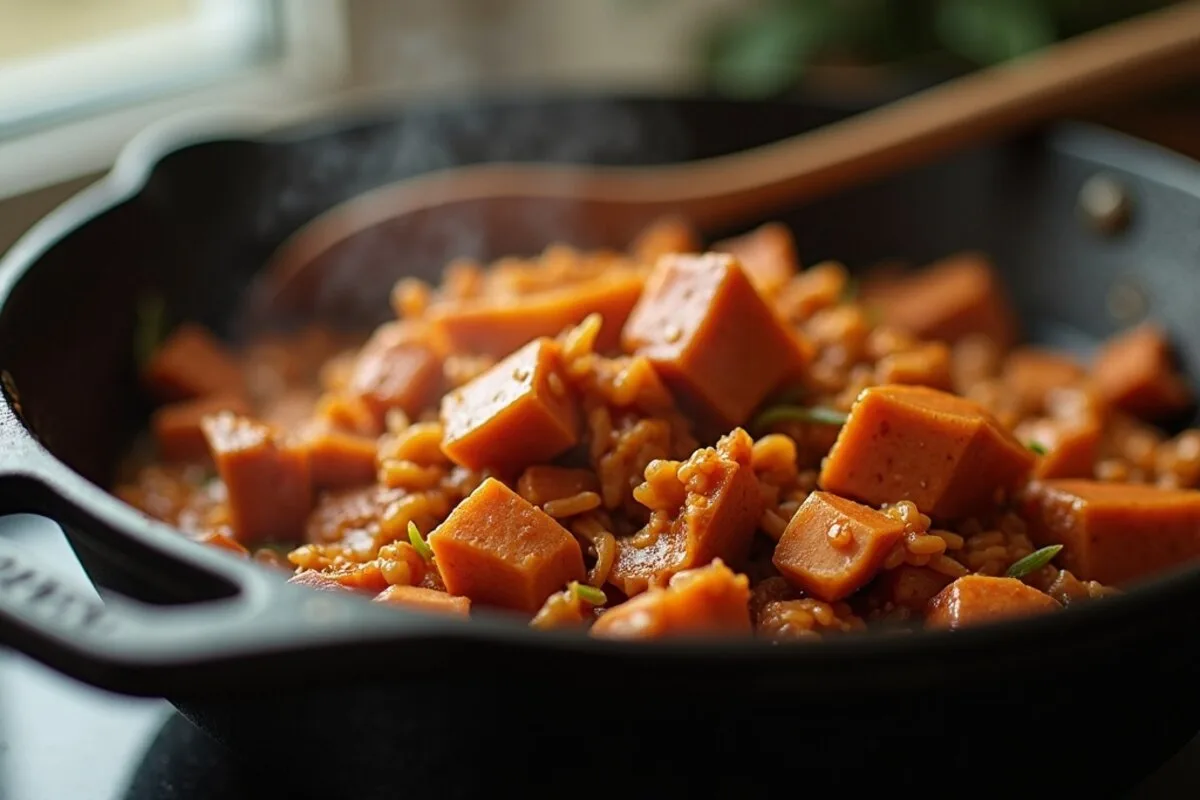
Here's how I actually cook it, the version I've landed on after a lot of slightly-wrong attempts. It lives in one wide pan, and it asks for nothing fancier than a wooden spoon. I use a cast-iron skillet because it holds heat and gives the jackfruit a little colour, but any wide, heavy pan does the job.
1. Prep the jackfruit
Drain both tins and rinse the chunks under cold water. Squeeze each piece gently to push out the brine, then pull it apart. The firm, pointed core of each chunk is the bit that shreds, so press it between your fingers until it loosens. You can also pinch it with two forks. Don't be too gentle. You want strands, not cubes.
Some chunks come with little round seeds and a softer fleshy part. Keep all of it. The seeds soften as they cook and the soft flesh melts into the sauce, thickening it slightly. Nothing here is waste. This is also the messiest, most satisfying step, the part my partner always volunteers for.
If you're cooking for someone who's nervous about texture, take an extra minute here and shred everything finely. The more you break it down now, the more meat-like the finished dish feels later. It's the single biggest lever you have over the result.
2. Build the base
Warm a tablespoon of oil in a wide pan over medium heat. Soften a finely diced onion for about six minutes, until it's translucent and sweet. Add the minced garlic, smoked paprika, cumin and a little chilli, and stir for one minute so the spices wake up. Your kitchen will start to smell like a weekend.
Don't rush the onion. This is where the savoury backbone of the dish comes from, and a pale, half-cooked onion leaves the whole thing tasting raw underneath the sauce. I let mine go properly soft, even catching a little gold at the edges. Those few extra minutes pay off more than any single spice does.
Toasting the spices in the oil for that one minute matters too. Dry spices tipped into liquid stay muted, but bloomed in a little fat they open right up. You'll smell the difference, a deeper, rounder smokiness, the moment it happens.
3. Add the jackfruit and sauce
Stir in the tomato paste, then the soy sauce, maple syrup and vinegar. Tip in the pulled jackfruit and toss it so every strand gets coated. Pour in the water or stock, just enough to loosen everything without drowning it.
4. Simmer and shred
Let it bubble uncovered for 25 to 30 minutes. Every few minutes, press the jackfruit against the side of the pan with your spoon. It softens as it cooks, and the strands keep coming apart. When the sauce has reduced to a glossy coat and the jackfruit looks deep and ragged, it's done. Taste, then season.
If you want a little char, the kind you'd get from a grill, push the cooked jackfruit out into a thin layer and leave it untouched for a couple of minutes so the edges catch. Then stir and repeat once. Those crisp, slightly burnt bits are the best part, and they're easy to miss if you keep stirring out of habit.
The dish tells you when it's ready: the strands go from pale and stiff to dark and slack, and the sauce stops pooling.
The whole thing, from opening the tins to a plated dinner, runs about forty-five minutes, and most of that is hands-off simmering. I usually use that window to warm tortillas, throw together a slaw, or just sit down with a cup of tea while the pan does its work.
The sauce that makes it
Jackfruit is the canvas. The sauce is the painting. Get the balance right and people will swear you spent the afternoon on it.
My sauce is a quick barbecue style, built from cupboard staples rather than a bottle. It leans on four pulls: smoke, salt, sweet and sour. Smoked paprika does the smoke. Soy or tamari does the salt and depth. Maple syrup brings a rounded sweetness without the sugar rush. Apple cider vinegar cuts through it all and keeps the whole thing from turning flat.
I avoid bottled barbecue sauce here, not out of snobbery but because most of them are far too sweet and they flatten the jackfruit into one note. Building it yourself takes about ninety seconds of stirring and gives you a sauce that tastes layered instead of just sugary. The tomato paste is the quiet hero, by the way: it adds body and a slow-cooked depth you can't fake with ketchup.
How I dial it in
- Too flat? Add a teaspoon more vinegar. Acid is almost always the missing note.
- Too sharp? A little more maple or a pinch of brown sugar settles it.
- Not smoky enough? A drop of liquid smoke, or a chipotle in adobo blended into the sauce, takes it somewhere properly campfire.
- Want it richer? A teaspoon of tomato ketchup or a spoon of molasses deepens the colour and the body.
I keep a jar of the dry spice mix (smoked paprika, cumin, a little garlic powder and chilli) so the whole thing comes together faster on a tired evening. If you cook plant-based food often, that kind of small prep is the quiet backbone of plant-based meal prep that doesn't feel like a chore.
One honest note: the sauce tastes good but young in the pan, and noticeably better an hour later. If you have the patience, make it ahead. The flavours marry the way a stew's do overnight.
Three sauce directions, if you want to wander
The barbecue base is my default, but the jackfruit doesn't care which road you take. Once you trust the method, the sauce becomes a place to play.
- Korean-leaning: swap the smoked paprika for gochujang and a little sesame oil, finish with spring onion and sesame seeds. Sticky, savoury, a touch of heat.
- Mexican-leaning: add chipotle, a pinch of oregano and a squeeze of lime at the end. This is my go-to for taco night.
- Curried: drop the barbecue notes entirely, use curry paste, coconut milk and a handful of peas. Less pulled-pork, more comfort, still gorgeous.
I mention these not to overwhelm you but to make a point: the jackfruit is permanent, the sauce is yours. Learn the one and you've quietly learned a dozen dinners.
Where it goes: tacos, sandwiches, bowls
This is the fun part, because one pan of jackfruit stretches across a whole week of different dinners. It never feels like leftovers because it keeps changing shape.
Tacos
My favourite, and the one in the photo. Warm small corn tortillas in a dry pan until they blister. Pile in the jackfruit, then top with quick-pickled red onion, sliced avocado, a fistful of coriander and a squeeze of lime. The cool, sharp toppings against the smoky filling are the whole point.
The quick pickle takes minutes and lifts the whole plate: thinly slice a red onion, cover it with equal parts vinegar and warm water, a pinch of salt and sugar, and leave it while you cook. By the time the jackfruit's done, the onion's gone pink and tangy. That contrast, soft and smoky against bright and sharp, is what makes these taste like more than the sum of their parts.
Sandwiches
Spoon the hot jackfruit onto a soft bun with a crunchy slaw and a smear of vegan mayo. This is the most pulled-pork-like way to eat it, and the version I serve to sceptical guests. The slaw isn't optional. It gives you the crunch the jackfruit can't.
My everyday slaw is just shredded cabbage and carrot tossed with a spoon of vegan mayo, a little vinegar and salt. Make it while the jackfruit simmers and let it sit so it softens slightly. A toasted brioche-style bun, the warm filling, the cool slaw, maybe a few slices of pickle: that's a sandwich I'd happily eat once a week, and nobody at the table misses the meat.
Bowls
For a quieter dinner, I build a bowl: a base of rice or quinoa, the jackfruit, roasted sweet potato, some greens and a drizzle of tahini. It turns the dish into something more grounding, and it's an easy way to fold in protein and vegetables. If filling, satisfying dinners are what you're after, it sits naturally beside my other cozy weeknight vegan dinners.
And the smaller ways
Beyond the big three, jackfruit slips into all sorts of corners. I've folded it through pasta with a little extra sauce, piled it onto a baked potato with vegan sour cream, and used it cold the next day to fill a wrap for lunch. It's good on a pizza, scattered over nachos, even spooned onto toast with avocado on a lazy Sunday.
For a gathering, I set the warm pan in the middle of the table with bowls of toppings around it and let people build their own. It turns dinner into something social and low-stress, which is most of what I want from cooking these days.
Jackfruit is light on protein by itself, so on the nights I want a meal that actually holds me, I serve it with beans or a side of something heartier. It pairs beautifully with the kind of high-protein vegan meals I lean on when I've trained or had a long day.
Troubleshooting and the swaps I trust
Most jackfruit problems come down to texture or timing. Here's what I've learned from the batches that didn't quite work, because I've made all of these mistakes more than once.
It's too wet and won't shred
You either rushed it or kept the lid on. Take the lid off and let it simmer harder. The strands loosen as the moisture leaves, not before. Patience does most of the work here.
It's chewy in the middle
You didn't pull the firm cores apart enough before cooking. Those pointed centres are dense, and if you leave them whole they stay rubbery. Next time, press every chunk between your fingers first. You can also simmer ten minutes longer.
It tastes thin
This is nearly always under-seasoning, not a flaw in the jackfruit. Add salt, then acid, then a touch of sweet, tasting after each. A whole-food ingredient needs more seasoning than people expect.
Swaps I actually use
- No maple syrup? Brown sugar, agave or a date paste all work.
- No smoked paprika? Sweet paprika plus a drop of liquid smoke gets close.
- Soy-free? Use coconut aminos and a little extra salt.
- No fresh garlic? Half a teaspoon of garlic powder, stirred in with the spices.
It's a little bitter
This one surprises people. If you skipped the rinse, the brine can leave a faint metallic edge. A good rinse fixes it, and a pinch of sugar or a splash more maple rounds off anything that lingers. I always rinse now, every time, even when I'm rushing.
It looks pale and unappetising
We eat with our eyes first, and pale jackfruit just doesn't read as dinner. The fix is colour: enough tomato paste, enough smoked paprika, and a longer reduction so the sugars in the sauce deepen. If it still looks washed out, a teaspoon of molasses or dark soy does wonders for the colour without changing the taste much. Let it catch a little in the pan, too. Those darker, crisper edges make the whole bowl look like something you'd want to eat.
On the nights I want something this comforting but with even less effort, I treat it as one more recipe in my rotation of vegan comfort food that feels like home. It belongs in that drawer of the brain marked "easy and reliable."
Making it ahead and keeping it well
This dish is a friend to the cook who plans ahead, which is most of us, most of the time. It's one of the few things I make where the leftovers are genuinely better than the first plate, so I lean into that.
In the fridge
Cooled and stored in a sealed container, it keeps for four days and genuinely improves after one. Reheat it in a pan with a splash of water to loosen the sauce, since it tightens as it sits.
In the freezer
It freezes well for up to three months. I portion it flat in bags so it thaws fast. Defrost overnight in the fridge, then warm it through gently. The texture holds up better than most cooked dishes do.
One trick I rely on: I freeze it slightly under-sauced and under-seasoned, because freezing dulls flavour a little. When I reheat it, I taste and brighten it with a fresh squeeze of lime or a splash of vinegar, and it comes back to life as though it were just made. A frozen portion has rescued more tired evenings than I can count.
A note on scaling
Double the recipe and you've fed a small crowd, or you've set up several quick dinners without any extra washing up. That's the case I'd make for cooking it in bulk. One pan, one evening, a week of warm plates.
The only thing to watch when you scale up is the pan. Crowd too much jackfruit into too small a pan and it steams instead of reducing, and you end up with something wet and pale. If you're doubling, use your widest pan or split it across two. The strands need room to shed their moisture and catch a little colour, and they can't do that if they're piled three deep.
How I build a week around it
On a Sunday I'll cook a double batch and eat it three or four ways without ever feeling like I'm repeating myself. Tacos on Monday, a loaded baked potato midweek, a wrap for a working lunch, and the last of it stirred through rice when I can't be bothered to think. One pan, several dinners, almost no decisions left to make at six in the evening.
That, more than anything, is why it earns its place. Good food shouldn't demand a heroic effort to land on the table on a tired Tuesday. This doesn't.
I keep coming back to jackfruit because it asks so little and gives so much back. It's cheap, it's a whole food, and it turns a tin and twenty minutes into a dinner people remember. That's a good trade, every single time. If you've been curious about it and kept walking past the tin, this is your sign. Buy two, pull them apart, and let the pan do the rest.
The recipe
Smoky vegan pulled jackfruit
Ingredients
- 2 × 400 g tins young green jackfruit in brine or water
- 1 tbsp olive oil
- 1 medium onion, finely diced
- 3 cloves garlic, minced
- 2 tsp smoked paprika
- 1 tsp ground cumin
- ½ tsp chilli powder, to taste
- 2 tbsp tomato paste
- 2 tbsp soy sauce or tamari
- 1 tbsp maple syrup
- 1 tbsp apple cider vinegar
- 120 ml water or vegetable stock
- Salt and black pepper, to taste
Method
- Drain and rinse the jackfruit, then squeeze out the brine and pull each chunk apart with your fingers or two forks.
- Soften the onion in the oil over medium heat for 6 minutes, then add the garlic, smoked paprika, cumin and chilli and cook for one minute.
- Stir in the tomato paste, soy sauce, maple syrup and vinegar, then add the jackfruit and the water.
- Simmer uncovered for 25 to 30 minutes, breaking the jackfruit down with a wooden spoon, until the sauce clings and the strands turn deep and glossy.
- Season, then pile into tacos, sandwiches or bowls while hot.
Common questions
Does vegan pulled jackfruit actually taste like meat?
It doesn't taste like meat, but it gives you the texture and the savoury, smoky satisfaction we associate with pulled pork. The flavour comes from the sauce, not the fruit, so a good sauce is everything. Most people are surprised by how convincing the mouthfeel is.
Is jackfruit high in protein?
No, it's fairly low in protein and more of a savoury vegetable than a protein source. That's fine. I just pair it with beans, lentils or a grain so the meal holds me. Think of it as the flavour and texture, with the protein coming alongside.
Can I make it in a slow cooker?
Yes, and it's lovely that way. Sauté the onion and spices first, then add everything to the slow cooker and cook on low for four to six hours. Shred the jackfruit before serving. You'll get an even deeper, mellower flavour for the extra time.
Why is my jackfruit chewy and not stringy?
You probably left the firm cores whole. Each chunk has a dense, pointed centre that needs pulling apart with your fingers before it goes in the pan. Do that, simmer it long enough, and it shreds into soft strands every time.