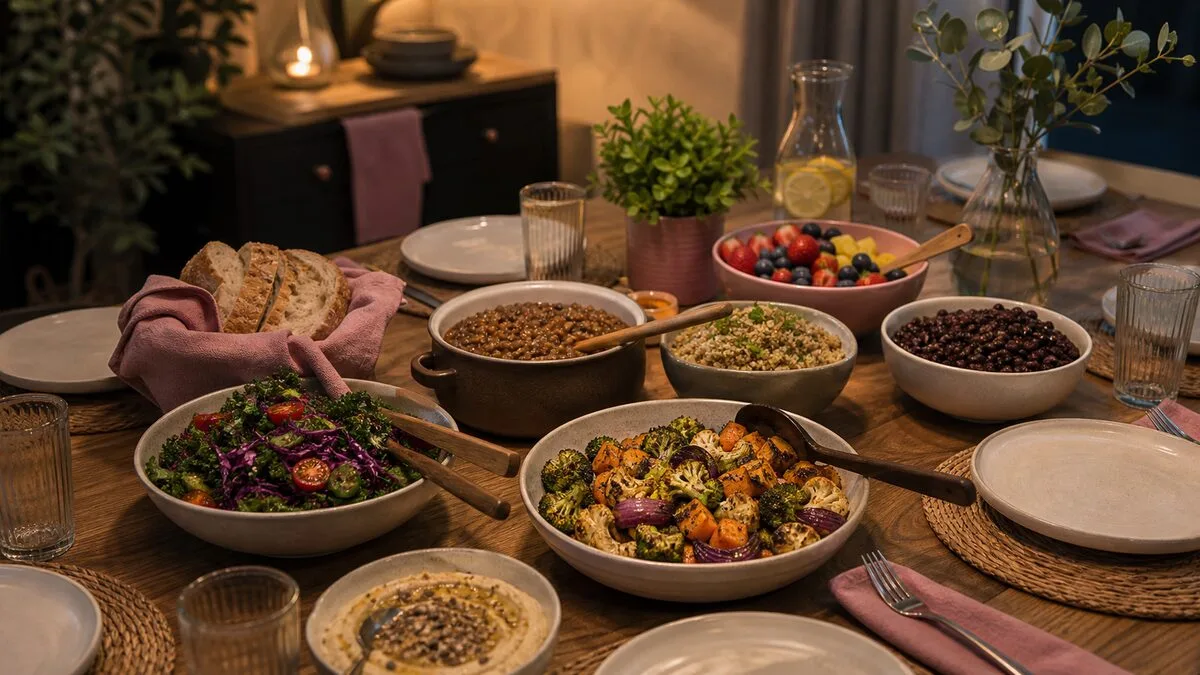
Generous, not strict. Meals people recognise, choices kids can help with, patience at the table.
What I learned cooking for non-vegans
The secret to plant-based family life is to cook food that doesn't announce itself as vegan. Make meals people already recognise and love, that happen to be plant-based, and most of the drama just never starts. Most of my family isn't vegan. Most of my friends aren't either. The meals that keep the peace are the ones that don't wave a flag.
I learned this the hard way, by getting it wrong first. Early on, I cooked "vegan versions" of things, with the word vegan doing a lot of nervous work. The fake meat front and centre, the substitutions announced, a faint air of this is a sacrifice we're all making. It put everyone on edge, including me.
Nobody enjoys a meal that feels like a statement. The moment food becomes a position you're taking, the people at the table brace for it, and the eating stops being pleasant. So I stopped doing that.
The best vegan meal at a mixed table is the one nobody clocks as vegan.
Now I cook food first and let the plant-based part be quiet. A tomato pasta is just a tomato pasta. A tray bake is just dinner. People eat well, the conversation's good, and only later, if it comes up at all, does anyone notice there was no meat. That's the whole approach in one sentence: feed people, don't convert them.
It's not about hiding anything
To be clear, this isn't about sneaking or deceiving. I'm not hiding the lentils. If someone asks, I tell them happily. It's about not leading with it, not making the food's identity the point. The point is that it's good and there's plenty of it.
This is the same generous instinct that runs through the lifestyle I write about: less performance, more substance. A table that feeds people well does more for the plant-based cause than any amount of arguing, and it does it without anyone feeling lectured.
Generous, not strict
If I had to name the principle that makes a mixed household work, it's this: be generous, not strict. Strictness at a shared table breeds resentment. Generosity makes the plant-based food the easy, abundant, obvious choice, and people choose it without being pushed.
Generous means there's enough, and it's good, and nobody leaves hungry eyeing the fridge. A common failure of plant-based cooking for non-vegans is that it's a bit thin, a bit worthy, a salad pretending to be a meal. So I cook hearty. Beans, pasta, rice, bread, proper portions. Food that satisfies, not food that proves a point.
Strict means rules, and rules at a family table are a fight waiting to happen. I don't police what other people eat. If a relative wants to bring something with meat in it to a shared meal, fine. My job is to make the plant-based food so good and so plentiful that it's where everyone's fork ends up anyway.
The pressure that backfires
Every vegan who's tried to convert their family knows the backfire. Push, and people dig in. Lecture at dinner, and the next family meal is defensively meat-heavy. Pressure creates the opposite of what it wants, every time.
So I dropped the pressure entirely and let the food do the persuading. Years on, my family eats far more plant-based than they used to, and not one bit of it came from an argument. It came from good dinners they happened to enjoy, repeated until the meat stopped being the default. Generosity is just more effective than strictness, even on its own terms.
Five meals everyone eats
Here are the five that disappear fastest at a mixed table, vegans and non-vegans alike. None of them read as "vegan food." They read as dinner. That's exactly why they work.
- Tomato pasta with a fistful of basil. The most universally loved meal there is, and it was basically always plant-based anyway.
- Tofu fried rice with peas. Salty, savoury, familiar, and a great way to use up yesterday's rice.
- White-bean tomato soup with good bread. Hearty enough to be a full meal, gentle enough for any palate.
- Sheet-pan tray bake with bread. Vegetables and beans roasted together, almost no effort, and it scales to feed a crowd.
- The chickpea sandwich. The one that converts the most sceptics, because it tastes like a thing they already know.
The common thread is that they're all recognisable. There's no uncanny-valley substitute doing a nervous impression of meat. They're just good versions of familiar food, and familiarity is what lets people relax and eat.
Why familiar beats novel
At a family table, novelty is a risk and familiarity is safety. The relative who's suspicious of "vegan food" will happily eat a tomato pasta, because it's a tomato pasta, a thing they've loved their whole life. Lead with the familiar and the plant-based part becomes a non-event.
Most of these come from the same small pantry I write about in the high-protein vegan meals piece. Beans, grains, pasta, tinned tomatoes, tofu, vegetables. A handful of staples that combine into dozens of recognisable dinners. You don't need a special shop or a long ingredient list to feed a family this way.
Feeding kids without a battle
Kids are the part people worry about most, and the worry is mostly misplaced. Kids will happily eat plant-based food when it's the normal food in the house and nobody makes a big deal of it. The battles come from pressure, not from the food itself.
My approach with the kids in my life is the same as with the adults: cook familiar, generous food, and don't turn meals into a negotiation. Pasta, beans, rice, bread, fruit, the dependable stuff. Most of what kids reject, they reject because it's new or because it's been made into a power struggle, not because it lacks meat.
I also keep it low-pressure about trying things. A new vegetable on the plate, no comment, no insistence. Sometimes it gets eaten, sometimes not. Repeated exposure without pressure is how tastes actually broaden, and pressure is the thing that reliably stops it.
Snacks and the in-between
A lot of feeding kids is the in-between, not the meals. So I keep easy plant-based snacks around as the default: fruit, hummus and bread, nut butter, the kind of thing that's just there and gets grabbed. When the easy snack is the plant-based one, the plant-based eating happens on its own.
Breakfast is similar. Oats, fruit, toast, smoothies, the things in my easy vegan breakfast piece. Familiar, quick, and not framed as anything special. A kid eating porridge with fruit isn't eating "vegan breakfast," they're eating breakfast. Keep it that ordinary and the whole thing stops being a project.
The relatives, the holidays, the table
Mixed-household eating gets its hardest test at the big shared meals: the holidays, the grandparents, the family gathering where everyone has opinions. This is where strictness causes the most damage and generosity does the most good.
My rule for the big meals is simple. I bring or make plant-based food that's genuinely good and abundant, I don't demand anyone else change what they eat, and I don't make my food a topic. A generous plant-based dish on a holiday table, with no commentary, does more quiet persuading than any speech, and it keeps the peace besides.
The mistake I made early was treating shared meals as a battleground for the cause. It made gatherings tense and made me the difficult one. Now I just contribute something delicious, eat well from it and the other plant-based options, and let everyone else do as they please. The food wins people over. The arguing never did.
Hosting a mixed crowd
When I host, I cook entirely plant-based, but I cook it so well and so generously that nobody feels deprived. The trick is to make the food the star, not its category. A big pot of something rich, good bread, a couple of sides, plenty of it. People leave full and happy and frequently surprised there was no meat.
I borrow a lot here from the unhurried, food-centred approach in my slow living routine: a long meal, no rush, the table as the point. When the meal is generous and relaxed, the plant-based part is the least interesting thing about it, which is exactly how I want it.
When someone makes it weird
Occasionally someone does want to make it a thing, the relative with strong opinions about protein, the friend who needs to comment. I've learned not to take the bait. A calm, brief answer and a change of subject defuses almost all of it. I'm not there to win a debate. I'm there to eat with people I love, and I'd rather keep the meal warm than score a point.
Letting kids help in the kitchen
One of the best things I've found for plant-based family life is getting kids involved in the cooking. A kid who helped make the meal is a kid who'll eat it. Ownership beats persuasion, and it's a lot more fun for everyone.
The jobs can be small and age-appropriate: tearing basil, stirring the pot, mashing the beans for the sandwich, arranging vegetables on the tray. None of it has to be efficient. The point isn't help, it's involvement. A child who tore the basil for the pasta is invested in that pasta in a way no amount of "just try it" can manufacture.
It also quietly teaches the thing I most want to pass on: that food comes from ingredients and a bit of effort, not from a packet. A kid who can throw together a tray bake or a pot of beans has a life skill and a healthier default than one who only knows food as something that arrives. That's worth more than any single meal.
Keep it relaxed and a bit messy
Cooking with kids is messy and slow, and that's fine. If I need a calm, efficient dinner, I do it myself. The cooking-together is for the unhurried evenings and the weekends, where the mess and the slowness are part of the point rather than a problem. Some of that fits naturally into the mindful weekend routine, where a slow Saturday meal made together is one of the warmest things a family can do.
Nutrition, honestly and without panic
Let me address the nutrition worry directly, because it's the question every relative asks and every parent quietly wonders about. A well-planned plant-based diet is fine for the whole family, including kids, and the planning isn't complicated. I'm not a doctor, so I'll keep this practical and tell you to check with yours, especially for young children.
The honest short version is that most of it takes care of itself if you eat a varied diet built on beans, grains, vegetables, fruit, nuts, and seeds. The few things worth being deliberate about are straightforward.
- B12: supplement it. This is the one genuine non-negotiable on a plant-based diet, for everyone.
- Protein: easier than the panic suggests. Beans, lentils, tofu, and grains across the day add up without effort. The high-protein meals piece covers this in full.
- Iron and calcium: come from beans, greens, fortified foods, and a bit of attention, not from worry.
- Variety: the real secret. A diet that's beans-and-rice every single day is dull, not dangerous, but variety covers the bases naturally.
I find the protein anxiety the most overblown. The amount of hand-wringing about whether a child eats enough protein on plants is wildly out of proportion to the actual difficulty, which is low if they're eating beans, tofu, and grains. Feed a varied, generous, plant-based diet and the nutrition mostly looks after itself, with B12 as the one thing you actively add.
Don't let the worry drive the table
The bigger risk, in my experience, isn't a nutrient gap. It's letting the nutrition worry make mealtimes anxious, which does more harm to a kid's relationship with food than any plant-based diet ever could. A relaxed table with varied, generous food beats an anxious one optimising every macro. Get the basics right, supplement the B12, check in with a professional if you're unsure, and then relax and eat.
How to start as a mixed household
If you're the only plant-based person in a house of non-vegans, or you're trying to shift a family in a gentler direction, here's how I'd start. Slowly, generously, and without announcing a revolution.
- Pick one familiar meal from the five and make it brilliantly, plant-based, with no commentary. Let it just be a good dinner.
- Make it a regular thing. Repetition turns it from novelty into normal.
- Add a second, then a third, building a rotation of plant-based dinners nobody thinks of as vegan.
- Get the kids involved in making one of them. Ownership does the rest.
- Never lecture at the table. Let the food and the full bellies make the case.
The aim isn't to convert anyone on a timeline. It's to slowly make the plant-based dinners the easy, abundant, normal ones, until the household eats far more of them without anyone deciding to. That's how it went in my family, over a few quiet years, with zero arguments and a lot of good meals.
Plant-based family life without the drama really comes down to one shift: stop treating it as a position and start treating it as dinner. Feed people generously, involve them, and keep the peace. If you want to keep going, the meal prep piece makes the weeknight cooking gentler, and the minimalist lifestyle essay is the wider philosophy this all grows out of: less performance, more table.
The budget reality of feeding a family this way
People assume plant-based family cooking is expensive, and I want to push back on that directly, because the opposite has been true in my kitchen. Built on beans, grains, pasta, and seasonal vegetables, this is one of the cheapest ways to feed a household well. The expense only creeps in when you lean on the fancy stuff, and the fancy stuff is exactly the part you don't need.
The cheap core is genuinely cheap. Dried beans and lentils, rice and pasta, tinned tomatoes, oats, frozen vegetables, a few onions and some garlic. Those staples cost very little and make the bulk of the five meals I lean on. A pot of bean stew that feeds the whole family costs less than a single takeaway, and it makes lunch the next day too.
What blows the budget is the convenience tier: the vegan cheeses, the realistic meats, the branded ready meals with a leaf on the packet. They're fine occasionally, but they're a treat, not a foundation. When I see a family say plant-based eating is pricey, it's nearly always because that convenience tier became the centre of the plate instead of the edge of it.
Where I happily spend and where I don't
I'm not austere about it. There are a few places I spend a little more on purpose, and a lot of places I don't. The split keeps the weekly shop sensible without making it joyless:
- Spend: good olive oil, decent bread, a few spices, the things that make cheap staples taste like more than the sum of their parts.
- Spend, occasionally: one nice "centrepiece" item for a weekend meal, so the table feels generous without the everyday cost.
- Skip: most of the branded meat-substitute aisle, most weeks. Beans and tofu do the same job for a fraction of the price.
- Skip: single-serve anything. Cooking in batches is cheaper per portion and saves the weeknight scramble.
This overlaps a lot with the thinking in my sustainable living tips piece, because cheap and low-waste tend to be the same habits wearing different hats. Buy the staples, cook them generously, eat the leftovers, lean on the convenience tier rarely. A family eats well, the shop stays modest, and very little ends up in the bin.
Lunchboxes, school, and food away from home
Feeding a family plant-based at home is the easy part. The harder edges are the lunchbox, the school canteen, and the birthday party, where you've less control and a child suddenly cares a great deal about looking normal in front of their friends. I take those edges seriously, because that's where the gentle approach gets tested.
The lunchbox I keep deliberately ordinary. The trick is the same as at the dinner table: pack food that looks like food the other kids have, not food that announces a diet. A sandwich, some fruit, a few crackers, a little something sweet. The chickpea sandwich travels brilliantly and reads, to a nine-year-old's eye, as a totally normal sandwich, which is exactly what you want.
The aim is that a child never opens their lunchbox and feels like the odd one out. Plant-based food can do that effortlessly when it's familiar in form. Hummus and pitta, pasta salad, a flask of soup in winter, fruit and a treat. None of it flags itself. The kid eats lunch and gets on with their day, which is the whole point.
Parties, canteens, and the wider world
Away from home I hold the approach loosely, because rigidity here costs a child more than it gains. At a party, I'd rather my kid eat the non-vegan birthday cake and feel included than sit out and feel different. A relaxed exception at someone else's table teaches flexibility, not failure, and it keeps the whole thing from feeling like a cage.
For the canteen and regular away-from-home eating, a quiet word with the school usually sorts the practical side, and most places are more accommodating than parents fear. I keep my own anxiety out of it, because a child reads a parent's tension about food and absorbs it. Calm, practical, flexible at the edges. That same generous, low-drama instinct that runs through my minimalist vegan lifestyle applies just as well outside the front door as in.
The picky eater, the fussy phase, and the firm no
I'd be lying if I painted every meal as a calm success, so let me talk about the picky eater honestly. Some kids go through phases where they reject nearly everything, and this has almost nothing to do with the food being plant-based. It's a developmental phase about control, not about lentils, and treating it as a vegan problem leads you down the wrong path entirely.
When a child hits a fussy stretch, my instinct is to lower the stakes rather than raise them. I keep offering the familiar plant-based food, I don't make a meal into a battle, and I trust that a child who's offered good food regularly will eat enough across a week even if any single dinner is a write-off. Kids are better at self-regulating intake than the panic suggests, as long as the pressure stays off.
The firm no, the "I'm not eating that," I meet without drama. No bribing, no extended negotiation, no short-order cooking of a second separate meal to replace the rejected one. The plate is there, the alternative is simply the bread and fruit that's also on the table, and that's that. Calmly holding the line beats both caving and forcing, and it keeps the table from becoming a stage for the standoff.
The two-meal trap
The trap I see most parents fall into is becoming a short-order cook: a separate, blander meal made on demand the moment the main one is refused. I understand the impulse, a hungry, upset child is hard to sit with, but it teaches that refusal produces a better option, which guarantees more refusal. So I don't run two kitchens.
Instead there's always one low-effort, always-acceptable thing already on the table, bread, fruit, plain rice, something safe, so a child who genuinely won't eat the main meal isn't going hungry, but isn't being cooked a bespoke replacement either. They can fill up on the safe thing. Over time, with no battle attached, the main meals get eaten more, not less. The fussy phase passes faster when nobody's feeding it attention.
A gentle weekly rhythm that holds it together
Everything above works far better with a loose weekly rhythm underneath it, so the cooking doesn't depend on willpower or inspiration on a tired Tuesday. I'm not talking about a rigid meal plan pinned to the fridge. I mean a soft shape to the week that makes the generous, plant-based, low-drama eating the path of least resistance.
Mine leans on a small amount of weekend prep, the engine I describe in the plant-based meal prep piece. A pot of beans, a batch of grains, a sauce or two, made on a slow Sunday. With those in the fridge, the weeknight meals assemble themselves, and "what's for dinner" stops being a daily crisis that pushes a tired parent toward the convenience tier.
The week then more or less runs itself on the five familiar meals in rotation, plus whatever the fridge suggests. Pasta one night, fried rice another, the tray bake when I can't think, soup when it's cold, the sandwich for a no-cook evening. The repetition isn't boring to a family, it's reassuring. Kids especially like knowing roughly what's coming.
Letting the weekend carry the warmth
The weekday rhythm is built for ease, so the weekend can carry the warmth. That's where the long, unhurried, cook-together meals live, the ones I borrow straight from my mindful weekend routine. A weeknight dinner just needs to be good and quick. A weekend one can be the slow event, kids helping, a bigger pot, no rush to clear the table.
Splitting it this way takes the pressure off every individual meal. No single dinner has to be special, because the week has a clear high point and a calm baseline, and both are fine on their own terms. That balance, easy weekdays and a warm weekend, is what's kept this sustainable in my house for years rather than collapsing into takeaway by Wednesday.
If you read just one companion piece after this, make it the slow living routine, because the family table is really just slow living with more chairs at it. Feed people generously, keep a gentle rhythm, let the weekend be warm, and the whole drama-free thing stops being a technique and just becomes how your house eats. There's a wider, lovely tradition behind this too, the unhurried, sufficiency-minded idea of simple living, which is where a lot of my instincts here quietly come from.
Common questions
How long will this take, honestly?
The reading is 10 min. The practice is a lifetime. Start with one small piece this week and let the rest follow when it feels natural, not before.
Do I have to be fully plant-based for this to help?
No. Everything I write is for people who want a softer relationship with food and routine. The recipes happen to be plant-based; the ideas work in any kitchen.
What should I read next?
The related essays below, in order. If you only read one more thing, read A minimalist vegan lifestyle that still feels warm, it picks up exactly where this one ends.
Can I cite this guide somewhere?
Yes. Please link back to this page and credit Caleb Leuchi. All photographs are made for Leuchi unless noted; the writing is original.
Continue reading in this cluster
All lifestyle →
Lifestyle
A minimalist vegan lifestyle that still feels warm
Lifestyle
Everyday balance habits I actually keep
Lifestyle
Sustainable living tips for everyday people
Lifestyle