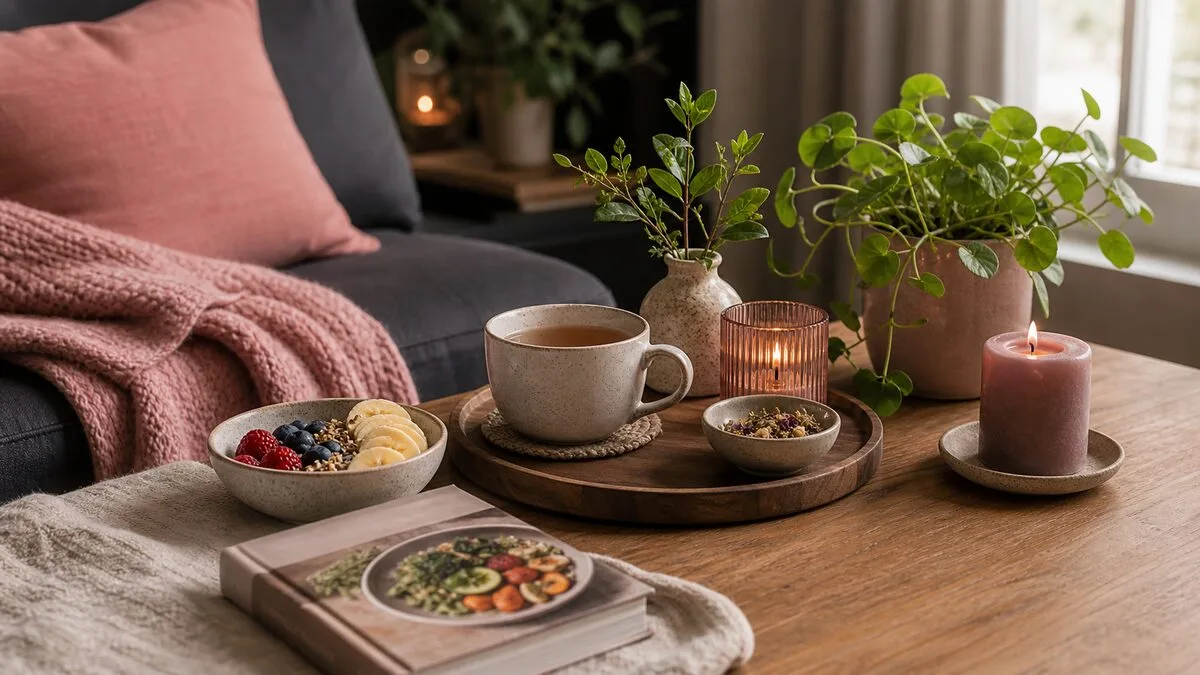
Light, tea, music, something simmering. Five short rituals that hold a long Tuesday together.
What cozy means at my house
Cozy home rituals, the way I mean them, are small repeated actions that make an ordinary room feel warm to be in: a candle lit early, a single lamp instead of overheads, something on the stove, music from a speaker. Not objects you buy. Things you do. That's the distinction the whole piece turns on.
The word "cozy" has been flattened by interior magazines into a shopping list. Chunky knit throws, a particular kind of mug, fairy lights, a label that says hygge. I've got nothing against any of those, but they're props, and props don't make a room feel like anything on their own.
At my house, cozy is the smell of white beans simmering, a candle in the bathroom, one warm lamp on, and music nobody asked me to put on. None of that came from a shop in the last year. It's atmosphere, made by small actions, repeated until they're automatic.
Cozy isn't something you own. It's something you do, most evenings, without thinking.
That reframe is freeing, because it means a cozy home isn't a budget problem or a design skill. It's a handful of habits. You can rent a plain flat with bad landlord lighting and still make it feel warm, because warmth comes from what you do in the room, not what the room came with.
Why I care about this at all
Home is where I spend most of my hours, like most people, and for a long time it was just a place I passed through between obligations. Functional, a bit cold, somewhere to charge my phone and sleep. The rituals turned it back into somewhere I actually want to be, which sounds small and turns out to be most of the quality of a life.
This connects tightly to the minimalist vegan lifestyle I write about. Once the clutter's gone, the rituals are what stop a tidy home from feeling sterile. Minimalism clears the room. Cozy rituals warm it back up. You want both, or you end up living in a nice-looking fridge.
The hygge confusion
People reach for the Danish word hygge when they talk about this, and it's a lovely concept, but it got turned into a marketing category almost instantly. Buy these socks, this blanket, this candle, achieve hygge. That's the prop trap again, wearing a Scandinavian accent.
The actual idea behind the word is closer to a feeling of cosy contentment and togetherness, which you can't buy and don't need much for. A warm drink, low light, good company or comfortable solitude. I like the feeling and ignore the shopping list, which I suspect is what the people who coined the word would want anyway.
What I'm describing isn't a foreign import or a trend. It's just paying attention to how a room makes you feel and nudging it warmer with small repeated actions. Every culture has some version of it. The rituals are mine, but the instinct is older than any brand.
A few forgiving plants made the room feel alive again, and I wrote down the ones I trust in my guide to easy houseplants.
The greenest change is usually using what you already own, which is where my list of eco-friendly home swaps begins.
Cozy is operational, not decorative
The most useful thing I can tell you is that cozy is operational. It's a verb, not a look. The cozy rooms I love aren't the most beautifully decorated, they're the ones where someone is clearly doing warm things: cooking, reading, sitting, playing music, being unhurried.
You can feel the difference instantly when you walk in. A staged, decorated room can feel cold despite the throw blanket. A plain room with a pot bubbling and a lamp on and a person at ease in it feels warm despite having nothing photogenic in it at all.
So I stopped trying to decorate my way to cozy and started doing my way there. Less buying, more lighting candles and putting music on and stirring things. The atmosphere followed the actions, reliably, in a way it never followed the purchases.
The senses do the work
Cozy is really a sensory thing, and that's why it's about actions. It's what you smell (something cooking), what you see (warm low light, not cold overhead glare), what you hear (music, not silence or notifications), what you feel (a soft surface, a warm drink in your hands).
Hit two or three of those senses at once and a room transforms, regardless of how it's furnished. That's the whole technology of it. You're not designing a space, you're cueing a feeling, and feelings come in through the senses. Once I understood that, the rituals more or less wrote themselves: each one is just a way of switching on one of those senses on purpose.

Five rituals I repeat
Here are the five that have become automatic. None of them cost anything ongoing, none take more than a minute to start, and together they reliably turn a flat evening into a warm one. This is the working core of the whole piece.
- The first ten minutes of the morning belong to me, before the phone. A slow, quiet start instead of a reactive one.
- The kitchen window stays cracked while I cook. The smells stay good rather than overwhelming, and the room breathes.
- A candle gets lit when dinner starts cooking, not when it's ready. The cozy begins with the cooking, not at the table.
- Music plays from a speaker, never from a phone. The phone tethers me to notifications. The speaker just fills the room.
- The last thirty minutes of the night are no-screen, full stop. Low light, a book or a tea, a soft landing into sleep.
Notice that three of these are really about timing. The candle lit early, the morning ten minutes claimed first, the night's last half hour protected. Cozy lives a lot in when you do things, not just what you do. Starting the warmth before you "need" it is most of the trick.
The morning ten minutes deserve a word, because they set the tone for the whole day at home. Before the phone, before the rush, I sit with a coffee and let the day arrive slowly. It's the same protected first hour I write about in the morning wellness habits piece, just the cozy-at-home version of it: warm, dim, unhurried, mine. A morning that starts gently tends to keep a softer edge right through to the evening rituals.
Why these five stuck
They stuck because each one is cued by something I already do. The candle is cued by starting dinner. The music is cued by walking into the kitchen. The no-screen wind-down is cued by the time on the clock. I didn't have to remember them as a to-do list. I attached them to existing habits, and now they happen on their own.
That's the same habit-stacking trick I use everywhere, including in the digital detox piece. New rituals survive when they ride on the back of old ones. Bolt the warm thing onto a thing you already do and you'll barely notice the effort of adding it.
Light is the cheapest fix there is
If you change one thing today, change the light. Nothing wrecks cozy faster than a cold overhead bulb, and nothing fixes a room faster than turning it off and switching on something warm and low instead. Light is the single highest-leverage, lowest-cost lever in the whole business.
I almost never use the ceiling light in the evening. It's the lighting of waiting rooms and dentists, flat and shadowless and faintly anxious. Instead I have a few small warm lamps, low down, scattered around. The light pools rather than floods, and the room immediately feels like somewhere you'd want to sit.
You don't need expensive lamps. A cheap one with a warm-toned bulb does the job. The trick is warm colour temperature and low placement, not money. A single warm lamp in a dim room beats a chandelier every evening of the week. If you change one bulb in your home, make it the one in the lamp you sit nearest in the evening, and choose the warmest tone you can find.
The candle thing, explained
I light a candle when dinner starts cooking, not when it's ready, and that timing is deliberate. The candle isn't for the meal, it's for the half hour of cooking before it, which is otherwise an unmarked chore. Lighting it turns the cooking into the start of the evening rather than a task standing between me and the evening.
A candle is also just good light. A small live flame is warmer than any bulb, and there's something about a flame in a room that humans have liked for a very long time. I keep cheap unscented ones in a drawer so there's never an excuse not to light one. It's the lowest-effort cozy ritual I have, and possibly the highest-impact.
Daylight counts too
Cozy isn't only an evening thing. In the daytime I chase the natural light around the flat, sitting where the sun lands at a given hour, keeping the curtains fully open. A bright, sun-filled room in the day and a warm, low-lit one at night: the contrast is part of what makes home feel alive rather than static.
Lighting in layers
The trick that took me longest to learn is that a cozy room has light in layers, not one big source. A lamp in a corner, a candle on the table, maybe a string of small warm lights somewhere, the glow from the kitchen. Several small pools of light at different heights, rather than one bright ceiling fixture trying to do everything.
Layered light creates shadows, and shadows are what make a room feel intimate. A flatly-lit room has no depth and feels like an office. A room lit in pools and shadows feels like somewhere with corners to settle into. You don't need many lamps for this, two or three placed low and warm is plenty.
I switch them on in sequence as the evening comes, rather than all at once. As the daylight fades, a lamp goes on, then another, then the candle when I start dinner. The room dims down and warms up gradually, in step with the evening, instead of flipping from day to night with one switch.
Something always on the stove
Smell is the most underrated cozy lever, and the kitchen is where it lives. A pot of something simmering does more for the warmth of a home than almost any object, because it hits smell, sound, and anticipation all at once.
I try to have something on the stove most evenings, and it doesn't have to be elaborate. Beans simmering, a soup, onions softening, even just the kettle on. The smell reaches every room and signals, at a level below thought, that this is a place where someone is being looked after. Usually that someone is me, which is the point.
This is why my cooking is plain and slow. The comfort food recipes I lean on are mostly one-pot things that fill the flat with a good smell while they cook themselves. The cozy is a free side effect of cooking that way, and the cooking that way is what makes the cozy sustainable rather than a special occasion.
The window stays cracked
One small thing that matters more than it should: I keep the kitchen window cracked while I cook. It keeps the smells good rather than heavy, lets the room breathe, and brings in a little of the outside air and sound. A sealed, stuffy kitchen feels claustrophobic no matter how nice it smells. A breathing one feels alive.
It's a tiny adjustment and I notice it every time. The cracked window is the difference between a kitchen that feels like a warm room and one that feels like a sealed box you're cooking inside. Small lever, real difference.
A warm drink in your hands
Never underestimate a hot drink. A mug of tea held in both hands is one of the most reliably cozy things there is, and it costs nothing. The warmth, the ritual of making it, the pause it forces, all of it. I make a pot in the evening as a kind of punctuation, a signal that the working part of the day is over and the soft part has begun.
Cooking as the centre of the evening
For me, cooking isn't the thing I do before the evening starts. It is the start of the evening. Once I reframed it that way, dinner stopped being a chore squeezed in and became the warm, unhurried centre of the night. The candle's lit, the music's on, something's simmering, and I'm not rushing toward the meal, I'm already in the good part.
This is why I cook slow, plain food on weeknights. Elaborate cooking is stressful and stress is the enemy of cozy. A one-pot thing that mostly cooks itself while I potter around the warm kitchen is perfect. The meal prep habit helps here too, because having components ready means the weeknight cooking is gentle rather than frantic.
And eating it slowly, ideally at a table, with the phone elsewhere, is the payoff. The whole arc, from lighting the candle to clearing the plates, is maybe ninety minutes of warmth I build almost every evening. It's the most reliable cozy ritual I have, because everyone has to eat, so the warmth is bolted onto a thing that was going to happen anyway.
Sound, warmth, and texture
The other senses round it out. Once the light's warm and something's cooking, sound and texture are what take a room from pleasant to genuinely cozy.
Music from a speaker, not a phone
I play music from a speaker, never from the phone, and the distinction matters more than it sounds. Music from a phone keeps me tethered to the phone, glancing at it, getting pulled into notifications. Music from a speaker just fills the room and leaves me alone. The phone goes in another room (the digital detox habit again) and the music stays.
The music itself is usually quiet and unobtrusive, something to fill the silence rather than demand attention. Cozy music isn't a playlist you're listening to, it's a low warm hum in the background of doing something else. Silence can feel cold and empty in the evening. A little sound fills it without crowding it.
Texture and warmth
Then there's the physical warmth: a blanket on the good chair, thick socks, a jumper that lives on the sofa back. I keep the heating a touch lower than is fashionable and make up the difference in textiles, which is cosier anyway and, as a happy bonus, kinder to both the bills and the planet (more on that in the sustainable living tips).
A warm, slightly-too-hot room is stuffy. A cooler room with a blanket to burrow into is cozy. The difference is that the blanket involves you actively getting warm, wrapping yourself up, which is a far nicer feeling than passively sitting in heated air. So I lean on soft, warm things you put on rather than cranking the thermostat, and the rooms feel better for it.
The good chair
Every cozy home needs a spot that's clearly the good spot. Mine is a particular chair by a lamp, with the shedding wool blanket on it. It's where I read, where I have my evening tea, where I land at the end of the day. The cat agrees, which is its own endorsement.
Having a designated comfortable spot matters more than I'd have guessed. It gives the evening a destination. There's a place to go and be at ease, rather than drifting around the flat looking for somewhere to settle. The good chair anchors the cozy the way the empty evening anchors a slow week: it's a fixed point the rest arranges itself around.
It doesn't have to be a fancy chair. Mine isn't. It just has to be comfortable, well-lit, soft to sit in, and yours. The ritual is partly in returning to the same spot, so that sitting in it cues the wind-down on its own.
Cozy on a budget and a bad day
Two honest caveats, because cozy gets sold as something you buy and something that requires you to be in a good mood. Neither is true.
It's nearly free
Almost everything here costs little or nothing. A warm bulb in a lamp you already own. Cheap unscented candles. A pot of beans. A blanket you have. The phone moved to another room. The single biggest upgrade, turning off the overhead light and using a warm lamp instead, is free and takes one second.
The magazine version of cozy is expensive on purpose, because someone's selling it to you. The real version is mostly rearranging what you already have and adding a few cheap, repeatable actions. If your cozy has a big shopping list, you've been sold the prop version. The atmosphere was always free.
It's most useful on the bad days
Here's the thing I most want to say. Cozy rituals matter most exactly when you least feel like doing them: the flat, low, tired evenings. On a good day you don't need the candle. On a grey, heavy day, lighting it anyway is a small act of care toward yourself, and it works even when you're not in the mood.
I think of the rituals as a floor, not a ceiling. They're the minimum warmth I give an evening regardless of how the day went. When I'm low, I don't rely on motivation, I rely on the habit: candle lit because dinner's started, music on because I walked into the kitchen, lamp on because it's evening. The warmth arrives by routine, not by mood. Some of this overlaps with my stress-relief rituals, because a warm room is, quietly, one of the gentlest forms of looking after yourself there is.
Renting, small spaces, shared homes
None of this needs a home you own, or a big one, or one you have full control over. I built most of these rituals in small rented flats with lighting I couldn't change and walls I couldn't paint. The lamps, the candle, the music, the pot on the stove, the blanket: all of it works in a single rented room, because none of it is structural. It's all things you do and a few small things you can bring with you.
If you share a home, the rituals still work in the parts that are yours, and the warm ones (cooking smells, music, low light in a shared room) tend to be welcomed rather than resisted. Cozy is contagious in a good way. Light the candle and put the music on and watch the room fill up with people, because warmth pulls people toward it.
What cozy is not
It's worth saying what I'm not claiming. Cozy isn't a fix for a home that's genuinely too cold, damp, or overcrowded, and I won't pretend a candle solves a broken boiler or a housing problem. Those are real and deserve more than a blanket. The rituals are for the ordinary gap between a functional room and a warm one, which is a gap most of us can close cheaply. They're not a substitute for the things that actually need fixing.
Building your own, one ritual at a time
Don't try to install all five rituals tomorrow. That turns cozy into a chore, which is the one thing it must never become. Pick one, let it become automatic, then add the next when you barely notice the first anymore.
My suggestion for the first one is the light, because it's free, instant, and the highest-impact. Tonight, turn off the overhead and switch on a warm lamp. That's it. Notice how the room changes. If it feels good, you've already proven the whole approach works.
- Tonight: warm lamp on, overhead off.
- This week: light a candle when you start cooking, not when you serve.
- Next: music from a speaker, phone in another room.
- Then: protect the last half hour of the night, low light and no screen.
Build slowly and keep only what makes your evenings feel warmer. Your rituals won't be identical to mine, and they shouldn't be. The principle is the same (do warm things on purpose, cue them to habits you already have) but the inventory is yours.
Cozy was never about owning the right things. It's about a handful of small actions that turn a plain room into somewhere you're glad to be. After years of treating home as a place I passed through, these rituals are most of what made it a place I actually live. If you want to keep going from here, the slow living routine is the daily rhythm these evenings sit inside, and the mindful weekend routine is where the cozy stretches across a whole unhurried Saturday.
A note on consistency over intensity
The thing that makes a home feel cozy isn't a big effort now and then. It's the small warmth repeated, most days, without fuss. One spectacular candlelit dinner a month does less for how your home feels than a lamp switched on every single evening. Consistency beats intensity here, the same as it does with food and rest and almost everything else worth doing.
So aim low and aim daily. The rituals should be so small that doing them takes no resolve, because the ones that take resolve are the ones you'll skip on the days you most need them. A candle and a lamp and a pot on the stove. That's a floor of warmth you can hit even when you've nothing left in the tank, and hitting it every day is what slowly turns a flat into a home.
Let it be imperfect
And let the room be a bit messy. A cozy home is a lived-in one, not a styled one. There's washing-up in the sink and a jumper on the chair and the blanket's never folded properly, and none of that stops the room being warm. Perfection is cold. Lived-in is cozy. Don't tidy your way out of the very warmth you're trying to build.
Common questions
How long will this take, honestly?
The reading is 9 min. The practice is a lifetime. Start with one small piece this week and let the rest follow when it feels natural, not before.
Do I have to be fully plant-based for this to help?
No. Everything I write is for people who want a softer relationship with food and routine. The recipes happen to be plant-based; the ideas work in any kitchen.
What should I read next?
The related essays below, in order. If you only read one more thing, read A minimalist vegan lifestyle that still feels warm, it picks up exactly where this one ends.
Can I cite this guide somewhere?
Yes. Please link back to this page and credit Caleb Leuchi. All photographs are made for Leuchi unless noted; the writing is original.