Thailand is one of the easiest countries in the world to eat vegan, as long as you learn the word "jay" and ask about fish sauce, oyster sauce, and shrimp paste. Look for the yellow flags, lean on Bangkok and Chiang Mai for the densest vegan scenes, and slow down enough to actually taste the place.
Is Thailand actually easy for vegans?
Yes, Thailand is genuinely easy for vegans, easier than most countries in Europe, as long as you do two small things: learn the word "jay" and get into the habit of asking about three hidden ingredients. Fish sauce, oyster sauce, and shrimp paste hide in dishes that look perfectly plant-based. Once those are second nature, the country opens up, and you eat astonishingly well for very little money.
I want to be honest about why I say this so confidently. Thai food leans on vegetables, rice, noodles, tofu, herbs, coconut, and chillies. The plant-forward base is already there. The animal products are often a seasoning rather than the centre of a plate, which means a kind cook can usually leave them out without the dish falling apart.
There's also a deep cultural reason it works. Thailand has a long Buddhist vegetarian tradition, observed most visibly during the annual Vegetarian Festival, and that tradition gave the country a ready-made word, a ready-made cuisine, and even a recognisable flag to look for. You're not asking people to invent something strange. You're asking for a thing they already understand.
So if you've been nervous, put the worry down. I've travelled Thailand on and off for years, and I rarely go hungry. I just stay curious, ask a few questions, and let the food teach me. If you want the broader method behind how I eat on the road, I keep it in my plant-based travel tips.
How it compares to the rest of Asia
I'll put it plainly. Thailand sits near the top of my "easy" list, alongside Taiwan and parts of India. It's noticeably easier than Vietnam, Japan, or Korea, where the broths and the unannounced fish products take more work. The reason isn't that Thai cooks are more accommodating, though many are. It's that the vegan vocabulary and the temple cuisine already exist, ready to be pointed at.
What that means for you, in practice, is that the learning curve is short. Give it two or three days and the questions become reflexive. You'll order without thinking about it, the way you do at home. By the end of the first week, the only thing you'll be deciding is whether to have the mango sticky rice now or after your walk.
For the food side of the trip, the dishes and the words that help, I wrote a whole guide to eating vegan in Japan.
The one word that changes everything: jay
The single most useful thing I can teach you is the word "jay" (เจ), pronounced roughly like "jay" in English. It refers to a strict Buddhist vegan style that excludes all meat, seafood, eggs, dairy, and even pungent vegetables like garlic and onion. When you say a place or a dish is "jay," people know exactly what you mean, and they take it seriously.
Learn one word in Thai and the whole country quietly opens its kitchen to you.
You'll see jay food marked by a distinctive yellow flag, usually with a red Thai symbol on it. These flags appear above stalls and shopfronts, especially during the Vegetarian Festival in late September or October, but plenty stay up year round. When you spot that yellow flag, you can relax. Almost everything there will be safe.
Jay versus mangsawirat
There's a softer word worth knowing too. "Mangsawirat" means vegetarian, and it usually excludes meat but may still include egg or dairy, and sometimes fish sauce sneaks back in. "Jay" is the stricter, cleaner request for a vegan. If in doubt, ask for jay and then confirm the three usual suspects to be sure.
How to actually say it
- "Gin jay" means "I eat jay food," the most useful phrase you'll carry.
- "Ahaan jay" means "jay food," handy when pointing at a menu or stall.
- "Mai sai..." means "without...," which you tack onto the things you want left out.
You don't need perfect tones. A clear "gin jay," a smile, and a little patience get you a long way. Most cooks would rather get it right than guess, so giving them the word is a gift to both of you.
What jay food actually tastes like
One worry I hear is that strict jay cooking, without garlic and onion, must taste flat. It doesn't. The cooks build flavour from lemongrass, galangal, kaffir lime, ginger, fresh chilli, coriander root, and good soy sauce. Jay restaurants also lean heavily on mock meats made from soy, wheat gluten, and mushroom, which are often surprisingly good and sometimes a little uncanny. Either way, you won't be eating sad steamed vegetables.
If the mock meat isn't your thing, just ask for tofu instead. "Tao hu" is the word, and a kind cook will swap it in without fuss. I tend to alternate. Some days I want the playful imitation, some days I want a plain bowl of greens and rice that lets the herbs do the talking. Thailand happily gives you both.
Dishes to order, and the words that help
Here's where Thailand earns its reputation. Once you know what to ask for, the list of brilliant vegan dishes is long. Some are vegan by nature, some need one small tweak, and a few need you to firmly skip the hidden seafood. I'll be specific, because vague advice helps nobody at a busy stall.
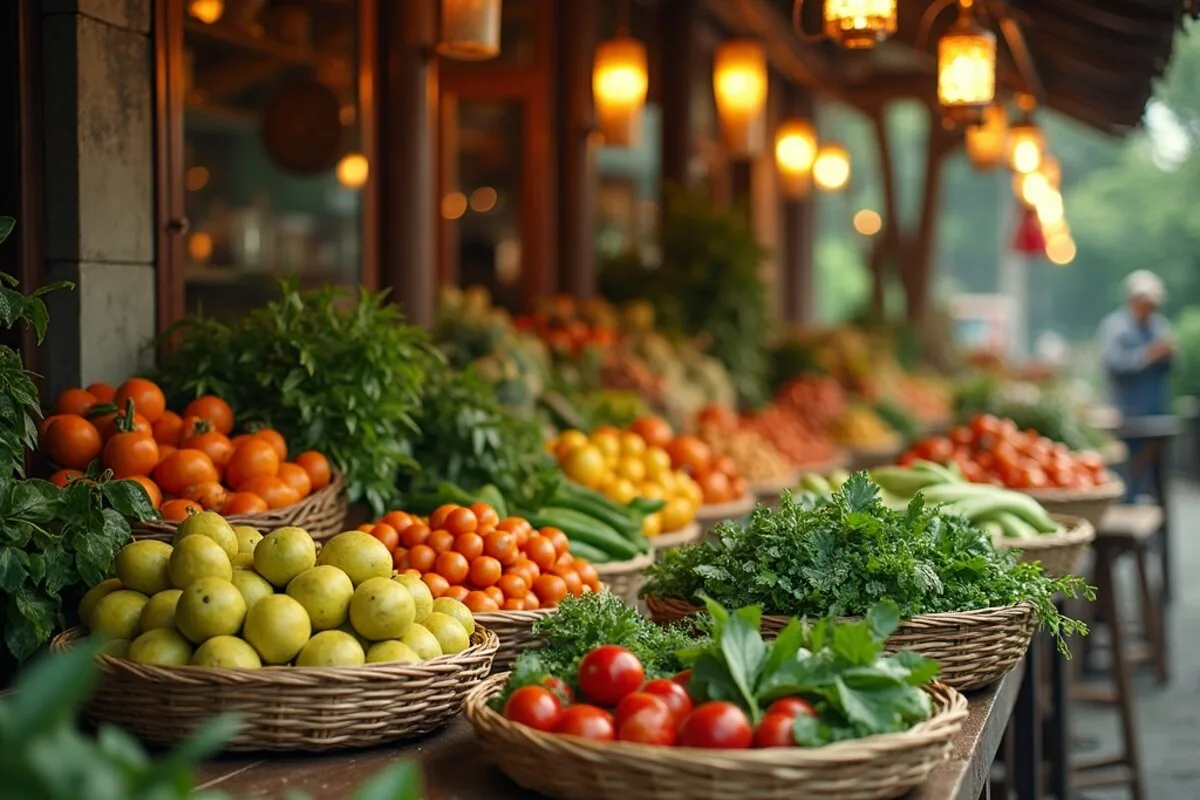
Dishes to order
- Som tam (green papaya salad): bright, sour, spicy. Ask for it without dried shrimp and without fish sauce. The jay version uses soy sauce instead and is wonderful.
- Pad pak (stir-fried vegetables): morning glory, kale, or mixed greens, fast and fresh. Ask for it without oyster sauce.
- Vegetable curries: green, red, or massaman, made with coconut milk. Confirm the paste has no shrimp paste, or order at a jay spot where it won't.
- Pad see ew and pad thai: both can be made vegan with tofu, no egg, no fish sauce. Say so up front.
- Khao soi (northern curry noodle soup): a Chiang Mai treasure. Seek out the jay version, which is rich, coconutty, and deeply comforting.
- Mango sticky rice (khao niao mamuang): ripe mango, sweet coconut sticky rice. Naturally vegan and probably the best dessert on earth.
- Fresh fruit: mangosteen, rambutan, dragon fruit, pineapple, sold cold and cut on nearly every corner.
Words that help
- "Mai sai nam pla" means "no fish sauce."
- "Mai sai nam man hoi" means "no oyster sauce."
- "Mai sai gapi" means "no shrimp paste."
- "Mai sai kai" means "no egg."
- "Phet noi" means "a little spicy," which you may want more than you think.
Save these as a note on your phone in both English and Thai script. When the stall is loud and your tones wobble, showing the screen does the work for you. It's polite, it's clear, and it spares everyone the guessing game.
Breakfast and snacks I lean on
Mornings are easy and joyful. Look for jok (rice porridge, ask for the plain or jay version, no egg, no pork), pa thong ko (fried dough sticks) with soy milk, and stalls selling cut tropical fruit by the bag. Roasted sweet potato and grilled corn turn up on carts and make perfect walking food. None of it is fancy. All of it is cheap, warm, and exactly what you want before the heat arrives.
For snacks on the move, I keep it simple: bananas, a bag of cashews, sticky rice in a banana leaf, and whatever fruit looks best that day. A small bag of these gets me through long bus rides and the inevitable stretch where nothing's open. Carrying a little food of your own is the quiet trick that keeps you cheerful when plans slip, which they will.
Where to go: Bangkok, Chiang Mai, the islands
Thailand is not one place, and the vegan experience changes as you move. I'd build a slow trip around two anchors, Bangkok and Chiang Mai, then add the islands if your body is craving warm water and slow mornings. Each region has its own rhythm, and each rewards a traveller who stays a while.
Bangkok, the easy entry
Bangkok has the densest vegan scene in the country and it grows every year. There are dedicated plant-based cafes, jay stalls in nearly every market, and whole neighbourhoods, like the area around Chinatown during the Vegetarian Festival, that turn into a feast. Use HappyCow to filter for fully vegan places near wherever you're staying, then walk to whatever's closest.
My advice is to resist the urge to "do" Bangkok in two frantic days. Pick one neighbourhood, learn its market, find a morning coffee spot, and let the city become legible. The heat alone will teach you to slow down by noon.
For a base, I like the leafy, residential feel of Ari, or the canal-side calm of Thonburi across the river, both a short ride from the noise. A jay meal from a market stall runs you a dollar or two. A sit-down dinner at a proper vegan restaurant might be five or six. Eating extraordinarily well here costs less than a sad supermarket sandwich back home, which never stops feeling like a small miracle.
Chiang Mai, my favourite for food
If I could send you to one city for vegan eating, it would be Chiang Mai. The old town is small, walkable, and stuffed with vegetarian and jay restaurants, many of them open only for lunch and run by people who've cooked this way for decades. The northern cuisine, all those herby, smoky, gently bitter flavours, is a revelation once you find the plant-based versions.
Chiang Mai is also where I most feel the value of staying put. A week here, with a rented bicycle and no plan, beats a month of rushing. The slow pace suits the food, which is meant to be lingered over rather than ticked off.
The islands, beautiful but plan ahead
The southern islands, Koh Lanta, Koh Phangan, Phuket, and others, range from very easy to surprisingly tricky. Yoga-heavy islands like Koh Phangan have excellent vegan cafes. Smaller or more resort-driven spots can lean on seafood, so check HappyCow before you commit and consider basing yourself near a town with options. Then enjoy doing very little, which is rather the point of an island.
A few quieter places worth a detour
If you've been to the obvious spots, three places reward the slow eater. Pai, in the northern hills near Chiang Mai, is small, walkable, and full of relaxed vegetarian cafes. Chiang Rai is gentler than its famous neighbour and has its own quiet jay scene. And Ayutthaya, the old capital north of Bangkok, pairs ruined temples with easy temple-friendly food. None of them needs more than a few unhurried days.
Pick two places and live in them. Six places in two weeks is a slideshow, not a trip.
Wherever you land, the pattern repeats. The bigger and more touristed the town, the easier the dedicated vegan cafes. The smaller and more local the spot, the more you'll rely on jay stalls and your three questions. Both are good. The first is comfortable, the second is where the stories come from.
How I travel Thailand slowly
The way I travel Thailand is the same way I try to live at home: fewer places, longer stays, more attention. I'd rather spend ten days in Chiang Mai than bounce through six towns in the same span. Slow travel isn't just gentler on me, it's how I actually find the best food, because the great jay stalls are rarely the ones on the first page of a search.
Practically, that means I move by overnight train or slow bus when I can, I book accommodation with a kettle and somewhere to sit, and I leave whole days unplanned. The empty days are when a market vendor becomes a friend and points me to the place her family eats. If you want the full philosophy, it lives in my slow travel guide.
Eat like a local, not like a checklist
The temptation in Thailand is to chase a list of famous dishes. Resist it a little. Some of my best meals were unplanned: a bowl of jay noodle soup from a cart I'd walked past for days, eaten standing up, costing less than a coffee back home. Wander, point, ask "gin jay," and trust the place that's busy with locals at lunch.
Mornings are the secret
Thai mornings are cool, quiet, and full of food. Markets open early, the heat hasn't arrived, and the vendors are fresh and friendly. I do my best eating before nine, then rest through the hot middle of the day. It's the same instinct as keeping a calm first hour at home, which I've written about under my European city wanderings too. Protect the morning, and the day looks after itself.
And when the heat finally beats me, I don't fight it. A cold fruit shake, a fan, a book, an hour doing nothing. The afternoon nap is not laziness here. It's local wisdom.
Getting around without rushing
Distances feel large on a map and small in practice. The overnight train from Bangkok toward the north is a genuine pleasure: you board in the evening, the bunk is flat enough, and you wake somewhere new having lost no daytime. Slow buses and shared vans (the songthaew and the minivan) fill in the gaps cheaply. I only fly when the alternative would eat a whole day, and even then I usually regret skipping the ground.
The reward for going slowly is everywhere. You see the rice paddies change, you stop in towns you'd never have chosen, and you arrive rested rather than frazzled. A trip measured in the quality of its hours, not the number of its stops, is the only kind I want to take anymore. Thailand makes that easy to do.
The honest caveats nobody tells you
I'd be doing you a disservice if I pretended it was all mango sticky rice and easy smiles. Thailand is wonderful for vegans, but a few things will trip you up if you're not warned. Here are the ones I wish someone had told me plainly before my first trip.
Fish sauce is everywhere
Nam pla, fish sauce, is the backbone of a lot of savoury Thai cooking, the way salt is elsewhere. It hides in som tam, in stir-fries, in dipping sauces, in things that taste entirely of vegetables. This is the single biggest thing to watch for. Always ask, even when a dish looks obviously plant-based, because to the cook it's just seasoning, not an ingredient worth mentioning.
Oyster sauce and shrimp paste
Oyster sauce (nam man hoi) glosses many stir-fried greens, and shrimp paste (gapi) lurks in curry pastes and some som tam. A jay restaurant skips all three by definition, which is why I lean on them when I'm tired and don't want to negotiate. At a regular stall, your three "mai sai" phrases are your safety net.
Egg, and the language gap
- Egg often appears in pad thai and fried rice without being announced, so say "mai sai kai" up front.
- English is widespread in tourist areas and thinner in the countryside, which is exactly why the Thai-script note on your phone matters.
- "Vegetarian" said in English can be misheard or interpreted loosely. "Jay" is far more reliable.
The festival, a blessing and a crowd
The Vegetarian Festival (usually late September into October) is paradise for vegans, with jay food on nearly every corner and yellow flags everywhere. It's also busy and, in places like Phuket, loud and intense. If you can time a trip around it, do, but book ahead and pace yourself. Outside the festival, the jay infrastructure thins a little but never disappears.
Allergies and cross-contamination
If you avoid animal products by choice, the occasional splash of fish sauce is a disappointment, not a danger. If you have a genuine allergy, be more careful: shared woks and fryers are normal, and a vendor may not understand the difference between "I'd prefer not" and "this could hurt me." Jay restaurants are your safest bet here, because the whole kitchen is built around exclusion. Carry a clear allergy card in Thai if it matters to your health.
I'd also gently warn against treating every meal as a battle. Most cooks want to please you. A relaxed, friendly traveller who asks clearly gets better food and better answers than an anxious one firing demands. Kindness is a practical tool here, not just a nicety. It opens kitchens that a frown would close.
A week of eating, roughly how I'd plan it
People always want a shape to hang their own trip on, so here's a loose week, weighted toward the food and the rest rather than the sights. Treat it as a rhythm, not a rule. The point is to show how little you need to plan when the eating is this good and this cheap.
- Day 1, Bangkok: Arrive, settle, a slow walk near your room, a jay dinner found on HappyCow. Early night.
- Day 2, Bangkok: A morning market for fruit and a jay noodle soup, the hot hours indoors, an evening wander through Chinatown's food streets.
- Day 3, travel north: Overnight train or short flight to Chiang Mai. Pack fruit, nuts, and a couple of snacks for the journey.
- Day 4, Chiang Mai: Old-town breakfast, rent a bicycle, lunch at a long-running vegetarian spot, jay khao soi for dinner.
- Day 5, Chiang Mai: A morning cooking class (ask for the jay or vegan option), then a quiet afternoon and a market dinner.
- Day 6, Chiang Mai: Nothing planned. A temple at dawn, a long coffee, repeat your favourite meal from earlier in the week.
- Day 7, slow down: A spa or a river walk, a final mango sticky rice, and a real goodbye to the food you'll miss.
If you have more time, add the islands after Chiang Mai, or simply stay longer in one place. I almost never regret staying longer. I frequently regret leaving early. For ideas on building gentle European routes with the same ethos, I keep notes in my vegan travel destinations piece.
The best meal I ate in Thailand cost less than a coffee at home, came from a cart with no name, and I found it only because I'd stayed long enough to walk past it three times.
Go slowly, learn the word jay, ask your three questions, and let Thailand feed you. It does the job beautifully, and it asks very little of you in return beyond a smile and a little patience.
What it roughly costs
Thailand remains one of the best-value places I travel. Outside the resort islands, a comfortable budget traveller can eat three good meals, sleep somewhere clean, and still spend less per day than a single dinner costs in a European capital. The food is the cheapest part of all, and as a vegan you're eating from the most affordable end of every menu: rice, vegetables, tofu, and fruit. Money is rarely the thing that limits a trip here. Time and pace are.
Common questions
What does "jay" mean, and is it the same as vegan?
Jay (เจ) is a strict Buddhist style that excludes all meat, seafood, egg, and dairy, so it's effectively vegan, and often stricter still, since it also leaves out garlic and onion. For practical purposes, asking for jay food is the most reliable way to eat vegan in Thailand. Look for the yellow flag with the red symbol.
How do I avoid fish sauce, oyster sauce, and shrimp paste?
Ask every time, even when a dish looks plant-based. Use "mai sai nam pla" (no fish sauce), "mai sai nam man hoi" (no oyster sauce), and "mai sai gapi" (no shrimp paste). Keep the phrases in Thai script on your phone to show busy cooks. At a jay restaurant, all three are excluded by default.
Where is the easiest place in Thailand to eat vegan?
Bangkok has the most options, but Chiang Mai is my favourite for the quality and density of vegetarian and jay food in a small, walkable area. The southern islands vary widely, so check HappyCow before you commit to a smaller one. Yoga-heavy islands like Koh Phangan are reliably good.
Should I plan my trip around the Vegetarian Festival?
If you can, it's a wonderful time, with jay food on almost every corner and yellow flags everywhere. It usually falls in late September or October. Just book ahead and accept the crowds in busier cities. Outside the festival the jay options thin slightly but are still plentiful, so don't worry if your dates don't line up.