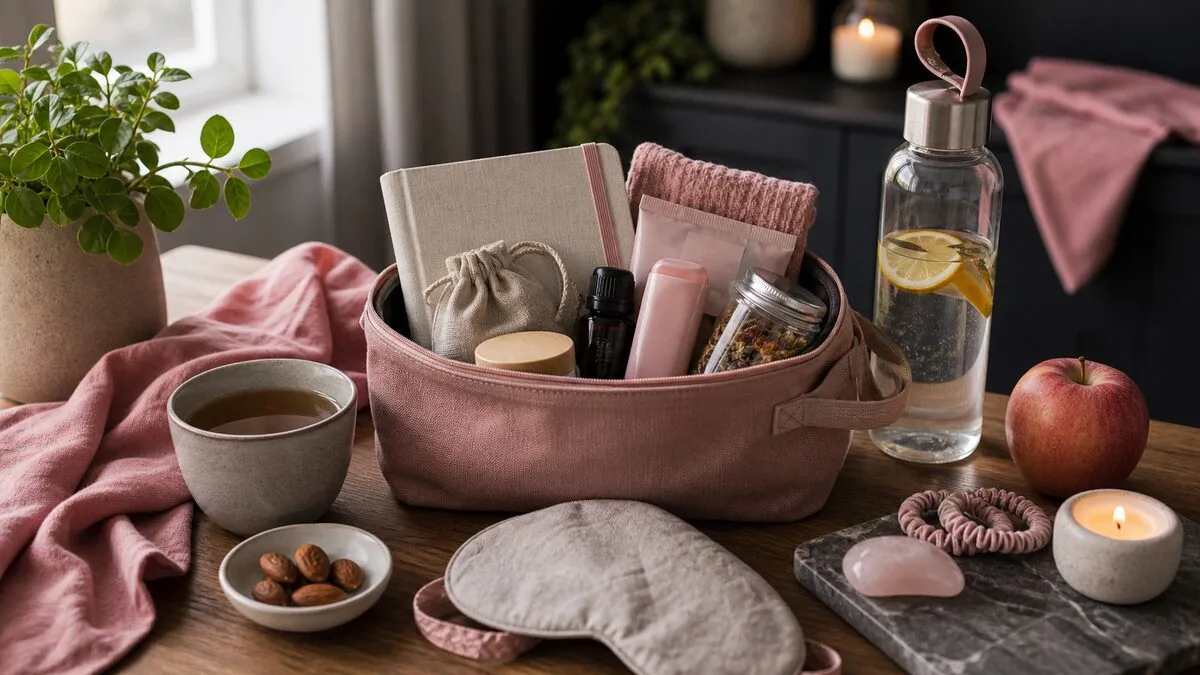
A prepared kindness for the tired version of you. Twelve real things, not a luxury box.
What a wellness kit actually is
A wellness kit is a small basket of decisions you make in advance, so the tired version of you doesn't have to make them at the worst possible moment. That's the whole idea. It is not a luxury box, and it is not a pharmacy. It's closer to leaving your keys in the same dish every night, except the keys are the small things that help you feel like a person.
I built my first one by accident. I'd had a rough stretch, the kind where the days blur, and I noticed I kept reaching for the same four or five things to steady myself. Tea. A particular pen. An eye mask I'd bought on a whim. So I gathered them into one shallow basket and put it where I'd see it. That was it. It wasn't a project. It was just me getting out of my own way.
The reason it works, for me at least, is that decision-making is the first thing to go when I'm depleted. On a good day I can figure out what would help. On a bad day, choosing feels like lifting something heavy. The kit removes the choosing. You already decided, back when you had the energy to decide. Now you just reach.
People sometimes expect a wellness kit to be aspirational, a glimpse of the calmer life they'll have once they get their act together. Mine is the opposite. It assumes the act will not always be together. It's built for the version of me who's behind on everything, hasn't slept well, and can't be bothered. That's the version who needs help, and it would be strange to design the help for the version who's already fine.
A wellness kit is a letter from the rested version of you to the exhausted one. It says: I thought about this already, so you don't have to.
This sits alongside the rest of the wellness pillar, and it's the most physical piece of it. Everything else I write about, the morning, the sleep, the breathing, is a practice. This one is an object you can hold, which makes it strangely easier to start.
I'll also be honest about what a kit can't do, because I'd rather you trust me than oversell you. It won't fix a hard season. It won't replace sleep, or a real conversation, or help you actually need. What it does is lower the cost of the small kindnesses by a degree, on the days when even small kindnesses feel expensive. That's a modest promise, and it's one I can keep.
And there's a quieter thing it does that took me a while to notice. Just having the basket there, visible, on a shelf, is itself a small comfort. It's a standing reminder that I'm worth a little tending. On a flat week I sometimes don't even open it, and it still helps, the way a lighthouse helps a coast it never gets to talk to.
What goes in mine
Here's exactly what's in my basket right now. It changes a little with the seasons, but the spine of it has stayed the same for a couple of years. None of it is expensive, and most of it I already owned. The point isn't the gear. It's that these particular things, gathered in one place, reliably make me feel a degree better.
- A glass water bottle
- A simple journal and a pen that works
- Magnesium for sleep nights
- One sachet of electrolytes
- A silk eye mask
- A short paperback
- An essential oil you actually like
- A hair tie
- A small candle
- Two herbal tea bags
- A sealed bar of dark chocolate
- One handwritten note from a past version of yourself
Twelve things. You'll notice there's nothing clever in there, no gadget that needs charging, no app, nothing that expires next week. That's deliberate. A wellness kit that needs maintenance isn't a kit. It's another chore wearing a nicer coat.
If twelve feels like a lot, ignore most of it. I'd happily start someone on three: the tea, the candle, the note. Those three carry the spirit of the whole thing, the small ceremony, the warm thing to hold, the kind word from yourself. Everything else on the list is just me, over a couple of years, noticing what else I kept reaching for. Your list will look different, and that's exactly as it should be.
You'll also notice it's mostly low-stakes comfort rather than self-improvement. There's no resistance band, no productivity planner. I tried versions with those and they made the basket feel like a to-do list, which is the opposite of the point. The kit is for steadying, not striving.
The hair tie deserves a quiet word, because people laugh at it and then admit they've hunted for one at the worst moment. It's the most boring item on the list and one of the most reached-for. That's actually the test for everything in here: not how impressive it sounds, but how often the depleted version of me genuinely needs it and can't find it elsewhere. Boring and reached-for beats impressive and ignored, every single time.
A word on the journal, since people always ask if they have to write in it. No. The journal is there for the nights I want to put something down, not the nights I think I should. Some weeks I don't open it at all. The pen that works, though, is non-negotiable, because the small daily betrayal of a dead biro is exactly the kind of friction the whole kit exists to remove.
The herbal tea is the most-used thing in the basket by a mile. Boiling the kettle is such a small, ordinary act that it slips past whatever part of me resists self-care, and by the time the tea is steeping I've already changed the gear of the evening. If you only take one thing from this list, take the tea, and pair it with a real wind-down. I write about that whole evening shape in the sleep wellness guide.
Why each thing earns its spot
I'm a little ruthless about what goes in, because a basket full of "might be nice" quickly becomes clutter you ignore. Each item has to answer one question: does the tired version of me actually reach for this? If the honest answer is no, it's out. Here's the reasoning behind a few that surprised me.
The boring practical three
The water bottle and the electrolyte sachet are in there because being even slightly dehydrated makes everything feel worse, and I never think to drink when I'm low. The magnesium is for the nights my mind won't switch off. I'm careful not to oversell supplements, and I'm not making a medical claim. Many people find magnesium helps them wind down, I'm one of them, and if you're on medication it's worth a word with a pharmacist first.
The comfort objects
The silk eye mask, the candle, the essential oil. These do almost nothing measurable and they help enormously, which tells me the measurable isn't the point. They're sensory anchors. Lighting the candle is a small ceremony that says the evening has changed gear. I write more about that kind of low-effort ritual in cozy home rituals, because the principle runs right through the home.
The two odd ones
The sealed bar of dark chocolate is in there because pretending I'm above a small treat never lasted, and a planned treat is kinder than a guilty one. And the handwritten note. That one's the secret weapon. Past-me wrote a few lines on a bad day, and present-me reads them on the next bad day. It's not profound. It just says "this passes, you've been here before." On the right evening it does more than any supplement.
The most useful thing in the basket cost nothing and took two minutes to write.
The paperback, and why it's paper
The short paperback is in there instead of an e-reader for one stubborn reason: paper doesn't offer me anything else. No notifications, no "while you're here," no glowing rectangle that could just as easily become an hour of scrolling. A physical book is a closed loop. I pick it up, I read three pages, I put it down, and nothing tried to steal me along the way. I keep a short one, novels I can re-read, so the bar to opening it is low even on a foggy night.
If you want to copy the note idea, here's roughly what mine says. Not advice, just a hand on the shoulder. "You're tired, not broken. Drink the water. The thing you're dreading is usually smaller in the morning. You've survived every single one of these nights so far." It's plain and a little corny and it works precisely because past-me wasn't trying to be clever. He was just trying to be kind to a future stranger who happened to be me.
I'd gently push back on one common kit item, too: the phone as a comfort tool. I know a podcast or a playlist can soothe, and I'm not banning screens. But I keep the phone out of the basket on purpose, because for me it's a doorway into everyone else's noise, and the kit is meant to be a doorway out of it. Your mileage may differ. Just be honest about whether the screen is comforting you or numbing you, which are not the same thing.
Where to keep it so you'll actually use it
A kit you can't see is a kit you'll forget. This is the part people skip, and it's the part that decides whether the whole thing works. Mine lives on an open shelf in the bedroom, at eye level, where I pass it a dozen times a day. Out of sight really is out of mind when you're depleted.
I'd suggest a shallow open basket over a closed box for exactly this reason. The lid is friction, and friction is the enemy of a tired person. You want the kit to be the easy thing to reach for, easier than the phone, easier than doom-scrolling on the sofa. Position does half the work.
- Keep it where you already stand still: the bedside, the kitchen counter, the bathroom shelf.
- Open container, no lid, nothing to unzip or unclip.
- One kit, one home. Don't scatter it, or you'll never have the whole thing when you need it.
If you live with other people, it helps to make it visibly yours, so it doesn't quietly turn into a household junk basket. Mine is a particular colour and everyone knows not to dump keys in it. Small boundary. It keeps the kit a kit.
There's a deeper reason the location matters that I only understood later. Where you keep the kit becomes a small cue in the room, and cues are how habits actually form. I lean on the same idea everywhere, and I lay it out properly in healthy habits for beginners: you don't run on willpower, you run on the path of least resistance, so you arrange the room to make the kind thing the easy one.
One more practical note. Refill the consumables when you refill anything else, not as a separate errand. When I restock tea for the kitchen, two bags go straight into the basket. When the electrolytes run low, I add one line to the existing shopping list. The kit stays stocked because it rides along with chores I was doing anyway. A kit you have to "maintain" will quietly empty out and die. A kit that refills itself in the slipstream of ordinary life sticks around for years.
The travel version that fits in a coat pocket
The full basket doesn't travel, so I keep a stripped-down version in a small zip pouch that lives in my bag. Travel is exactly when you most need the steadying and least have your routines, which is why a tiny kit earns its weight. I learned this the hard way on too many trips spent frazzled in unfamiliar rooms.
The pocket version is brutal about size. One electrolyte sachet, a couple of tea bags, the eye mask, a pen, and a folded card with the same kind of note as the one at home. That's it. It weighs almost nothing and it turns a strange hotel room into somewhere I can land.
If you travel often, especially the slow way, I put more of this in plant-based travel tips, where the kit overlaps with the rest of what keeps me human on the road. The principle is identical: pack the decisions, not just the things.
The eye mask earns its place in the travel kit more than anywhere else. Strange light, planes, hotel curtains that never quite close, an overnight train. A scrap of silk over the eyes is the cheapest sleep aid I know, and it folds to nothing. I'd take it over almost any gadget the wellness industry tries to sell a traveller.
I keep the pocket kit packed at all times, even between trips, so leaving never requires assembling it from scratch. Departure days are chaotic enough. The whole spirit of a wellness kit is "decide once, when you're calm," and travel is where that pays off most, because the version of me at the airport is in no state to decide anything well.
The desk version for a hard workday
There's a third tiny version that lives in a drawer at my desk, for the afternoons that go sideways. It's even smaller than the travel one, because the failure mode at work isn't a lack of supplies, it's forgetting that I'm a body that needs a break. So the desk kit is mostly a prompt.
- A glass for water, kept on the desk, not in a cupboard.
- One tea bag, so a break has a built-in reason to stand up.
- A small card that just says: stretch, breathe, look out a window.
- A square of that dark chocolate, for the 3pm dip.
The card is the real tool. When I'm tight at my desk I don't reach for elaborate techniques, I reach for the smallest possible reset, which is usually just standing up and breathing for a minute. If you want the longer list of those, my stress relief rituals are the blunt-instrument version, built for exactly these afternoons.
I think desks are where wellness most often dies, because we treat the working hours as a separate, harsher country where the normal rules of being a body don't apply. They do apply. You still need water, light, and the occasional minute of standing still. The desk kit is a quiet rebellion against the idea that you have to earn the right to take care of yourself only after the work is done. You don't. You take care of yourself in the middle of it, and the work tends to go better for it.
What I left out on purpose
What's not in the kit matters as much as what is. I left out anything that turns rest into a task, anything that beeps, and anything that made me feel I was failing a standard. A wellness kit should lower the bar to feeling okay, not raise it.
No fitness tracker. No detailed planner. No supplements I couldn't explain to a friend. No "self-improvement" book, because the kit is for the evenings I want to improve nothing and simply be a person who's allowed to rest. There's a version of wellness culture that quietly makes you feel inadequate, and I wanted this basket to be the opposite of that.
I think this is where a lot of wellness shopping goes wrong. We buy the markers of a calm person instead of the small things that actually calm us. A drawer full of unused gadgets is its own quiet stressor. I'd rather own five things I reach for than fifty that watch me from a shelf and make me feel behind. If minimal is your instinct, you might like the broader argument in a minimalist vegan lifestyle.
I also left out anything that turns the kit into a comparison. No "morning person" merch, no aspirational quotes that aren't actually true for me, nothing that belongs to someone else's idea of wellness. The basket should feel like coming home, not like auditioning for a healthier life. The moment it starts making you feel behind, take that thing out, no matter how nice it looked in the photo that sold it to you.
And I left out scale. There's a temptation, once a small kit works, to make it big, to keep adding, to build the perfect cabinet. Resist it. The power of the thing is its smallness. A basket you can take in at a glance is a basket your tired brain can use. The moment it needs sorting, it's stopped being a comfort and started being one more thing to manage.
How to build yours without spending much
You almost certainly already own most of a wellness kit. Building one is less shopping than gathering. The mistake is treating it as a purchase event, the "I'll get well once the order arrives" trap. Start with what's in the house tonight.
- Walk through your home and pull the five things you already reach for when you feel rough. Tea, a particular jumper, a book, whatever they are.
- Put them in one open container, somewhere you'll see it.
- Use it for two weeks. Notice what you reach for and what you ignore.
- Cut the things you ignored. Add one small thing you wished was there.
That's the entire method. The kit you'll actually open is the one you built from your own habits, not from a list a stranger wrote, mine included. Treat my twelve items as a starting sketch, then make it yours. The note from past-you is the one thing I'd insist on, and it's free.
If you're new to this whole way of doing things and the idea of "a practice" feels like a lot, the kit is honestly the gentlest place to begin. It asks nothing but a basket and a few minutes. I'd put it right next to healthy habits for beginners as a first step that's almost impossible to fail at.
On the spending question, since the wellness aisle is built to separate you from your money: you genuinely don't need the expensive versions. A jam jar makes a fine candle holder. Any tea works. The eye mask can be a cheap one; silk is nice but cotton sleeps you just as well. The note costs nothing and matters most. If money is tight, build the whole thing from what you own and a single small treat, and it'll work exactly as well as a basket that cost a hundred pounds.
I'd actually argue the cheap kit is better, because nothing in it carries the quiet pressure of "I paid for this, I should be getting more out of it." That pressure is the enemy of rest. A basket of humble, familiar things asks nothing of you. It just sits there being useful, which is all you ever wanted from it.
Using the kit when you don't want to
The hardest part isn't building the kit. It's reaching for it on the nights you most need it and least feel like it. Low moods are sneaky that way. They talk you out of the exact things that would help, and a wellness basket is no match for a determined bad evening if you treat it as a should.
So I keep the bar absurdly low. On a flat night, success is lighting the candle. That's the whole goal. Not journaling, not the full wind-down, just the one smallest thing. Once the candle's lit I've often, almost by accident, made the tea too, and then I'm halfway into a better evening without having decided to be.
I've started thinking of this as the "one item" rule. On any given night I'm only ever allowed to ask one thing of myself: reach for one thing in the basket. Not a routine, not a plan, one object. It's almost always the candle or the tea, and almost always it pulls a second thing along behind it. But even if it doesn't, I've done the one thing, and the one thing was the whole job. Lowering the ask to a single object is what makes the kit survive the nights I'm least able to use it.
This is the same logic that runs through everything I write: make the good thing so small it slips under the radar of your resistance. A whole evening routine is easy to refuse. Lighting one candle is hard to argue with. If you want the bigger picture of how these small acts stack into a week, the self-care routine and the morning wellness habits essays are where the kit becomes a rhythm rather than a one-off.
And on the nights you don't reach for it at all? That's allowed. The kit isn't a test you're passing or failing. It's just there, patient, on its shelf, for whenever you're ready. That patience is the kindest thing about it.
If I'm honest, the kit changed something about how I talk to myself, more than how I spend my evenings. Building it was a small act of betting that I'd have hard nights and that I'd be worth tending when they came. That bet, made on a calm afternoon, quietly contradicts the voice that shows up on the bad nights and says I should just push through. The basket is physical proof that an earlier, kinder version of me disagreed.
So if you build only the smallest version, build that part. Gather a couple of comforting things, put them where you'll see them, and write yourself one honest note. The rest, the travel pouch, the desk drawer, the seasonal tweaks, can come later or never. The point was never the basket. The point was deciding, in advance and on purpose, to be on your own side. Everything in the kit is just a way of remembering you already made that choice.
Common questions
How long will this take, honestly?
The reading is 7 min. The practice is a lifetime. Start with one small piece this week and let the rest follow when it feels natural, not before.
Do I have to be fully plant-based for this to help?
No. Everything I write is for people who want a softer relationship with food and routine. The recipes happen to be plant-based; the ideas work in any kitchen.
What should I read next?
The related essays below, in order. If you only read one more thing, read A first hour worth keeping, it picks up exactly where this one ends.
Can I cite this guide somewhere?
Yes. Please link back to this page and credit Caleb Leuchi. All photographs are made for Leuchi unless noted; the writing is original.
Continue reading in this cluster
All wellness →
Wellness
A first hour worth keeping
Wellness
A self-care routine that truly helps
Wellness
Stress relief rituals for hard weeks
Wellness