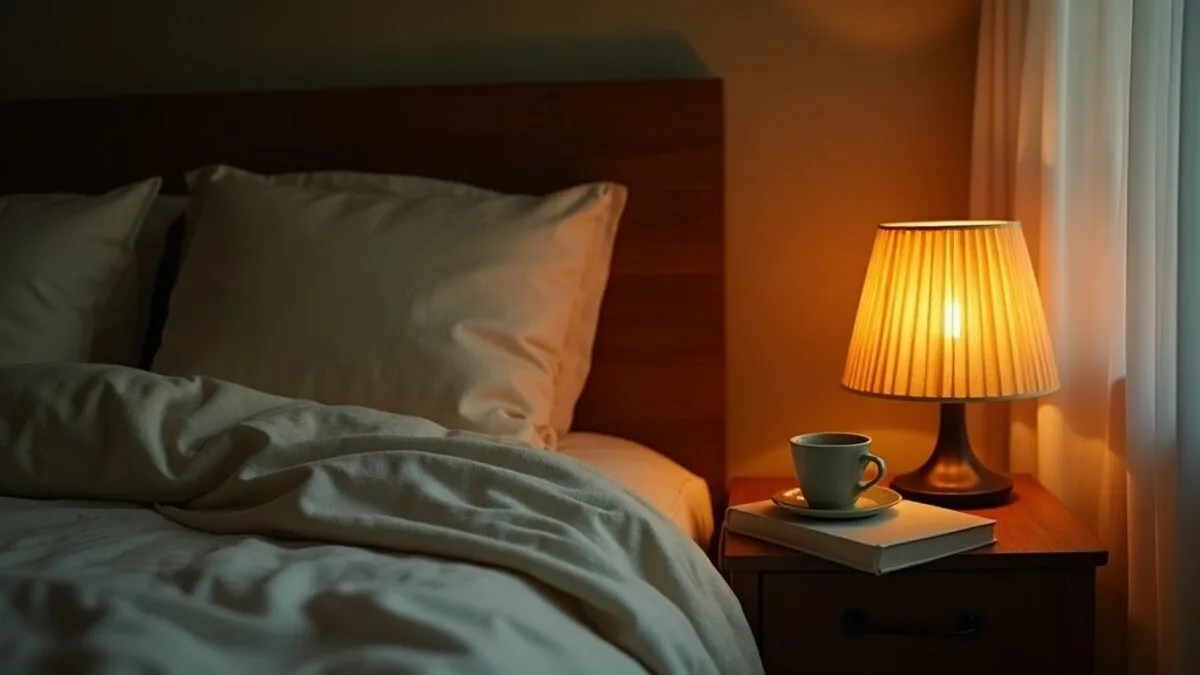
Sleep changed when I stopped treating bedtime like a light switch. The evening needs a runway.
The evening runway
A good night starts about ninety minutes earlier than you think. That's the single most useful thing I know about sleep, and it took me years to believe it. Mine has four small markers: dim the kitchen, walk the block, make a small herbal tea, get into bed with one paperback. That's the runway. Not a rule, a runway, the gentle slope a plane needs before it can leave the ground.
For a long time I treated sleep like a switch. Lights off, eyes closed, why isn't this working. I'd lie there annoyed at my own brain, which is a reliable way to stay awake. The reframe that fixed it was realising sleep isn't a switch you flip. It's a slope you walk down, and you have to start walking well before you reach the bed.
The body wants a series of cues that say the day is closing, and if you skip them and crash straight from a bright kitchen and a glowing phone into a dark room, it's no wonder it doesn't go smoothly. You've given it nothing to read. The runway is just me handing the body a few easy signals in a row.
Sleep is not a switch you flip. It's a slope you walk down, and most of us try to leap.
This is the evening bookend to the morning wellness habits essay, and the two loop into each other. A decent wind-down makes the morning easier, and a decent morning, with light early and no doom-scrolling, sets you up to be tired at a sensible hour. If you only read one alongside this, read that one.
I should be clear about who I am here. I'm not a sleep scientist and I won't pretend the body's chemistry is simple. What I can offer is the honest report of a person who slept badly for the better part of a decade and slowly, by trial and a lot of error, found a handful of evening moves that hold. Take what fits your life and leave the rest. There is no single correct night.
And I want to take some pressure off right at the start, because pressure is half the problem. You do not have to optimise your sleep. You don't need a perfect score on a tracker or eight flawless hours. You need to feel rested enough to be yourself the next day, which is a much softer and more reachable target than the one the wellness industry keeps selling.
On the days my head will not settle, I come back to the small practice in my meditation for beginners guide.
When my head is loud, three lines on a page help, which is the whole idea behind journaling for a quieter mind.
Why the night starts at dinner
Your night starts at dinner, not at bedtime, and that's where most sleep advice quietly skips a step. By the time you're lying in the dark, the important decisions have already been made: when you ate, how much, whether you had a coffee at 4pm, how bright the evening was. Bedtime is just where the bill arrives.
I noticed this when I started paying attention to my worst nights. They almost never began at bedtime. They began with a heavy dinner eaten late, or a glass of something at 9pm, or an evening spent lit up like an operating theatre and then expecting my body to drop into darkness on command.
So I started thinking of the whole evening as the sleep. The wind-down isn't the last twenty minutes. It's the last few hours, lived slightly more gently. That sounds like a big ask, but in practice it's small: eat a bit earlier, dim the lights after dinner, stop pouring the day's noise into my head past a certain hour.
The other big lever hidden in the evening is consistency. Going to bed and waking at roughly the same time, even on weekends, did more for my sleep than any single trick. The body loves a rhythm it can predict. I'm not rigid about it, life happens, but I keep the swing small. A bedtime that wanders by three hours a night gives your body no pattern to settle into, and then we wonder why it won't cooperate on demand.
If you want the science-flavoured version, the page on sleep hygiene covers the standard advice well, and most of what I do is just a softer, more human translation of it. I'm not a clinician. I'm a person who slept badly for years and slowly worked out a runway that holds.
There's a phrase I keep coming back to: you can't force sleep, you can only allow it. Everything in the evening is really about removing the obstacles, not adding effort. The body knows how to sleep. It's been doing it your whole life. The job isn't to make it happen, it's to stop standing in its way with bright lights, late caffeine, and a head full of the day's noise.
Once that clicked for me, I stopped chasing sleep hacks and started subtracting. Less light, less caffeine, less screen, less late food. The subtractions did more than any addition ever did, and they cost nothing, which is rare in a field that's very keen to sell you things.
The four markers, slowly
Here are my four markers in detail, because the order and the why matter more than the list. None of them is dramatic. Together they tell the body, unmistakably, that the day is closing.
Dim the kitchen
After dinner I drop the lights. Not romantic candlelight, just off the bright overheads and onto a couple of lamps. Bright light late in the evening keeps the body in daytime mode, at least for me, and dimming is the cheapest cue I have. It costs a switch. It changes the whole feel of the room.
Walk the block
A short, slow walk after dinner, ten minutes, no phone, no podcast if I can manage it. It helps the food settle, it lets the day finish outdoors rather than at a screen, and there's something about the cooler evening air that my body reads as "winding down." On bad-weather nights I skip it without guilt, but I miss it.
Make a small herbal tea
The tea is half ritual, half warmth. Something caffeine-free, sipped slowly, ideally not a huge mug an hour before bed or I'll be up at 3am for other reasons. The point is less the tea and more the pause: a warm thing in the hands that signals the evening has changed gear. It's the most-used item in my wellness kit for exactly this.
Bed with one paperback
I get into bed to read, not to scroll. A physical book, on purpose, because paper doesn't ping or suggest the next thing. A few pages of something undemanding, and my eyes start to go on their own. That's the runway complete. From there, sleep usually takes over without my help, which was always the goal.
A note on the book choice, because it matters more than you'd think. It should be undemanding. Not the gripping thriller that keeps you up to find out what happens, and not the dense thing you read for work. I keep a few gentle, slightly boring favourites by the bed, the kind I can re-read without urgency. The aim is for the reading to put me to sleep, not to win my attention. A page-turner at bedtime is just a screen made of paper.
You don't have to keep all four markers, by the way. On a calm week I do. On a busy one I might just dim the lights and read. The markers are a menu, not a contract. Pick the two that fit the night you're actually having, and let the runway be as long or as short as your evening allows.
What I stopped doing
The wind-down matters, but honestly, removing a few things did more for my sleep than adding rituals ever did. Here's what I cut, and I cut each one only after a stretch of noticing it wreck a night.
- Phone in the bedroom. It lives on a hallway shelf now, charging where I can't reach it from the bed.
- Big dinners after 8pm. A heavy meal late sat on me and woke me up.
- Coffee after 1pm, even one, even a small one. Caffeine outstays its welcome by hours.
- News read at midnight under the duvet, which is a genuinely strange thing to do to a brain you'd like to switch off.
The phone one was the hardest and the most worth it. For years I told myself I needed it as an alarm, which was a polite lie. I bought a cheap clock and exiled the phone, and the first few nights felt oddly empty, like missing a habit I didn't enjoy. Then I started falling asleep faster, and the matter was settled.
I'd flag that "stop doing" is gentler than it sounds. I didn't go cold turkey on all of it at once. I cut one thing, lived with it for a couple of weeks, then cut the next. The slow version is the one that lasted, which is the same lesson that runs through healthy habits for beginners.
Why subtracting beats adding, in my experience, is that the things wrecking your sleep are usually active intrusions, not missing ingredients. You don't sleep badly because you forgot a magnesium pill. You sleep badly because a screen is feeding your brain at midnight, or a coffee from 5pm is still circulating. Remove the intrusion and the sleep often just returns on its own.
The midnight-news habit is the one I'd most gently warn people off, because it feels harmless and isn't. Reading distressing things in the dark, on a glowing screen, right before you ask your nervous system to power down, is about the least kind thing you can do to a tired body. The world will still be there in the morning. It does not need your attention at 11:58pm, and you do not need its weight in your dreams.
The bedroom as a signal, not a screen room
The bedroom should mean one thing to your brain, and ideally that thing is sleep. The more your bed becomes a place you also work, scroll, eat, and argue with the internet, the harder your body finds it to read the room when you actually want to sleep. I learned this slowly and a bit reluctantly, because the bed is comfortable and the laptop is light.
My rules here are loose but real. The bed is for sleep and reading, mostly. Work happens elsewhere, even if "elsewhere" is just the kitchen table six feet away. It's not about discipline, it's about keeping the association clean, so that lying down still carries a clear message.
Light, temperature, and the small stuff
A few physical things help more than I'd expect. Cooler is better than warm, for me, so I keep the room on the cool side and use an extra blanket rather than cranking the heat. Dark matters, which is where the silk eye mask from the kit earns its keep on summer mornings. And quiet, or at least consistent sound, beats a room that's silent then suddenly not.
None of this needs to be expensive. I'm wary of the sleep-gadget industry, which is happy to sell you a hundred solutions to a problem that's often just "too much light and too much phone." Fix those two first, for free, before you buy anything. The cheapest improvements are nearly always the biggest, and a calmer bedroom is close kin to the calmer home I write about in cozy home rituals.
One small thing about clutter, since it surprised me. A bedroom buried in unfinished tasks, laundry, a desk of work, the dishes you meant to do, keeps a low hum of "not done yet" running in the background as you try to settle. I'm not a tidy person by nature, but I've learned that clearing the surfaces near the bed quiets that hum. It doesn't have to be spotless. It just shouldn't shout at you while you're trying to sleep.
If you share the bed, a quick word on the diplomacy of all this. Different bodies want different temperatures and different amounts of light, and a sleep wind-down works best when it's not a battle. Separate blankets solved more arguments in my house than any conversation did. The goal isn't a perfect shared routine, it's two people each getting a runway, even if the runways don't quite match.
What I do when I wake at 3am
When I wake at 3am, the worst thing I can do is fight it, so I've mostly stopped. Waking in the night is normal, far more normal than the "eight unbroken hours" myth suggests, and the panic about being awake usually does more damage than the waking itself. The trick is to make 3am boring.
My rule is simple: if I'm awake for what feels like more than twenty minutes and getting tense about it, I get up. I go to another room, keep the lights low, and read a few pages of something dull until my eyes get heavy again. Lying in bed wide awake, frustrated, just teaches the body that bed is a place for frustration, which is the opposite of what I want.
What I do not do is check the phone, because nothing good lives there at 3am, and the light alone tells my body it's morning. I also don't do mental maths about how little sleep I'll get, which is a special kind of self-sabotage I've practiced enough to recognise and stop.
The fastest way back to sleep, for me, is to stop caring whether I sleep.
If anxiety is what's waking me, I reach for the same blunt tools I use in the day. A few slow breaths with a long exhale. Naming what I'm carrying, then setting it down until morning. The full kit of those lives in my stress relief rituals, and they work in the dark just as well as in daylight.
There's a notebook trick that helps on the nights my brain wakes me up to "remind" me of tomorrow's tasks. I keep a pad by the bed and write the thing down, badly, in the dark. Once it's on paper my mind seems satisfied that it won't be forgotten and lets go of it. Half the 3am wakings I used to have were just my head trying to be helpful at the worst possible hour. Giving it somewhere to put the thought ends the argument.
I'll also say: stop watching the clock. I turned mine to face the wall. Knowing it's 3:47am and then 4:12am does nothing but feed the maths-of-doom that keeps me awake. If I can't see the time, the waking stays vague and forgettable, which is exactly what I want it to be. A forgettable waking barely counts. A timestamped one becomes a whole anxious project.
Caffeine, food, and the quiet saboteurs
The quiet saboteurs are the ones you don't connect to sleep, because they happened hours earlier. Caffeine is the obvious one, and it's sneakier than people think. For me, a coffee after early afternoon still costs me at the wrong end of the night, even when I feel fine at the time. The effect is invisible until you remove it.
I'm not anti-coffee, far from it, I just front-load it. Most of mine is in the morning, paired with the rest of my first hour, and the cut-off is firm by early afternoon. If you sleep badly and you've never tried moving your last coffee earlier, that's the cheapest experiment available, and the most likely to surprise you.
Food, alcohol, and timing
Big late dinners are the other big one. Eating early and a little lighter in the evening changed my nights more than any supplement. I still eat well, I just do most of it earlier, and I lean on my plant-based meal prep so a sensible early dinner doesn't require energy I don't have after work.
I'll say something honest about alcohol, gently and without preaching: it knocks me out fast and then wrecks the back half of the night, every time. Many people find the same. It's not a sleep aid, even though it feels like one going down. I'm not telling anyone how to live. I'm just reporting what the mornings taught me.
The water balance
Hydration is its own small puzzle. Too little water and I wake up parched and headachy. Too much in the last hour and I'm up to use the bathroom at 2am. My answer is to drink steadily through the day and ease off in the final stretch before bed, so I arrive at the pillow neither dry nor over-full. The herbal tea counts toward that, which is why I keep the bedtime mug small.
And sugar, quietly, is on the saboteur list too. A sweet, heavy pudding late in the evening seems to give me a small lift right when I want the opposite, and sometimes a softer landing a couple of hours later that interrupts the night. I'm not banning dessert, I love it, I just try to have the sweeter things earlier in the day. If you want them done well and not too sugary, I keep a few in my recipe notes over in the recipe pillar.
When the runway is short
Some nights there's no runway, and pretending otherwise just adds guilt to exhaustion. A late event, a deadline, a crying child, a flight. On those nights I don't try to run the full wind-down. I keep one marker, the same way I keep one cue on a wrecked morning, and I let the rest go.
Usually the one I keep is the phone staying out of the bedroom, because that single move protects the night more than the tea or the walk ever could. If even that's not possible, I keep the lights low for the last few minutes and take a few breaths once I'm horizontal. Something beats nothing, and a short runway still slopes downhill.
I've also made peace with the occasional genuinely bad night. One poor sleep is not a crisis. It's a Tuesday. The catastrophe is usually the story I tell about it the next day, not the lost hour itself. I drink water, get some morning light, go easy, and let the next night sort itself out, which it almost always does.
The broader floor version of all this, for hard weeks generally, lives in my vegan wellness routine: one walk, one real meal, eight hours horizontal. When the runway's gone, "horizontal in a dark room" is the whole target, and it's enough.
I'd also warn against the trap of "catching up" with a wild lie-in. The occasional long sleep is lovely, but I've found that if I swing too far, sleeping until noon on a Sunday, I scramble the next few nights and pay for it through the week. A gentler approach, a slightly earlier night and a normal-ish morning, recovers me better than one heroic lie-in followed by three ruined evenings. Steady beats dramatic, here as everywhere else.
The other short-runway reality is shift work and travel across time zones, which break the whole logic of a fixed evening. I won't pretend I have that fully solved. What helps me on those weeks is anchoring to light rather than the clock: get bright light when I want to be awake, keep it dark when I want to sleep, and let the rest be rough for a few days without treating it as a personal failing. The body adjusts. It just needs honesty about which way is "morning."
A week to build a better night
If you want to actually change your sleep rather than just read about it, I'd do it the slow way, one small change at a time. Here's the order I'd suggest, because each step makes the next one easier.
- This week: move the phone out of the bedroom. Just that. Buy a cheap clock if you need to.
- Next week: pick an earlier coffee cut-off and hold it. Early afternoon at the latest.
- Then: dim the lights after dinner. Lamps, not overheads.
- Then: add a short evening walk, or a small herbal tea, or both if they stick.
- Finally: get into bed to read, not to scroll. Keep a paperback on the bedside.
Notice that's mostly the same handful of things I started with, just spaced out so no single week asks much of you. I know the all-at-once version is tempting, the full sleep overhaul starting Monday, but I've watched that approach collapse by Thursday too many times to recommend it.
Build the runway one marker at a time, and forgive yourself the nights it falls apart, because they will, and the habit is in the returning, not the streak. A better night is rarely one big fix. It's a few small, kind decisions made earlier in the evening than you'd think, repeated until they stop feeling like decisions at all. That's the whole guide. The rest is just sleeping.
One last reframe to leave you with. Stop measuring sleep so much. I gave up the tracker after it started making me anxious about a thing I was supposedly improving, which is its own special absurdity. The body knows whether you're rested. You can feel it in the first hour of the day, in your patience and your appetite and how the light looks. Trust that over a number on a screen, every time.
And if good sleep keeps eluding you despite all of this, please don't take my essay as the final word. Persistent, real sleep trouble is worth a proper conversation with a doctor, not a blog. I write for the tired-but-fine majority, the people whose nights got noisy and just need quieting. If that's you, start with the phone on the hallway shelf tonight, and let the rest follow when it's ready. Sleep well. It's most of everything else.
Common questions
How long will this take, honestly?
The reading is 10 min. The practice is a lifetime. Start with one small piece this week and let the rest follow when it feels natural, not before.
Do I have to be fully plant-based for this to help?
No. Everything I write is for people who want a softer relationship with food and routine. The recipes happen to be plant-based; the ideas work in any kitchen.
What should I read next?
The related essays below, in order. If you only read one more thing, read A first hour worth keeping, it picks up exactly where this one ends.
Can I cite this guide somewhere?
Yes. Please link back to this page and credit Caleb Leuchi. All photographs are made for Leuchi unless noted; the writing is original.
Continue reading in this cluster
All wellness →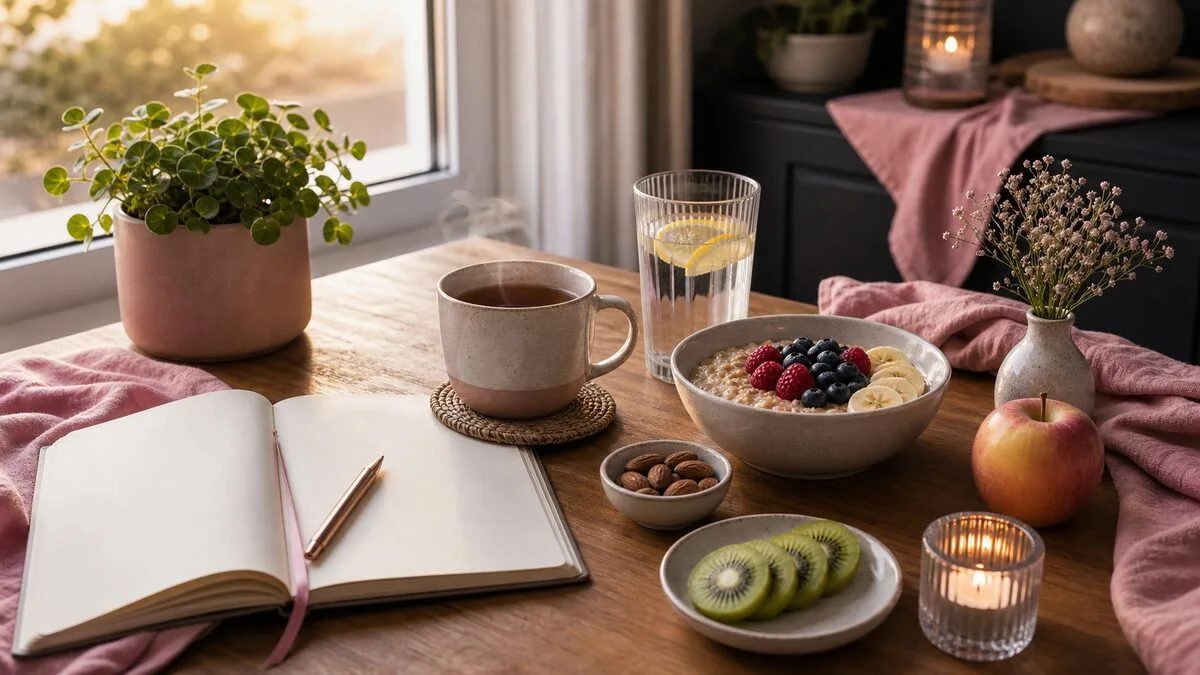
Wellness
A first hour worth keeping

Wellness
Stress relief rituals for hard weeks

Wellness
A self-care routine that truly helps
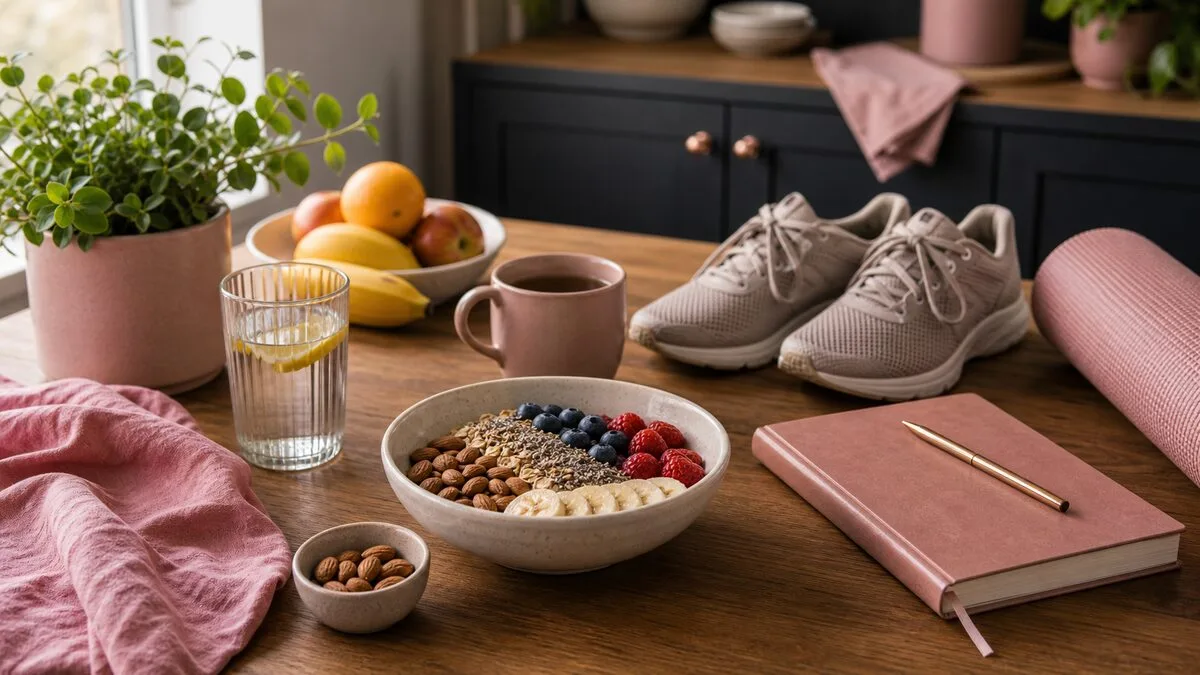
Wellness