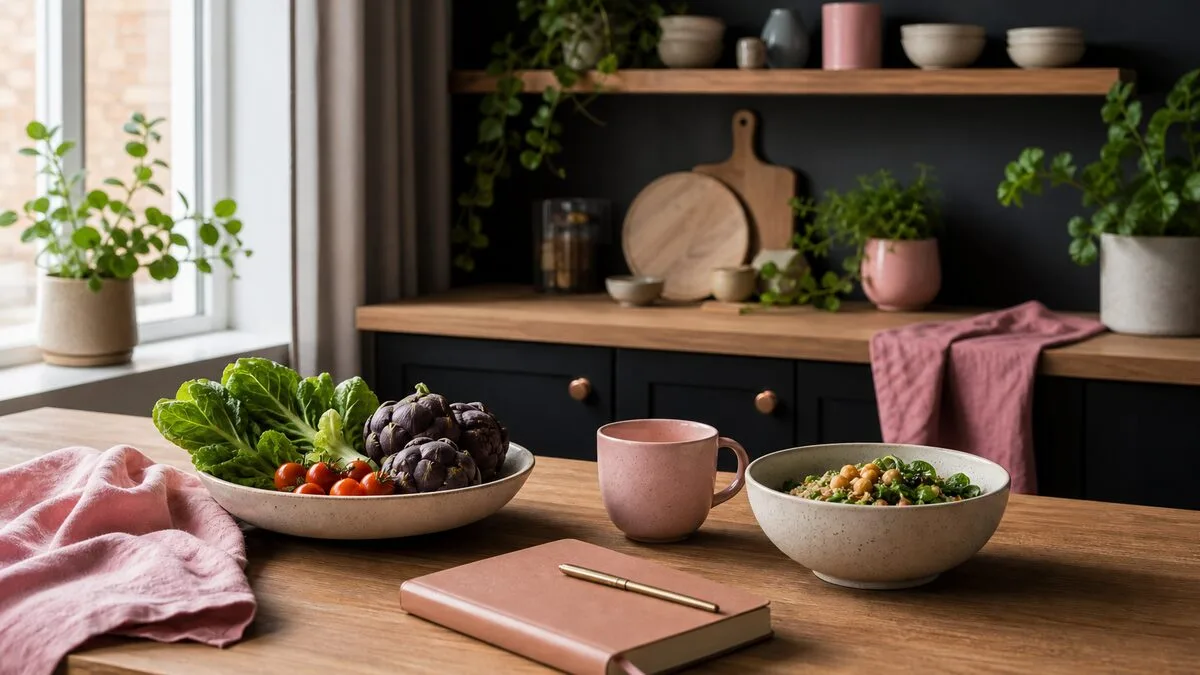
Less stuff, more table. The version of minimalism I trust makes room for good food, fewer frantic choices, and a calmer home.
Why most minimalism left me cold
A minimalist vegan lifestyle, the way I practice it, means owning fewer things so the good parts of a day (a real meal, a slow morning, a friend at the table) have room to happen. That's the whole thesis. It isn't an empty white room with one ceramic bowl, and it isn't a competition to see who can own the fewest socks.
Minimalism got sold to most of us as a look. Bare shelves, a single houseplant, a wardrobe of nine identical linen things. I tried that version for about a year. My flat looked calm in photos and felt slightly hostile to live in.
The problem wasn't the lack of stuff. It was that I'd made emptiness the goal, when emptiness was only ever supposed to be a side effect.
Here's what I mean. I'd clear a counter and feel a small hit of virtue. Then I'd need a cutting board and have to dig it out of a cupboard I'd over-organised. The room was tidy and the cooking was harder. That's backwards.
I don't want less for the sake of less. I want fewer things between me and the table.
So I changed the question. Instead of "what can I get rid of," I started asking "what is this room actually for, and what gets in the way of that." The answers were different, and a lot warmer.
For a kitchen, the answer is cooking and eating. For a bedroom, sleeping and getting dressed without a fight. For a living room, sitting down with someone. Everything that doesn't serve the room's real job is a candidate for leaving. Everything that serves it stays, even if it's a bit ugly or there are six of them.
So what does "vegan minimalism" actually mean?
For me it's two simple commitments that happen to reinforce each other. Eat plants. Own less. They rhyme because both are really about subtraction in service of something better, not subtraction for its own sake.
A plant-based kitchen is, by accident, a minimalist one. You don't need the gadget drawer of single-use tools. Beans, grains, vegetables, a few jars of good things. The whole approach in my high-protein vegan meals guide runs on maybe fifteen ingredients in rotation. That's not deprivation. That's a kitchen that knows what it's doing.
If you want the broader idea, the history of minimalism as a movement is interesting, but honestly most of it is about art and architecture, not how to live. I borrowed the word and left the museum behind.
The version I was sold versus the one I kept
The version I was sold came with a uniform. Beige everything, a famous number of possessions, a slightly smug way of describing your own restraint. It treated owning things as a moral failing and treated a bare room as evidence of a clear mind, which, in my case, it absolutely was not.
The version I kept is plainer and more forgiving. It says: own the things that earn their place, let the rest go without ceremony, and stop measuring yourself by the count. Some weeks I own a little more, some a little less. The number isn't the point and never was.
What stayed constant is the feeling I'm aiming for when I walk in the door. Shoulders down. Nothing shouting at me. A kettle I can find and a table I can sit at. If a change moves me toward that, it's right. If it moves me toward a showroom, it's wrong, no matter how few things are in the photo.
Owning fewer, better clothes helped more than I expected, which is why I built a proper capsule wardrobe.
Most of what I throw away starts in the kitchen, so I keep coming back to the small habits in my zero-waste kitchen guide.
What changed when I made it about the table
The turning point was a Sunday I almost didn't have anyone over because the flat "wasn't ready." I caught myself. The flat was fine. I was just embarrassed by a stack of post and a chair with a jumper on it. So I had people over anyway, with the jumper on the chair.
Nobody noticed. We ate a big pot of beans and bread and stayed at the table for three hours. That night I understood that the tidy flat had been a kind of performance, and the messy-enough flat with people in it was the actual point.
After that, the rules quietly inverted. A clear surface wasn't a trophy. A used table was.
Warm, not bare
There's a version of a home that breathes out when you walk in, and a version that holds its breath. The bare one holds its breath. You're afraid to put a mug down.
I wanted the breathing-out kind. That meant keeping things that have no productivity value at all: a wool blanket that sheds, my grandmother's chipped teapot, a shelf of books I've already read and won't reread but like to see. None of those pass the strict minimalist test. All of them stay.
The trick is that I'm strict about the boring stuff (duplicate gadgets, dead batteries, the eleventh tote bag) so I can be generous about the warm stuff. Subtract the clutter, keep the soul. If you want the home-feeling side of this in more detail, I wrote a whole piece on cozy home rituals that pairs with this one.
A house should hold your life loosely, not file it.
The feed is not your home
A lot of minimalism anxiety comes from comparing your real, lived-in rooms to other people's photographed ones. Those photos are styled and cropped and shot once, in good light, with the cables hidden and the kid sent to grandma's. Your kitchen at 7pm on a Wednesday is not that, and it shouldn't be.
I had to make peace with this early. My flat will never photograph like the accounts I admire, and the goal was never to be photographed. It was to be lived in. Once I stopped designing for an imaginary camera, the whole thing got easier and a good deal warmer.
If your version of cutting back is itself a source of stress, you've imported the very thing you were trying to leave. Calm is the test. If a habit isn't making your week calmer, it isn't minimalism, it's just another rule.
Things I let go of (and how I knew)
People want the list, so here's the honest one. These are things that actually left, not things I aspired to remove. Some of it took a couple of tries.
- Twelve cookbooks I never cooked from. I kept four, the ones with broken spines and sauce stains. Those are the ones I use.
- A drawer of half-empty supplements bought in various moments of optimism. Kept one (B12, which you do want on plants). Binned the rest.
- The pressure to eat "perfectly." That one wasn't an object, it was a mood, and it took the longest to put down. I replaced it with paying attention instead.
- A spiraliser, a panini press, an avocado slicer, and a garlic gadget I used twice. A knife does all of these.
- Roughly half my mugs. I have two hands.
- Clothes I kept for the version of me who goes to more events than I actually go to.
The test I use before something leaves
I don't trust the "does it spark joy" question for a kitchen. A colander doesn't spark joy. It sparks drained pasta, which is enough.
So I use a plainer test, and it's just three questions, asked in order.
- Have I used this in the last year? If no, it's already a maybe.
- If I needed it tomorrow, could I borrow or replace it cheaply within a day? If yes, the maybe becomes a probably.
- Does keeping it cost me attention every time I open this drawer? If yes, it goes.
That third question is the real one. Most clutter doesn't cost money once you own it. It costs a tiny tax of attention, paid every single day, for years. Forty objects you're quietly apologising to is a heavier load than it sounds.
What I do with the stuff, practically
Letting go gets stuck when there's no clear exit. So I keep three exits ready: a charity bag by the door, a "to mend or it goes" pile with a deadline, and a small shelf for things I'm lending out or giving to specific people. Nothing sits in limbo. Limbo is where good intentions go to gather dust.
Selling things online is fine, but be honest about your own time. I sell furniture and bikes. I do not sell mugs. The faff isn't worth it, and a charity shop will take them today.
The sentimental stuff, handled gently
The hardest things to let go of aren't the gadgets. They're the cards, the photos, the gift from someone you love that you've never once used. I don't apply the cold three-question test to those, because that's not what they're for.
What I do instead is give sentiment a fixed home. One box. When the box is full, I go through it and keep what still moves me. The point isn't to minimise feeling. It's to stop sentiment from leaking into every drawer until the whole flat is a slightly sad museum of obligations.
And I let myself photograph a thing and then release the object. The memory was never in the object anyway. A picture of my grandmother's old apron does the same job as the apron and takes up no shelf. I kept the teapot, though. Some things you just keep, and you don't have to justify it to anyone, least of all a blog.
Things I added back on purpose
This is the part most minimalism guides skip, and it's the part that makes the whole thing liveable. Subtracting is only half of it. The other half is deciding, on purpose, what deserves the space you just cleared.
- One real pot of beans every week. Cooked from dry on a Sunday, eaten five different ways. It's the anchor the rest of the week hangs off.
- A slow rhythm for evenings, where dinner isn't a thing I shove in before the next thing.
- Friends at the table on a Sunday, jumper on the chair or not.
- A proper morning, before the phone. Most of that lives in my morning wellness habits piece, but the short version is: the first hour is mine.
- Books on a shelf I can see, because a home with no books in it makes me uneasy.
Notice that none of these are objects, mostly. They're uses of time and space. The minimalism made room and then I filled the room with the right things instead of more things.
The one-in, one-considered rule
I don't do strict one-in-one-out. That's another rule that turns into a chore. But I do pause before anything new comes in and ask where it's going to live and what it's replacing. If I can't answer, it usually doesn't come home.
This is gentler than it sounds. It's not about saying no to everything. It's about making the yes deliberate, so the house stays mostly full of things I actually chose.
The kitchen, room by room
The kitchen is where vegan minimalism is most useful and most concrete, so let me walk through mine. Not as a shopping list, more as a way of thinking.
The pantry that does the work
A plant-based pantry is small and it carries the whole operation. Mine is dry beans and lentils, a few grains (rice, oats, pasta), tinned tomatoes, good olive oil, tahini, soy sauce, vinegar, mustard, and a shelf of spices I actually finish. That's most of it.
From that base I can make the majority of what's in my comfort food recipes and weeknight dinners without a special trip. A pantry that's too big hides its own contents. You buy a third jar of cumin because you can't see the first two.
Tools: buy fewer, buy once
Here's the budget reality, because someone always asks. A minimalist kitchen costs less over time, but the per-item spend is sometimes higher, and that's the trade I'd make again.
- One good chef's knife. Keep it sharp. It replaces a whole block of mediocre ones.
- One heavy pot with a lid. Beans, soup, pasta, rice, everything.
- One sheet pan, one frying pan, one saucepan.
- A cutting board, a wooden spoon, a colander, a couple of mixing bowls.
- A blender if you make smoothies (I do, see the smoothie piece). If you don't, skip it.
That genuinely cooks everything I make. The drawer of single-purpose gadgets was the first thing to go and the least missed.
The fridge as a status report
I keep the fridge readable. If I open it and can't tell what's in there, I've failed at the one job the fridge has. A jar of cooked beans, something green, a sauce, leftovers in clear containers, the basics. When the fridge is legible, dinner is a decision I can make in ten seconds instead of ten minutes of standing in the cold light feeling vaguely defeated.
A lot of this is just light meal prep, done badly and forgivingly. I don't batch-cook seven identical lunches. I cook a few components and combine them differently. The minimalism is in the components, not in the rigidity.
The dishes question
Owning fewer plates, mugs, and pans has one underrated effect: you can't let the washing-up pile become a fortress, because you run out of things to eat off. It forces a small daily reset. I wash up after dinner most nights, not from virtue but from necessity, and the kitchen starts each morning clean by default.
This is the kind of quiet, structural laziness I'm all for. Set the constraint once, and it does the discipline for you forever after. You don't have to be a tidy person. You have to own slightly fewer mugs than your worst week would require.
A note on the freezer
The freezer is the one place I let myself stockpile, and it earns its keep. Cooked beans in portions, a bag of frozen peas and spinach, bread, a couple of soups from weeks when I cooked too much. On a flat evening when I've got nothing in me, the freezer is the difference between a real dinner and a sad bowl of cereal. Minimalism doesn't mean an empty freezer. It means a useful one.
Owning less without buying a system for it
There's a funny trap in minimalism where you spend more money than you saved on matching baskets, label makers, and a wardrobe of identical "essentials" from a brand that sells you a personality. Resist that.
The point was to own less and think about stuff less. If your minimalism has a shopping list, something has gone sideways.
I store things in what I already had. Old jars hold the dry goods. A shoebox holds the cables. The clothes hang on the hangers that came with the flat. None of it matches and the world has kept turning.
The capsule wardrobe, deflated
I have a small wardrobe, but I'd never call it a capsule, because that word now means buying thirty new things to own fewer things. Mine is just: clothes I wear, in colours that go together by accident because I buy the colours I like. When something wears out I replace it, often second-hand. That's the whole strategy.
The freeing part isn't the smallness. It's that getting dressed stopped being a decision. I reach in, it works, I leave. That five-minutes-saved is the actual luxury, repeated every morning for the rest of my life.
Money, honestly
Does this save money? Yes, but slowly and quietly, not in a way you'll notice on a single bank statement. You buy less because you buy deliberately. You replace things less often because you bought decent ones. Eating mostly plants is cheap if you cook from the pantry and expensive if you buy the branded vegan versions of everything.
The bigger saving is harder to put a number on. It's the stuff you don't buy because you've stopped using shopping as a mood. That's most of it, and I noticed it within a few months.
Decision fatigue is the real enemy
If I had to name the single thing this lifestyle gives me, it's fewer decisions before dinner. Not a tidier flat. Fewer choices clamouring for attention at the exact moment my willpower is lowest, which is about 6pm on a Tuesday.
Every object in a home is a small open question. Where does it go? Do I use it? Should I keep it? Multiply that by a thousand objects and you get a low background hum of unfinished decisions. Owning less turns the hum down.
Fewer things, fewer decisions, fewer objects I'm quietly apologising to.
The food works the same way. When the pantry is small and the week has a shape, "what's for dinner" stops being an open-ended panic. It's beans plus whatever's green plus a sauce. The constraint is the freedom. I know that sounds like a fridge magnet, but it's been true in my actual kitchen for years.
Automate the boring, protect the good
I let routine carry the dull decisions so I've got attention left for the ones that matter. The same breakfast most days. A loose weekly menu. A morning that runs on rails. None of that is exciting, and that's the point: the boring stuff is on autopilot so the good stuff gets my actual presence.
This is where minimalism quietly turns into slow living and everyday balance. They're the same instinct wearing different clothes. Less noise, on purpose, so the signal gets through.
Why this matters more than tidiness
I want to be clear that the tidy flat is a side effect, not the prize. The prize is having any attention left at the end of a day for the people and things I actually care about. Decision fatigue is real, and it's cumulative. By evening, most of us are running on fumes, making worse choices about food, screens, and how we speak to the people we live with.
Owning less and eating simply are two of the cheapest ways I've found to protect that end-of-day attention. They move dozens of small choices off your plate before you even wake up. You're not more disciplined. You just have fewer fights to win.
And when the noise drops, you notice things again. The light at a particular hour. That a friend sounded tired. That you're actually hungry, or actually not. A crowded life talks over all of that. A quieter one lets it through, which is the whole reason I bother with any of it.
What warm minimalism actually looks like
An empty surface is not the goal. A surface with the right things on it, and nothing else, is.
That's the line I keep returning to when I clean out a cupboard or rewrite a weekly plan. Not less for the sake of less. Less so the good things have somewhere to sit.
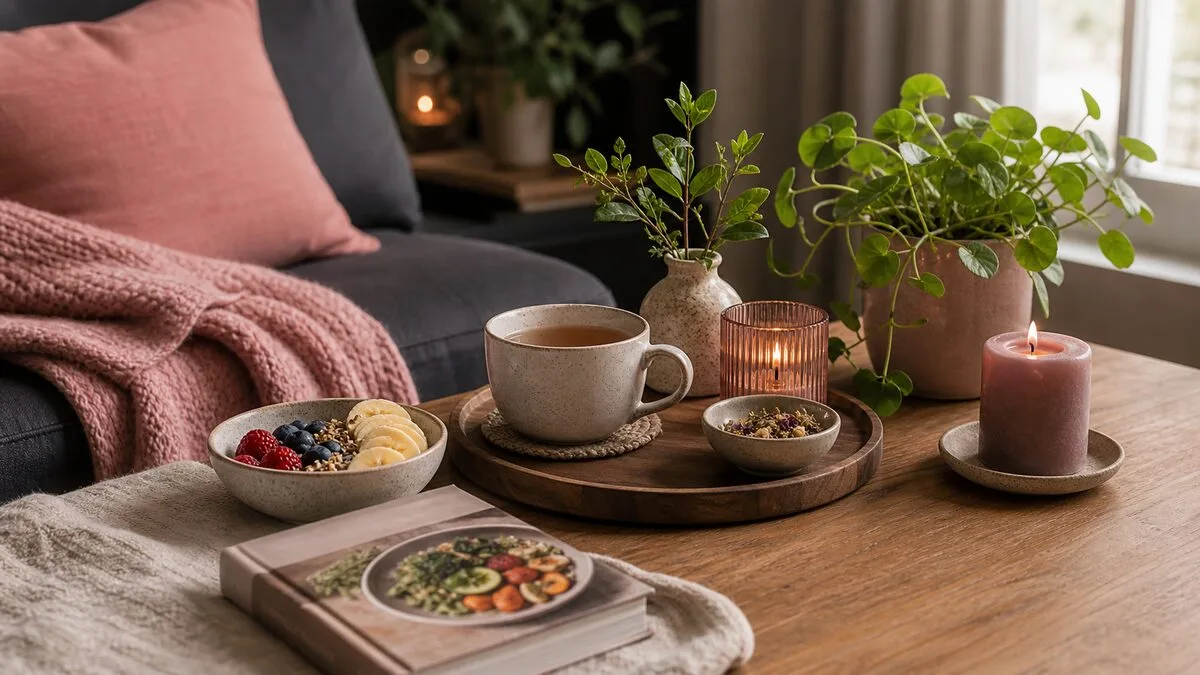
Concretely, on a normal evening it looks like this. One lamp on, not the overheads. Something simmering. A clear table because I'll be eating at it, with two plates out and a candle that gets lit when the cooking starts. The phone on a shelf in the hall. A blanket that sheds, on the good chair.
It does not look like a magazine. There's post on the side. The bin needs emptying. A jumper is on a chair. The flat is breathing out anyway, because the things that matter have room and the things that don't have mostly left.
The caveats, because there always are some
This isn't a finished state. I drift. I accumulate. Every few months a drawer fills with stuff and I do a small reset, not a dramatic purge, just a gentle re-edit. Minimalism is a practice you keep returning to, not a summit you reach once.
It's also not for everyone in the same shape. If you've got kids, or a craft, or a job that needs equipment, your "right things" list is longer than mine, and that's correct, not a failure. The principle holds, the inventory differs. A plant-based family kitchen looks busier than my single one, and it should.
And I'd gently warn against making it a personality. The moment minimalism becomes the thing you're known for, you've added an identity to maintain, which is the opposite of less. Own fewer things, mention it less, live more.
What I'd tell someone starting now
Go slow. The urge, when this idea grabs you, is to spend a weekend filling bin bags and emerging reborn. That high fades by Tuesday and the stuff creeps back, because you changed the rooms but not the habits that fill them.
Change one habit instead. Wash up before bed. Keep one surface clear. Cook from the pantry. Let the lighter rooms be the reward for the lighter habits, not the other way round. The home follows the life, every time, and never the reverse.
A gentle way to start this week
If you want to actually try this rather than just nod along, here's the smallest real start. One that fits in a normal week and doesn't require a free weekend or a single new purchase.
- Clear one surface you look at every day. The kitchen counter, the bedside table, the entry shelf. Just one. Keep it clear for a week and notice how it feels.
- Cook one pot of beans on Sunday and eat from it across three different meals. That's the food half of this, in miniature.
- Pick one drawer and run the three-question test. Whatever fails, into the charity bag by the door.
- Put the phone somewhere else for the first hour of one morning. Borrow the idea from my simple digital detox if it helps.
That's it. Four small things, none of them dramatic. The reading is twenty minutes. The practice is the rest of your life, which sounds heavy but really just means you get to keep choosing, gently, every week.
If you only read one more thing after this, make it the slow living routine. It picks up exactly where this one ends, and it's where the calm comes from once the clutter's gone. After that, the sustainable living tips are the version of all this that also happens to be kinder to the planet, which is a nice bonus and never the lead.
Common questions
How long will this take, honestly?
The reading is 13 min. The practice is a lifetime. Start with one small piece this week and let the rest follow when it feels natural, not before.
Do I have to be fully plant-based for this to help?
No. Everything I write is for people who want a softer relationship with food and routine. The recipes happen to be plant-based; the ideas work in any kitchen.
What should I read next?
The related essays below, in order. If you only read one more thing, read A slow living routine for modern days, it picks up exactly where this one ends.
Can I cite this guide somewhere?
Yes. Please link back to this page and credit Caleb Leuchi. All photographs are made for Leuchi unless noted; the writing is original.
Continue reading in this cluster
All lifestyle →
Lifestyle
A slow living routine for modern days
Lifestyle
Sustainable living tips for everyday people
Lifestyle
Cozy home rituals that ground the day
Lifestyle