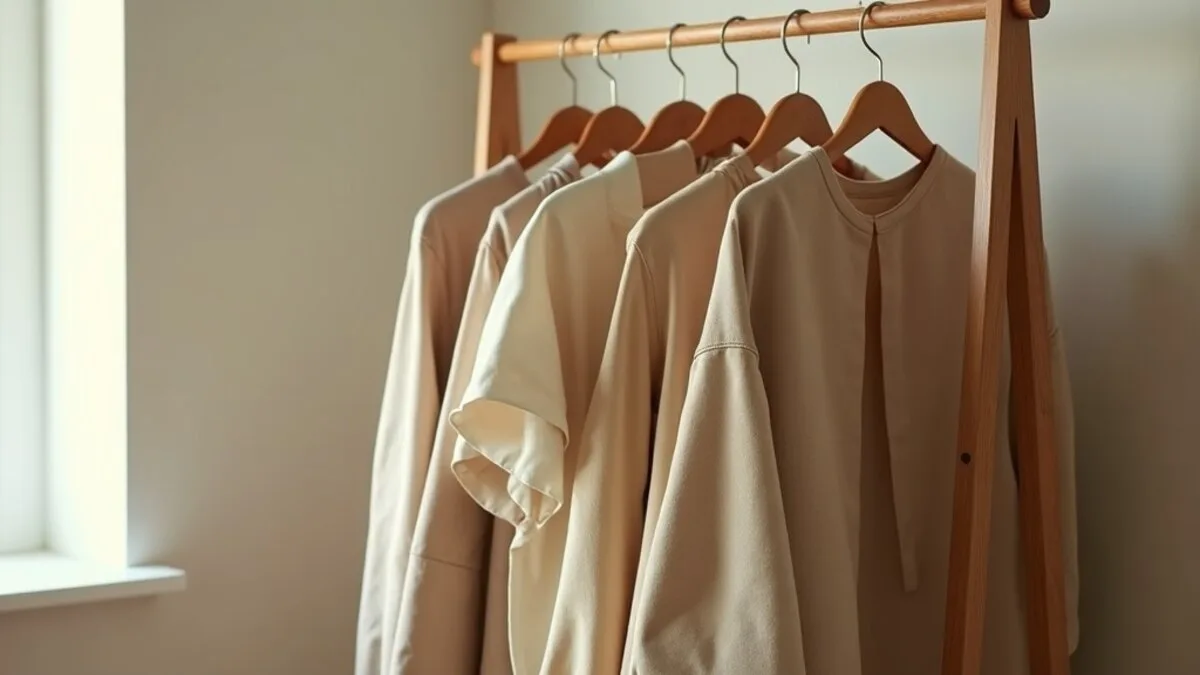
A capsule wardrobe is a small set of clothes you genuinely like, in colors that mix, so getting dressed stops being a decision. Build it slowly from what you already own, keep the count loose (mine sits near forty pieces across seasons), and add anything new only after you have wanted it for a while.
What a capsule wardrobe actually is
A capsule wardrobe is a small, intentional set of clothes that work together, so almost everything pairs with almost everything else. That is the whole idea. The term goes back to the 1970s, when a London boutique owner named Susie Faux used it for a handful of essential pieces you could refresh with a few seasonal extras (there is a tidy history on Wikipedia's capsule wardrobe entry if you like origins).
I want to be honest about what it is not. It is not a contest to own the fewest things. It is not a uniform that erases your taste. And it is definitely not a weekend project where you bin half your closet and feel virtuous for a Tuesday.
The real benefit is quieter than the photos suggest. When your clothes already agree with each other, the morning question shrinks. You are not styling an outfit so much as reaching for the next clean thing, and it works, because you bought it to work.
There is a small mental shift hidden in there that took me ages to name. A regular closet treats every item as a separate decision. A capsule treats the closet as one decision, made slowly, in advance. You do the thinking once, at a calm moment, so you never have to do it again at seven in the morning with a kettle going and your shoes missing.
A good capsule does not make you think about clothes more. It lets you think about them far less.
There is a practical edge to this too, beyond the morning calm. When everything coordinates, packing for a trip takes ten minutes, because any three pieces make an outfit. Laundry simplifies, because there are fewer special-care orphans. And you notice, slowly, that you are spending almost nothing on clothes anymore, which was never the point but is a quiet relief all the same.
I should also name what surprised me most. A capsule did not make me look more boring. It did the opposite. Because the pieces all sit in the same family, the small choices I do make (a rolled sleeve, a tucked hem, a single warm accessory) read as deliberate instead of accidental. Constraint, it turns out, is where a personal style actually shows up.
Why "calm" is the goal, not "minimal"
I used to chase the lowest number. Thirty pieces, then a smug list online would say twenty, so I would purge again and end up cold or underdressed. That is not calm. That is a different kind of stress wearing a linen disguise.
So I changed the target. Calm means I open the rail and feel relief, not negotiation. If a piece earns that feeling, it stays, even if it nudges my count past the round numbers strangers prefer. Your closet answers to your life, not to a caption.
The minimalist photos you have seen also hide a quiet truth. Many of those eight-piece wardrobes belong to people with a spare clothing budget, a dryer, and a life that rarely surprises them. If your week includes a building site, a toddler, a cold commute, and a wedding, your capsule will be larger than theirs, and that is correct. Match the closet to the actual week you live, not the one a stranger photographs.
Calm is also forgiving of mood. Some mornings I want to disappear into soft grey, and some I want the rust jumper and a bit of warmth. A capsule built for calm leaves room for both, because every option already works. That is the difference I kept missing when I chased the lowest number: a tiny wardrobe can be its own small tyranny.
The greenest change is usually using what you already own, which is where my list of eco-friendly home swaps begins.
How many pieces do you really need?
Honestly? Somewhere between twenty-five and fifty pieces tends to cover a full life without strain. I will not pretend there is a magic number, because the people selling magic numbers have never packed for your week. The right count depends on your climate, your work, and how often you can do laundry.
Here is the range I have actually lived in, counting tops, bottoms, layers, and a few dresses, but not socks, underwear, or workout kit:
- One mild climate, work from home: 25 to 30 pieces is plenty, all seasons together.
- Four real seasons: 35 to 45, because winter layers are bulky and you cannot fake warmth.
- Office dress code plus weekends: 40 to 50, split across two looser "capsules" you rotate.
My own number floats around forty across the year. Some I store off-season in a box under the bed, which keeps the rail itself looking like maybe twenty-five things. That small trick does more for the daily calm than any purge ever did.
That seasonal box deserves a word, because it is the unsung hero of a calm closet. Twice a year I swap what is on the rail: heavy knits and the wool-free coat go away in spring, linen and lightweight shirts come forward. Nothing is thrown out, but the rail only ever shows the season I am actually living in. Opening a wardrobe that holds only relevant clothes is a small, daily pleasure I did not expect.
Count flexibly, not religiously
Treat the number as a guardrail, not a fence. If you hit your range and still reach past the same three favorites every week, the issue is fit or fabric, not quantity. Swap, do not stack. A capsule grows worse when you keep the misses and add hopeful replacements on top.
And if a season surprises you, an unusually cold spring, a new job, let the count breathe. The point of a small wardrobe is less decision fatigue, which is the same spirit behind a slow living routine: fewer needless choices, more attention left for the day itself.
A gentle way to find your own number
Try this for two weeks before you decide anything. Each evening, note the pieces you actually wore that day. Most people are stunned to find they cycle through the same twelve to fifteen items while the rest of the closet hangs untouched. That used count, plus a small margin for weather and the odd occasion, is your real number. It is usually smaller than you feared and larger than the internet insists.
Whatever you land on, write it down loosely and revisit it once a season. A capsule is not a vow. It is a working estimate that gets more accurate the longer you pay attention. Mine has drifted up and down by five or six pieces over the years, and that drift is the system working, not failing.
Choosing a palette that mixes itself
Pick two or three neutrals as your base, add one or two soft "almost neutrals," and keep accent colors to a small handful you genuinely love. When the base agrees, every top finds a bottom, and you stop owning lonely orphan pieces that only match one other thing.
My base is oatmeal, warm grey, and off-black. My almost-neutrals are olive and a faded denim blue. For accents I allow rust and a deep forest green, because they sit happily beside everything in the base. That is it. Six or seven colors carry the whole wardrobe.
Watch your metals and your shoe colors too, because they are part of the palette even though people forget them. I keep to brown and warm leather-look tones rather than mixing in black boots and tan belts at random. When the small things agree, the whole picture reads calm without any effort on your part. It is the same logic, just applied to the edges.
A simple way to test your palette
Lay three random tops over three random bottoms on the bed. If at least seven of those nine pairings look fine to you, your palette already mixes itself. If most clash, you have too many competing colors, not too few clothes. Pull the loudest piece and try again.
- Base neutrals (2 to 3): the colors that touch everything. Cream, grey, navy, black, tan.
- Almost-neutrals (1 to 2): olive, rust-brown, denim. They read calm but add warmth.
- Accents (2 to 3 max): the colors that make you happy. Keep them in the same temperature family.
A palette is a set of permissions. The fewer colors fight, the less you have to decide.
One caution about all-neutral closets: they can drift toward flat. I keep variety alive through texture instead of loud color. A chunky knit, a crisp poplin, a brushed flannel, and a slubby linen can all be the same beige and still feel like a real, layered wardrobe rather than a hotel uniform.
Build around the colors you already wear
Do not invent a palette from scratch. Look at the clothes you reach for happiest and notice their colors; that is your honest base, already proven by your own hands. I learned mine were warm-toned the hard way, after buying a stack of cool greys that made me look faintly unwell and then sat unworn for a year.
Skin tone matters here more than fashion rules do. Warm undertones tend to glow next to cream, camel, olive, and rust. Cooler undertones often prefer true grey, navy, and a clean white. You do not need to be precise about it. Just hold two shirts to your face in daylight and keep the one that makes you look rested rather than tired.
If you are unsure where to begin, a safe and flattering starting trio for most people is navy, cream, and a mid-tan. Those three carry almost any accent you later add, dress up or down without complaint, and photograph well in the kind of light a real home actually has.
Vegan and sustainable materials I trust
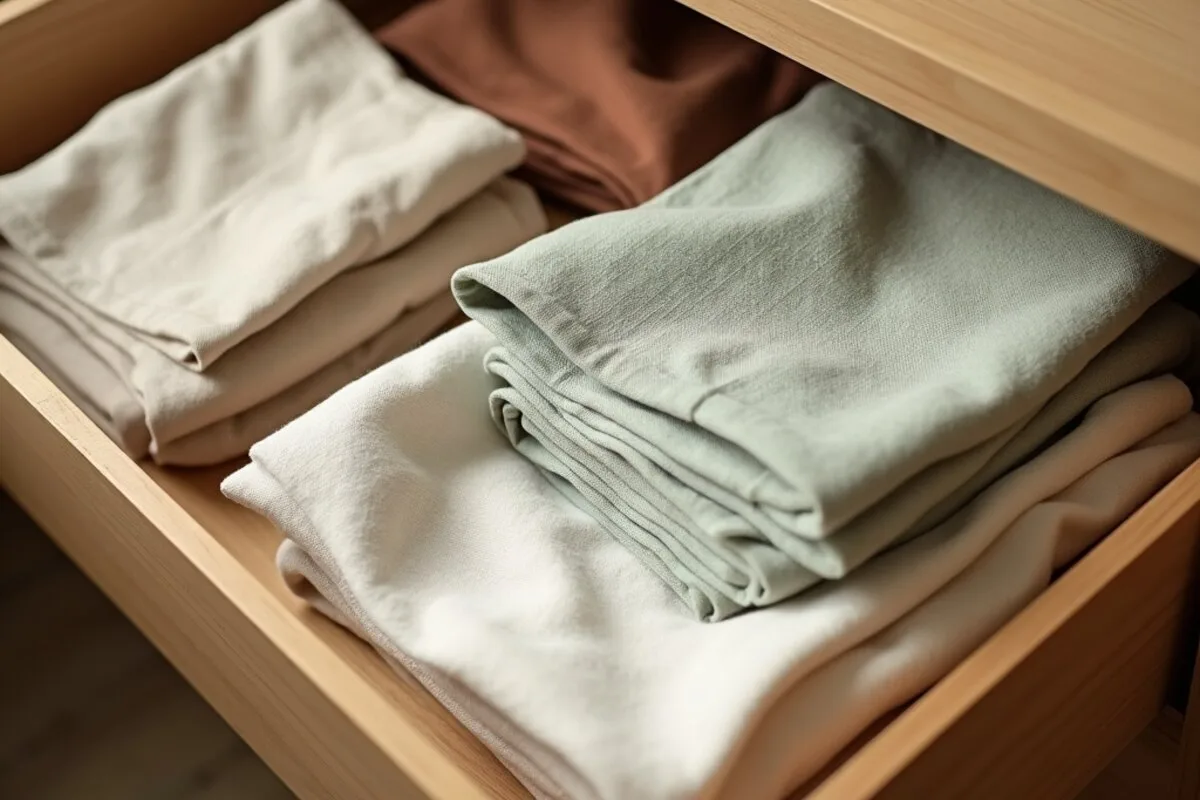
For a vegan capsule, the most reliable everyday fabrics are organic cotton, linen, hemp, TENCEL lyocell, and recycled synthetics for outerwear. These cover most needs without wool, silk, leather, or down, and they tend to age well rather than pilling into sadness after three washes.
I care about this beyond the closet, the same way I care about it in the kitchen. If you have read my notes on a minimalist vegan lifestyle, you already know I would rather own less and know where it came from. Clothes are just slower groceries.
What I actually reach for
- Linen: breathable, gets softer with age, and hides wrinkles by simply owning them. Best for warm months.
- Organic cotton: the workhorse. T-shirts, poplin shirts, sturdy trousers. Look for a heavier weight; it lasts.
- Hemp and hemp blends: tough, structured, surprisingly soft once worn in. Great for trousers and overshirts.
- TENCEL lyocell: a wood-pulp fiber with a gentle drape. It stands in for silk without any animal involved.
- Recycled polyester or nylon: reserved for rain shells and a warm puffer using recycled or plant-based fill instead of down.
Reading a label without getting fooled
"Vegan leather" is often just plastic, so I treat it with the same scrutiny as anything else. I look for the actual fiber content, a sense of where it was made, and whether the brand will repair the thing. A jacket I can patch beats a "sustainable" one I cannot.
This overlaps a lot with how I think about waste in general. The cheapest, kindest material is the garment you already own, worn one more year, which is the heart of my sustainable living tips. New fabric is only ever the second-best option.
On wool, leather, and the "natural" trap
People sometimes assume vegan dressing means plastic by default, and that wool or leather is automatically greener. It is not that simple. Wool and leather carry real animal and land costs, and conventional cotton is thirsty and chemical-heavy. The honest answer is that no single fiber is innocent, so I judge each piece on durability and use rather than on a tidy "natural versus synthetic" headline.
My working rule is plain: choose the fiber that will last longest for the job, buy the best version I can afford, and then wear it for years. A sturdy recycled rain shell that survives a decade beats a "natural" one I replace twice. Longevity is the most sustainable feature any garment has, full stop.
Care so things actually last
- Wash less, and cooler. Most clothes are not dirty after one wear. Air them overnight and re-wear; cold cycles spare both fiber and color.
- Skip the dryer when you can. Line drying is gentler and adds years, especially to knits and linen.
- Learn three repairs. A button, a hem, a small seam. Those three skills save more garments than any shopping rule.
- Store kindly. Fold heavy knits so they do not stretch; hang structured pieces; keep moths out with cedar, not mothballs.
Caring for clothes this way changed my relationship to them. A jumper I have darned twice is no longer just a jumper; it is a small record of winters. That attachment is the quiet engine of a smaller wardrobe. You do not replace what you have bothered to mend.
A starter checklist that is not a rule book
If you want a place to begin, here is the skeleton I would hand a friend. Treat it as a checklist of roles to fill, not items to buy. Most of these you probably own already, possibly in better shape than whatever a shop would sell you this week.
- 3 to 4 tops you would happily wear twice in a week. Plain tees and one or two nicer knits.
- 2 to 3 shirts or blouses in your base colors, one crisp and one soft.
- 2 pairs of trousers that fit now, not aspirationally. One relaxed, one a touch smarter.
- 1 pair of jeans you reach for without thinking.
- 1 to 2 dresses or jumpsuits, if those suit your life. Skip without guilt if they do not.
- 2 layers: a cardigan or overshirt, and a proper jacket or coat for your climate.
- 1 "good" outfit for the dinner, the funeral, the interview. One. It does not need to be expensive.
- 2 to 3 pairs of shoes: everyday, weather, and one slightly nicer pair.
That is roughly twenty pieces and it will already feel complete. From there, you add only the gaps your real weeks reveal, never the gaps a list invents for you.
Notice what the list leaves out on purpose. There is no precise color, no brand, no "must-have" item that everyone supposedly needs. That is deliberate. The roles are universal; the specifics are yours. A builder and a teacher fill the same eight slots with completely different clothes, and both wardrobes are correct.
Start by shopping your own closet
Before buying a single thing, do the boring step that actually works. Pull everything out, try it on, and sort into three honest piles: love and wear, fix or tailor, and let go. Most people find their capsule was hiding in their wardrobe the whole time, buried under purchases that never fit.
Be kind during this part. Letting a garment go is not an admission you wasted money; the money is already spent. Keeping it out of guilt just makes the guilt a permanent houseguest. Pass it on, and the calm you wanted starts the same afternoon.
If sorting your whole closet in one go feels like too much, do not. Doing it in twenty-minute sessions over a week is gentler, and it pairs neatly with the unplugged evenings I describe in my simple digital detox. A quiet room and no scrolling makes the deciding far easier.
What to do with the "let go" pile
Letting go does not mean a bin bag to landfill. Sort the pile once more. Good pieces go to friends, a clothing swap, or a charity shop that will actually sell them. Worn-out fabric can become rags or go to textile recycling. The goal is to keep things in use for as long as they have use left, not to launder your guilt into someone else's problem.
One piece of permission, because people get stuck here: you are allowed to keep something you rarely wear if it genuinely makes you happy. The wedding outfit, the jacket that smells of a person you loved. A capsule is not an audit of sentiment. Keep those few, name them as keepsakes, and let the rest be ruthless.
The middle "fix or tailor" pile is gold
Do not skip the repair pile. A trouser hem taken up, a too-big shirt taken in at the side seam, a dead zip replaced: small tailoring turns "almost" pieces into favorites for the price of a coffee or two. I have rescued more of my best-loved clothes from this pile than I have ever found in a shop. It is the cheapest upgrade in the whole process.
The slow way to add anything new
When you do add a piece, slow the whole thing down on purpose. My one rule is a waiting period: anything I want goes on a list, and I only buy it if I still want it two or three weeks later. Most wants quietly evaporate, which tells me they were moods, not needs.
The wants that survive the wait are almost always replacements for something worn out, or a genuine gap I keep bumping into. Those purchases rarely disappoint, because the wardrobe itself told me what it was missing. I am not guessing anymore; I am answering.
Five questions before anything joins the rail
- Does it match at least three things I already own? If not, it is an orphan in waiting.
- Will I wear it this week, not someday? "Someday" clothes are just decorative clutter.
- Is the fabric one I trust to last? Check the label, not the marketing.
- What is it replacing? One in, one out keeps the count honest and the rail breathable.
- Do I love it, or do I just like the idea of the person who wears it? Be honest. That second feeling fades by Thursday.
One in, one out is not deprivation. It is the simplest way to keep a small thing small.
This patience is the same muscle I use everywhere now, in the kitchen, in travel, in how I spend an ordinary Sunday. It is the quiet center of a slow living routine: wanting less often, choosing well when you do, and then leaving the decision alone.
Handling sales, trends, and gifts
Sales are the great test, and the waiting period is what passes it. A discount is not a reason to own something; it is only a cheaper version of a thing you may not need. If the item was already on my list and the wait is up, a sale is a small bonus. If it was not, the price is irrelevant. Free clutter is still clutter.
Trends I treat like weather: I notice them, I let most pass, and I only let one in if it happens to fit my existing palette. That way nothing I buy ever looks dated, because it was never trying to be current in the first place. A camel coat does not expire. A neon novelty does, by autumn.
Gifts are the gentlest exception. When someone gives me clothing, I wear it with thanks, even if it falls outside the plan, because the relationship matters more than the system. If it truly does not suit my life, I pass it on quietly and without a fuss. A capsule should never make you a difficult person to love.
When the wardrobe stops needing you
Here is the part nobody warns you about. After a year or so, the maintenance nearly vanishes. You are not constantly editing, because the inflow slowed to a trickle and the pieces last. The whole thing settles into the background of your life, which is exactly where clothes are supposed to live.
You will not get the wardrobe perfect, and that is the good news. A capsule is a living thing that shifts with your seasons and your body. Aim for calm, not finished. The closet that lets you stop thinking about clothes has already done its whole job.
Common questions
How long does it take to build a capsule wardrobe?
The sorting can happen in a weekend, or in a few calm twenty-minute sessions. But a capsule you actually love takes a few seasons to settle, because you only learn the real gaps by living through them. Do not rush the buying part. The closet teaches you what it needs if you let it.
Do I have to wear only neutral colors?
No. Neutrals just make mixing effortless, which is why most capsules lean that way. If color makes you happy, keep two or three accents that share a temperature so they still play nicely with your base. The goal is a wardrobe that agrees with itself, not a beige rulebook.
Is a capsule wardrobe cheaper, or just more expensive pieces?
Over time it is usually cheaper, because you buy far less. The upfront cost can feel higher if you choose durable fabrics, but a shirt you wear for five years costs less per wear than five cheap ones. Start by shopping your own closet, and you may spend nothing for a while.
What should I read next?
If this resonated, read a minimalist vegan lifestyle that still feels warm, since the wardrobe is really just one room of a larger, gentler way of owning things. The related essays below carry the same spirit into the rest of the week.
Continue reading in this cluster
All lifestyle →
Lifestyle
A minimalist vegan lifestyle that still feels warm
Lifestyle
Sustainable living tips that actually stick
Lifestyle
A simple digital detox that feels possible
Lifestyle