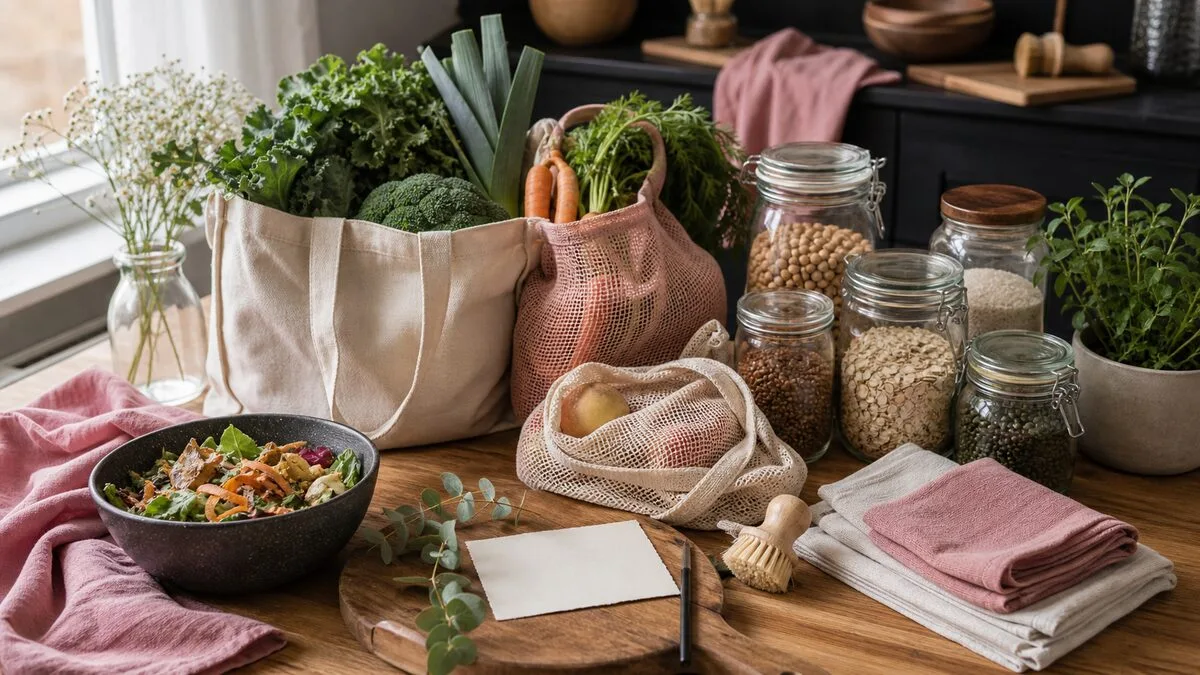
Sustainable choices that survive Tuesday. No purity contests, just small repeatable habits.
Why purity is a trap
The most useful sustainable living tip I have is this: aim for small repeatable habits, not a clean conscience. Sustainability got a lot easier for me the day I stopped treating it like a purity contest. Nobody wins the most-sustainable award. There isn't one. There's just your actual Tuesday, and what you can do on it without burning out.
I spent a while in the guilt phase. Reading labels until I felt sick, agonising over a plastic punnet of berries, doing the maths on a single car trip. It was exhausting, and exhaustion is the enemy of any habit that's meant to last.
The version that stuck is gentler and, oddly, more effective. I picked a handful of things I could do every week without thinking, and I let go of the things I couldn't. That's it. The planet doesn't need a few perfect people. It needs a lot of imperfect ones who don't quit.
The 80 percent rule
I aim for roughly 80 percent and refuse to feel bad about the other 20. The 20 is the flight to see my family, the takeaway in a plastic tub, the thing I bought new because I needed it that day. If I tried to close that gap to zero, I'd give up the whole project within a month, and zero percent is a lot worse than 80.
This is the same logic I use with food. My approach to eating isn't about a perfect diet, it's about paying attention most of the time. Sustainability works identically. Most of the time, gently, forever, beats all of the time, tensely, for three weeks.
If you want the philosophy this sits inside, it's basically the planet-facing version of the minimalist vegan lifestyle I write about. Own less, eat more plants, waste less. The sustainability is mostly a side effect of a calmer life.
The guilt economy
There's a whole economy built on making you feel bad and then selling you the cure. A guilty feeling about plastic, followed by a stainless-steel thing to buy. A worry about your wardrobe, followed by an "ethical" brand that wants you to consume more, just in a nicer colour. I fell for plenty of it.
The thing I eventually noticed is that guilt is a terrible long-term motivator and a fantastic short-term sales tactic. It spikes, you buy something to relieve it, and then it comes back because the underlying behaviour never changed. Round and round, with your money leaking out at every turn.
So I traded guilt for habit. Habits don't need to be felt to work. I don't feel anything about carrying a water bottle anymore. It's just what I do, automatically, which means it'll keep happening on the days I have no willpower at all. That reliability is worth more than any amount of good intention.
Owning fewer, better clothes helped more than I expected, which is why I built a proper capsule wardrobe.
Most of what I throw away starts in the kitchen, so I keep coming back to the small habits in my zero-waste kitchen guide.
The bathroom was the last room I greened, which is why I wrote down my whole zero waste oral hygiene routine.
If you are just starting out, I keep a gentle list of eco friendly swaps for beginners.
Start where you already are
The advice that always backfires is the advice that asks you to rebuild your whole life on day one. Solar panels, a compost system, a capsule wardrobe, an electric car, all at once. Most people can't, and feeling like you can't do "enough" is the fastest route to doing nothing.
So start with what's already in your hands. You already cook, shop, get dressed, and travel. Each of those is a place a small swap can live, and swaps inside habits you already have are the ones that stick.
I didn't decide to "become sustainable." I just changed how I did things I was doing anyway. The water bottle replaced the bought bottles. The dry beans replaced the tins, mostly. The bike replaced the short car trips. None of it was a project. All of it was a substitution.
The footprint thing, kept in proportion
People love to argue about which habit "actually matters," and the honest answer is that some matter more than others. Flying and driving and home heating tend to dwarf the plastic straw. If you want the real picture, the data behind a carbon footprint is worth a read.
But here's my unfashionable opinion. The small habits matter anyway, not because each one moves the global needle, but because they keep you in the practice. The person who carries a water bottle is more likely to also take the train. Habits travel in packs. The little ones are the gateway to the big ones, so I don't sneer at them.
What "where you are" looked like for me
When I started, I was renting a small flat with no garden, no compost scheme, an old gas boiler I didn't control, and a job that occasionally needed me on a plane. By the strict standards of the internet, I was a hypocrite for even writing about this. So I ignored the strict standards and worked with what I had.
What I had was a kitchen, a wardrobe, two feet, and a train station ten minutes away. So that's where the changes went. I couldn't fix the boiler, so I wore a jumper and turned it down. I couldn't compost, so I cut my food waste at the source by cooking less and using it up.
The point of telling you this is that your constraints are not an excuse and they're also not a failure. They're just the shape of where you start. Work the levers you actually control, and let the rest go until your circumstances change. They will, eventually, and you'll be ready.
The kitchen, where most of it lives
If I had to pick one room where everyday sustainability actually happens, it's the kitchen. Food is a daily, repeated decision, which makes it the highest-leverage place to change a habit. And the changes happen to make the food better and cheaper, which is the best kind of bribe.
Cook one big pot a week
This single habit does more than any gadget I own. One big pot of beans or soup or a grain, cooked on a Sunday, eaten across the week. It cuts packaging, cuts food waste, cuts the 6pm panic that ends in a delivery, and it's cheap. The whole rhythm is in my meal prep piece if you want the method.
Buying dry beans and lentils in bulk is the partner habit. They keep for ages, they cost a fraction of tins, and they come with far less packaging. A jar of dry chickpeas on the shelf is one of the most quietly sustainable objects I own.
Eat the seasonal version
I don't follow a strict seasonal rulebook. I just buy the seasonal version of what I want when there's an obvious one. Tomatoes in summer, squash in autumn, citrus in winter. It tastes better, costs less, and travels shorter distances, all without me having to consult a chart.
Waste less, the lazy way
Most food waste in my flat used to come from forgetting what I'd bought. The fix wasn't willpower, it was visibility. I keep the fridge readable, leftovers at eye level in clear containers, and I built a "use it up" night into the week. Whatever's wilting becomes soup or a tray bake. The comfort food recipes are mostly use-it-up dishes wearing a nicer name.
I compost what I can, locally, when there's a scheme that takes it. Where there isn't, I don't beat myself up. Composting is good. Not having access to composting is not a moral failing.
The budget reality of a plant-leaning kitchen
People assume eating sustainably is expensive. It can be, if you buy the branded vegan replacement for everything: the fake meats, the oat-milk-everything, the snacks with a leaf on the packet. Those cost a fortune and aren't especially virtuous.
Cooked from the pantry, though, this way of eating is one of the cheapest there is. Dry beans, rice, oats, seasonal vegetables, tinned tomatoes, oil. A week of dinners from that base costs less than a couple of takeaways. The high-protein vegan meals I lean on are built around exactly this, because cheap and sustainable and filling turn out to be the same shopping list.
So if money is the worry, this is good news. The sustainable version and the frugal version of a kitchen are nearly identical. You're not paying a premium to do the right thing. You're often paying less.
Buying loose and buying once
Where I can, I buy loose: vegetables without the punnet, grains from a refill shop when there's one nearby, bread from a bakery in my own bag. Where I can't, I don't agonise. A plastic bag of carrots is still carrots, and the carrots matter more than the bag.
For kitchen tools, I buy once and buy decent, which I cover in the minimalist lifestyle piece. A good pot that lasts twenty years is more sustainable than three cheap ones that warp and get binned. Durability is an underrated green virtue. The longest-lasting object is the one that never becomes waste.
Ten habits I actually keep
Here's the working list. Not the aspirational one, the real one, the things that have survived years of normal life. If you take nothing else from this piece, take a few of these and ignore the rest.
- Buy dry beans and lentils in bulk. Cheap, low-packaging, keep forever.
- Carry a water bottle out of the house every time. It lives by the door so I can't forget it.
- Cook one big pot a week and eat from it across several meals.
- Compost what I can, locally, without guilt when I can't.
- Repair clothes once before replacing them. A needle and thread settles most arguments.
- Walk instead of driving for trips under 2km. Most of my errands fit that.
- Take the train when it's reasonable, even when it's slightly slower.
- Buy second-hand first: books, kitchenware, jackets, furniture.
- Eat the seasonal version of what I want when there's an obvious one.
- Forgive myself for the trip, the tub, the purchase that doesn't make this list.
That last one isn't filler. It's the load-bearing habit. Self-forgiveness is what keeps the other nine going, because a habit you punish yourself for breaking is a habit you'll eventually abandon to escape the punishment.
How a habit actually becomes automatic
None of these started as habits. They started as decisions, made over and over until the decision dropped away. The water bottle by the door took maybe three weeks to become invisible. Now I'd feel odd leaving without it, the way you'd feel odd leaving without keys.
The trick that worked for me was attaching the new habit to an old one. The bottle lives next to the keys, so grabbing one cues the other. The big pot of beans goes on while I'm doing something else in the kitchen on a Sunday, so it costs no extra slot in the day. Stack the new thing onto a thing you already do, and you barely notice the addition.
And I never add two at once. One new habit at a time, until it's automatic, then the next. Trying to overhaul everything in a single motivated week is how people end up exhausted and back where they started by month's end. Slow really is faster here, because slow is the version that lasts.
Clothes, repair, and the second-hand habit
Clothes are where I used to do the most thoughtless damage and now do the least. Not because I bought a sustainable wardrobe, but because I mostly stopped buying clothes at all, and buy second-hand when I do.
Repair before replace
I'm no tailor, but I can sew a button, patch a knee, and darn a sock badly enough that it works. That covers maybe 80 percent of the reasons a piece of clothing gets thrown out. A small repair kit in a drawer has saved more garments than any ethical brand I could have bought.
There's a quiet pleasure in it, too. A mended jumper has a story. A new identical one has a receipt.
Second-hand first
Before I buy anything new (clothes, kitchenware, furniture, books) I check whether the second-hand version exists and is fine. Usually it is. Charity shops, marketplace apps, the free pile on a neighbour's wall. My most-used pot came from a charity shop for the price of a coffee.
This isn't deprivation. It's just a slightly slower buying process that filters out most impulse purchases on its own. By the time I've checked second-hand, half the urge to buy has passed, and that's a feature.
The same instinct shows up in how I travel light and buy little on the road, which I get into in the travel tips piece. Owning less and consuming less are the same muscle, used in different rooms of your life.
The 30-wears question
Before I buy a piece of clothing now, I ask whether I'll wear it thirty times. It's a rough rule, not a law, but it filters out an astonishing amount. The cheap trend thing I'd wear twice fails it instantly. The plain dark jumper I'll live in for years passes easily.
This quietly pushes me toward fewer, plainer, better things, which happens to be the most sustainable wardrobe there is. Not because of any label, but because I keep them for years and they don't end up in a bin bag by spring. The greenest garment is the one you already own and keep wearing.
Laundry, the unglamorous lever
Half the wear on clothes comes from washing them, so I wash less and cooler. Most things aren't actually dirty after one wear, they're just slightly tired, and an airing fixes that. Cold cycles, full loads, line-drying when the weather allows. None of this is heroic. It just makes clothes last longer and uses less energy, which is the same goal twice.
Getting around without the guilt
Transport is one of the genuinely big levers, so it's worth a little real thought rather than a slogan. My rule is simple and ranked: walk it if it's close, cycle it if it's medium, train it if it's far, fly only when the alternative is not seeing people I love.
Walking for trips under 2km has changed more than I expected. It's slower, which sounds like a downside but mostly isn't. The walk to the shops is now part of the day I like rather than a chore to minimise. That overlaps a lot with the slow living routine, where the unhurried version of a task is often the better version.
There's a health dividend hiding in here too. The walking and cycling I do for transport is most of the movement I get, and it doesn't require a gym, a plan, or any willpower, because it's just how I get places. The greenest exercise is the kind you'd be doing anyway to live your life, and I lean on it hard.
The train mindset
Taking the train often means choosing slightly slower over slightly cheaper-and-faster. I do it when it's reasonable, and I've stopped treating the extra hour as wasted. On a train I read, look out the window, or do nothing on purpose. On a plane I do none of those things and arrive frazzled.
The honest caveat about flying
I fly sometimes. I have family far away, and I'm not going to pretend otherwise or perform a guilt I don't fully feel. What I do is fly less, stay longer when I go, and not add lots of small flights on top. The slow-travel approach in my slow travel guide is partly an environmental choice and partly just a nicer way to travel. The two keep agreeing with each other, which is usually a sign you're on the right track.
Home energy, the boring giant
Heating and cooling a home is one of the biggest pieces of most people's footprint, and it's deeply unsexy, which is probably why nobody writes lifestyle posts about it. But turning the thermostat down a degree or two and wearing a jumper is genuinely one of the highest-impact, lowest-effort things you can do.
I keep my flat a touch cooler than is fashionable and warmer in clothing instead. A blanket on the sofa, thick socks, a jumper that lives on the back of the good chair. It's cosier than a hot, dry, over-heated room anyway. The cozy home rituals piece is, in part, a love letter to being warm without cranking the heat.
Other quiet wins: not heating rooms I'm not in, draught-proofing the obvious gaps, and switching off the standby glow of devices I'm not using. None of it is dramatic. All of it adds up, every single day, without any further effort once it's set up.
The big stuff and the small stuff
Do the few big things imperfectly. Don't sweat the many tiny things perfectly.
If your energy is limited, and everyone's is, spend it where it counts. Fly a bit less. Heat your home a bit less and wear a jumper. Eat more plants. Drive less. Those four move far more than obsessing over which yoghurt pot can be recycled.
That said, the small stuff has a job too. It keeps you mentally in the game, and it's where you have the most control on an ordinary day. So I do both, with different expectations. Big levers: pulled occasionally, imperfectly, on purpose. Small habits: run constantly, automatically, without drama.
What I've stopped doing
I've stopped buying "eco" versions of things I don't need. A bamboo gadget I'll use twice is not sustainable, it's just greener landfill. The most sustainable product is almost always the one you already own, or don't buy at all.
I've stopped buying bottled water entirely, stopped replacing things that still work because a newer one exists, and stopped treating a shopping trip as a hobby for a flat afternoon. That last one was the quiet giant. When buying stopped being entertainment, a surprising amount of consumption just evaporated, and I didn't miss any of it.
I've also stopped trying to convert everyone around me. Modelling a calmer, lower-waste life quietly does far more than lecturing at a dinner table. Most of my friends aren't vegan and aren't trying to be, and the plant-based family life piece is all about that: lead by feeding people well, not by making them feel bad.
The trap of measuring everything
Early on I tried to track my footprint in detail, logging things, doing the maths, feeling either smug or guilty depending on the week. It made me miserable and it didn't change my behaviour, because behaviour changes through habit, not through a spreadsheet.
So I dropped the measuring. I trust the direction instead of the number. Less flying, more plants, fewer things bought, more things kept. If the arrows are pointing the right way, I don't need the decimal places. The measuring was just another way of turning a calm intention into an anxious chore, and I've got enough of those.
One more honest limit
A lot of the biggest changes aren't individual at all. They're about how power is generated, how cities are built, how products are made. No amount of personal water bottles fixes that, and pretending otherwise lets the bigger actors off the hook. So I vote, I support the right things where I can, and I treat my personal habits as the part I control, not the whole solution. Both are true at once, and holding both stops the personal stuff from curdling into either guilt or smugness.
A realistic place to begin
If this is new and you want one thing to do this week, do this: pick a single habit from the list of ten that fits a thing you already do daily, and just start it. Don't announce it. Don't buy anything for it. Don't add a second one until the first feels automatic.
My honest suggestion for the first one is the water bottle, because it's free, it's daily, and it gives you a tiny daily win that proves the whole approach works. From there, the big pot of beans is the highest-value next step, because it touches food, money, waste, and packaging all at once.
- This week: carry a water bottle every time you leave the house.
- Next week: cook one big pot and eat from it for several days.
- The week after: check second-hand before the next thing you'd buy new.
That's a month of changes that cost nothing and add up to a quietly lighter footprint. Build from there at whatever pace doesn't make you resent it. If you want the next ideas after these, the everyday balance habits and the cozy home rituals both run on the same low-key, sustainable-by-default logic.
Sustainable living was never meant to be a hair shirt. Done right, it's mostly a calmer, cheaper, better-fed version of the life you already wanted. The planet benefits as a happy side effect, which is exactly the order I'd put those in.
A year from now
If you keep this up gently, here's roughly what a year does. Without any heroic effort, you'll be cooking more and wasting less, buying fewer things and keeping them longer, walking more of your short trips, and feeling a lot less guilty about the gaps. The flat will be a touch cooler and cosier. The grocery bill will be a little lower.
None of that will feel like a transformation, because it happened one small habit at a time. That's the whole point. The dramatic version burns out by February. The boring version is still going the following winter, quietly doing its work while you barely think about it.
So pick one thing, start it this week, and forgive yourself everything else. That's not a compromise on sustainability. As far as I can tell, after years of doing it both ways, it's the only version that actually lasts long enough to matter.
And if you slip, which you will, you just start again the next day. No streak to protect, no penance to pay. The whole thing is built to be picked back up easily, because the easy-to-resume version is the only one that survives a real, messy, ordinary life. That forgiveness, honestly, is the most sustainable habit on the list.
Common questions
How long will this take, honestly?
The reading is 10 min. The practice is a lifetime. Start with one small piece this week and let the rest follow when it feels natural, not before.
Do I have to be fully plant-based for this to help?
No. Everything I write is for people who want a softer relationship with food and routine. The recipes happen to be plant-based; the ideas work in any kitchen.
What should I read next?
The related essays below, in order. If you only read one more thing, read A minimalist vegan lifestyle that still feels warm, it picks up exactly where this one ends.
Can I cite this guide somewhere?
Yes. Please link back to this page and credit Caleb Leuchi. All photographs are made for Leuchi unless noted; the writing is original.
Continue reading in this cluster
All lifestyle →
Lifestyle
A minimalist vegan lifestyle that still feels warm
Lifestyle
Plant-based family life without the drama
Lifestyle
A slow living routine for modern days
Lifestyle