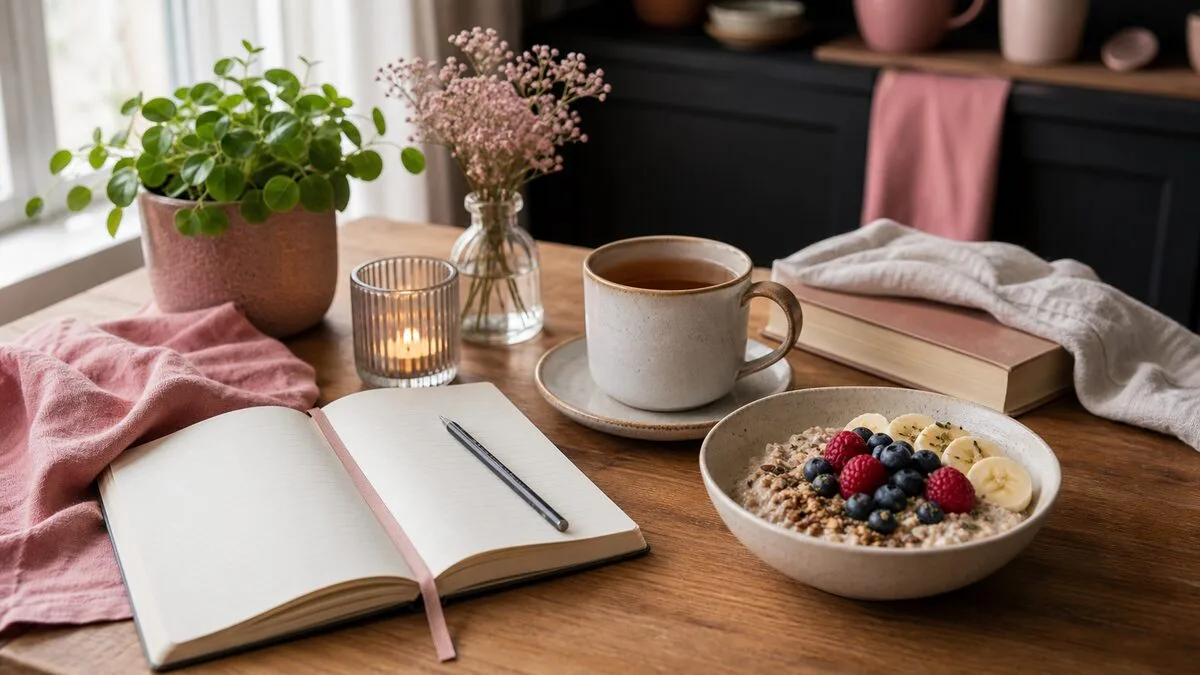
Less doing nothing, more refusing the emergency. A weekly rhythm with breathing room.
Slow living is not about doing less
A slow living routine is mostly about removing self-inflicted urgency, not about doing fewer things. That distinction is the whole essay, really. The actual amount of stuff in my week is not that different from anyone else's. The difference is that I refuse to treat every hour like an emergency.
People hear "slow living" and picture a person with no job, drinking tea in a sunlit window for six hours. That's a holiday, or a fantasy, not a life most of us can live. I have deadlines and a inbox and a body that occasionally lets me down, same as you.
What slow living changed wasn't my workload. It changed my relationship to time, which turns out to be where most of the suffering was hiding. I was treating everything as urgent: every email, every errand, every notification. The urgency was almost all invented, and inventing it was exhausting me.
I refuse to treat every hour like an emergency.
So the routine isn't a slower schedule. It's the same schedule, held differently. Fewer false alarms. More single-tasking. A handful of hours each week that are genuinely protected, where nothing is allowed to be urgent. That's it. It's less of a lifestyle and more of a posture.
What I mean by slow
Slow, for me, doesn't mean languid. It means deliberate. Doing one thing at a time and actually being there for it. Eating without scrolling. Walking without a podcast sometimes. Working in real blocks instead of a haze of half-tasks.
The movement around this has a long history, and if you want the wider context, the idea of slow living grew out of the slow food movement in Italy. But you don't need the theory to feel the difference. You just need one unhurried meal to remember what it was like before everything got rushed.
This all sits very close to the minimalist vegan lifestyle I write about. Owning less clears physical space. Slow living clears time. They're the same instinct, applied to different kinds of clutter, and they reinforce each other constantly.
How I got here
I didn't choose slow living off a Pinterest board. I backed into it after a year of running too hot. I was busy in the way that feels important and is mostly just anxious, saying yes to everything, treating rest as a reward I hadn't earned yet, checking my phone at red lights.
The crash, when it came, wasn't dramatic. I just got tired in a way that sleep didn't fix, and I started dreading ordinary days. That's the quiet kind of burnout nobody photographs. So I started subtracting urgency, not activities, and the difference was almost immediate.
What surprised me is that I didn't get less done. If anything I got more of the things that mattered done, because I'd stopped scattering my attention across a hundred fake priorities. Slow living turned out to be more effective than the frantic version, which I did not expect and still find a little funny.
A few forgiving plants made the room feel alive again, and I wrote down the ones I trust in my guide to easy houseplants.
Refusing the manufactured emergency
Most of the urgency in a modern day is manufactured, and once you see that, you can start refusing it. The email marked urgent that could wait until tomorrow. The notification engineered to feel like it needs you now. The errand that's been fine for a week suddenly feeling like it must happen this minute.
None of those are real emergencies. A real emergency is rare and you'll know it, because your body tells you in a way no notification ever could. The rest is just a culture that profits from your sense of urgency, dressed up to look like obligation.
I started asking a single question of anything that felt pressing: does this actually need to happen now, or does it just feel like it does? Ninety percent of the time, the honest answer is that it can wait, often until a time that suits me better.
The pause that breaks the spiral
The practical tool is a pause. When the urgent feeling spikes, I don't act on it immediately. I let a beat pass. In that beat, the manufactured part of the urgency usually deflates, and what's left is the real, much smaller thing.
This is the same pause I use for the phone in my digital detox piece, and the same one for food. A small gap between the urge and the action, just long enough for the thinking part of me to weigh in. Most of slow living is, honestly, just inserting that gap, over and over, until it becomes the default.
The payoff is enormous and immediate. When you stop treating everything as urgent, the genuine priorities get clearer, because they're no longer drowned out by a hundred fake ones shouting at the same volume.
Single-tasking as a quiet rebellion
The other half of refusing the emergency is refusing to multitask. Doing six things at once feels productive and is mostly just doing six things badly while feeling frazzled. I do one thing at a time now, on purpose, and it's slower per-task and far calmer overall.
When I cook, I cook. When I work, I work, with the other tabs closed. When I'm with someone, the phone's away. It sounds obvious written down, but the default modern mode is the opposite: everything half-done, all at once, attention shredded into confetti. Single-tasking is genuinely a small act of rebellion against that, and it's the engine room of the whole slow routine.
The bonus is that single-tasked work is usually better and quicker than the scattered version. So I'm not trading productivity for peace. I'm getting both, which still feels slightly like cheating.
Saying no, kindly
You can't have a slow week if you say yes to everything. So I've gotten better at the kind no. Not a dramatic boundary-setting speech, just a quiet, friendly declining of things that would over-stuff the week. Most people barely notice, and the ones who do usually respect it.
The hardest nos are to good things, the worthwhile invitation, the interesting project. But a week packed with good things is still a packed week, and packed is the thing I'm trying to escape. So I leave room, even when leaving room means missing out. The missing out is the price of the space, and the space is worth more.
The shape of my week
Here's the actual routine, since people always want the concrete version. It's looser than a schedule and firmer than a vibe. Think of it as a set of defaults the week falls into when I'm not actively choosing otherwise.
Mornings stay sacred. The first hour is mine, before the work and the noise (the full version is in my morning essay). Afternoons are for the work I'm paid for, in real blocks, one thing at a time. One evening a week stays empty on purpose, no plans allowed. Saturday holds one long, unhurried meal. Sunday holds a little prep: a sauce, a grain, a pot of beans for the week ahead.
That's the whole thing. It's not impressive on paper, and that's the point. The structure is mostly negative space: a few protected pockets that nothing is allowed to colonise. Everything else flexes around them.
Why defaults beat schedules
I tried the colour-coded calendar version of slow living and it made me tense, which rather defeats the purpose. A rigid schedule is just another source of urgency, another thing to fail at. Defaults are gentler. They're where the week settles when left alone, and you can override them freely without guilt.
The few firm ones (the empty evening, the protected morning) act as anchors. Everything between them can shift. A week where I move the long meal to Friday is still a slow week. A week where I skip the prep is still a slow week. The anchors hold the shape even when the details drift, and that flexibility is exactly what keeps the routine alive through a busy stretch.
If a routine is too detailed, every deviation feels like a failure, and the failures pile up until you abandon the whole thing. A loose one bends instead of breaks. That's why mine is mostly negative space with a couple of fixed points. I'm aiming for something that survives a chaotic week, not something that only works in an ideal one I rarely get.
Mornings, kept slow on purpose
If the morning goes fast and reactive, the whole day tends to follow. So I protect it, hard. It's the single highest-leverage hour in my routine, and it costs nothing but the discipline of not filling it.
My morning is plain. Coffee made slowly. No phone for the first stretch (that border lives in the digital detox piece). A bit of quiet, sometimes a short walk, sometimes just sitting and letting the day arrive instead of charging at it. Then I start the work.
The trick isn't doing anything special in the morning. It's not doing the rushed thing. Most mornings go wrong not because of what we do but because of the pace we do it at: the grab, the gulp, the scroll, the dash. Slow that down and the same actions feel completely different.
The pace sets the day
I've noticed that whatever pace I set in the first hour tends to stick. Rush the morning and I'm chasing the day until bedtime. Move through it deliberately and I carry that deliberateness into the afternoon, the meetings, the cooking, the lot.
So the slow morning isn't self-indulgence. It's calibration. I'm setting the tempo for everything that follows, and an hour spent setting it well saves me a whole day of feeling frantic. That's a trade I'll take every time, and it's the part of the routine I defend most fiercely.
The afternoon, in blocks
After the slow morning, the work afternoon is where I'm most at risk of sliding back into frantic mode. The defence is blocks. I work in chunks on one thing, with the noise turned down, rather than swimming in a soup of half-attended tasks all day.
A block might be ninety minutes on a single piece of work, then a real break, then the next block. The breaks are part of it, not stolen from it. I step away, make tea, look out a window, move my body a bit. The break is what makes the next block any good. Working through without pausing just produces tired, mediocre output and a frazzled head.
None of this is a rigid system. Some afternoons dissolve into errands or meetings and the blocks don't happen. But the intention (one thing at a time, with real pauses) is the thing that keeps the afternoon from undoing the calm I set up in the morning.
The one empty evening
The protected empty evening is the piece people are most suspicious of, and the one I'd give up last. One evening a week with nothing planned. No social obligation, no project, no errand, no catching up on work. Empty, on purpose.
It sounds like a waste to a productive brain. It's the opposite. It's the release valve that keeps the rest of the week from compressing into one long obligation. Knowing there's an empty evening coming changes how the busy days feel, the way a weekend changes a working week.
What happens in it varies. Sometimes I cook something slow and elaborate for no reason. Sometimes I read. Sometimes I genuinely do nothing and it's wonderful. The point is that nothing is required of me, which is rarer than it should be and more restorative than it sounds.
Protecting it against your own good intentions
The threat to the empty evening isn't usually other people. It's me, filling it with something productive because I can't quite bear the emptiness. So I guard it from myself. When I catch the urge to schedule something into it, I treat that urge with suspicion. The empty evening only works if it stays empty.
This is where slow living overlaps with the mindful weekend routine and the everyday balance habits: protected nothing is a feature, not a gap to be optimised away. The white space is the thing doing the work.
Boredom is allowed back in
One thing the empty evening restored is boredom, and I mean that as a compliment. We've engineered boredom almost entirely out of modern life, every gap filled with a screen, and I think we lost something in the bargain. Boredom is where the mind wanders, connects things, and occasionally hands you an idea you'd never have found while busy.
So I let the empty evening be a little boring sometimes. I resist the urge to rescue it with stimulation. And reliably, after the initial restlessness passes, something better arrives: a thought, a plan, a memory, or just a deep, unfamiliar calm. The boredom is the doorway, not the problem.
What it does to the rest of the week
The strange thing about the empty evening is that its benefit isn't confined to the evening itself. Knowing it's coming changes how the busy days feel. There's a release valve scheduled, so the pressure doesn't build to bursting. It's the same reason a weekend makes a working week bearable: not because of what happens in it, but because it's there, ahead, promised.
Take the empty evening away and the whole week subtly tightens. I've tested this accidentally, in weeks where I let it get colonised, and by Friday I'm noticeably more frayed. So I protect it not as a treat but as infrastructure. It holds the rest of the week up.
Slow food is the anchor
If slow living has a beating heart in my house, it's the kitchen. Food is the daily, repeated thing, which makes it the natural place to practise an unhurried pace. And cooking, done slowly, is one of the few activities that resists being rushed without punishing you for it.
The Sunday prep is the practical anchor. A pot of beans, a grain, a sauce, cooked while I do other things, ready to become quick meals all week. It's the same light-touch meal prep I write about, and it's what stops the weekday dinners from becoming a 6pm panic. Slow on Sunday buys calm on Tuesday.
The long Saturday meal is the other anchor. One meal a week that isn't fuel, that takes its time, ideally with people around the table. It doesn't have to be fancy. A big pot of something and good bread, eaten over hours, talking, is the most slow-living thing I do all week.
Between those two anchors, the weekday meals can be as quick as they need to be, and they often are. Slow living doesn't demand a leisurely dinner every night, which would be its own kind of pressure. It just asks for a couple of unhurried meals a week to remind you what the slow pace feels like, so the fast ones don't quietly become the whole of your relationship with food.
Eating without rushing
Most of us eat in a hurry, standing up, scrolling, half-tasting. Slowing down a single meal a day does more for the sense of an unhurried life than almost anything else. You sit, you taste, you're there for it. My mindful eating guide goes deeper, but the core is just: stop, sit, pay attention to the food in front of you.
And the food itself is plain on purpose. A slow life isn't compatible with elaborate cooking every night, and it shouldn't try to be. Simple, repeatable meals from a small pantry, the kind in my comfort food recipes, are what make the whole rhythm sustainable. Slow doesn't mean complicated. Usually it means the opposite.
The rhythm of cooking
There's a particular pleasure in cooking that has nowhere to rush to. Beans don't soften faster because you're stressed. A sauce reduces in its own time. The kitchen, when you stop fighting its pace, is one of the last places left that simply will not be hurried, and I've come to treasure that resistance.
So I cook the things that reward patience: a pot of beans from dry, a soup left to deepen, bread that needs its proving time. These aren't efficient. They're the opposite, and that's exactly why they slow me down. The food teaches the pace, and the pace spills out into the rest of the evening.
Eating together, unhurried
The single most slow-living thing I do is the long Saturday meal with people around it. No phones on the table, no rush to clear up, just sitting and talking until the conversation runs out on its own. It's how I imagine people ate before everyone was so busy, and it never feels like wasted time. It feels like the point.
You don't need a dinner party for this. Two people and a pot of something is enough. The cooking is generous and plain, the kind in my plant-based family life piece, food that brings people in rather than showing off. The slowness is in the lingering, not the menu.
The caveats nobody mentions
I want to be honest about the limits, because slow living gets sold as a cure-all and it isn't one.
First, it's a lot easier with some privilege behind it. If you're working two jobs, caring for someone, or just scraping by, the "protected empty evening" can sound like a luxury from another planet. I won't pretend otherwise. What I'd say is that the posture (refusing manufactured urgency) costs nothing and helps anyone, even when the protected hours aren't yet available. Start with the pause, not the schedule.
Second, it's not a personality to perform. The moment slow living becomes an aesthetic you're curating, linen and pottery and artful idleness for an audience, it's stopped being slow and started being another kind of pressure. The whole thing should be quieter than it photographs.
Third, slow doesn't mean lazy, and it doesn't mean passive. I work hard in my work blocks. I just don't smear that effort across every waking hour. There's a difference between being unhurried and being unproductive, and the people who sneer at slow living usually conflate the two. Done right, this is a way of working and living that's both calmer and, frankly, more effective than the frantic alternative I used to live.
It won't fix everything
Slowing down won't resolve grief, or a job you hate, or a genuinely overloaded life. Sometimes the busyness is a symptom and the slowness just leaves you alone with the real problem. That's worth knowing. When the rushing is really avoidance, the kinder work is to face the thing being avoided, sometimes with proper support. Some of that lives in my stress-relief rituals piece.
And I drift. Busy seasons come and the routine collapses and I find myself treating everything as urgent again. That's not failure, it's tide. I just return to the pause, protect one morning, claim one empty evening, and the rhythm rebuilds itself. Slow living is a practice you keep coming back to, not a state you achieve and keep.
How to start without quitting your job
You don't need to move to the countryside or downshift your career to start this. Slow living begins inside the life you already have, in the gaps you already own. The countryside fantasy is a lovely image and a terrible prerequisite, because waiting for the perfect circumstances is just another way of never starting. Here's the smallest real start.
- This week: insert the pause. When something feels urgent, wait a beat and ask whether it actually is. Most of the time it isn't.
- Protect one morning. Twenty minutes, no phone, no rushing. Just a slow start before the day's demands begin.
- Claim one empty evening. Put nothing in it. Defend it from your own urge to be productive.
- Slow one meal. Sit down, no screen, and actually taste it.
That's four small moves, none of which require permission from anyone or a single purchase. Keep the ones that make your week feel less frantic and let the rest develop at their own pace, which is, fittingly, the slow way to build a slow life.
The goal was never to do less. It was to stop manufacturing emergencies, so the hours I have feel like mine again. After years of the rushed version, this is the one that's let me actually be present for my own life. If you want to keep going, the cozy home rituals are the evening companion to all this, and the minimalist lifestyle piece is the same idea aimed at your stuff instead of your time.
What a slow month feels like
Give it a month and the change is subtle but real. You'll notice you're less braced, less ready to react to a phantom emergency. Mornings won't feel like a sprint. There'll be at least one evening you actually look forward to because nothing is required of you in it. Meals will taste like more than fuel.
You won't have a dramatically different schedule. The calendar will look much the same. What changes is underneath: the constant low hum of urgency drops, and the days start to feel like they have edges and air in them again. That's the whole win, and it's quieter and better than the productivity-overhaul version everyone tries first.
When you drift, and you will
A busy season will come and the whole thing will fall apart. You'll multitask, skip the empty evening, eat standing up, treat everything as urgent again. This is normal. The routine isn't a streak to protect, it's a place to return to.
So when you notice the frantic feeling creeping back, don't berate yourself. Just pick one anchor and reinstate it. Protect tomorrow morning. Claim one empty evening. Slow one meal. From a single anchor, the rest tends to rebuild on its own. The forgiveness is built in, which is exactly what lets it survive a real, uneven, ordinary life rather than the tidy one in the photos.
Common questions
How long will this take, honestly?
The reading is 11 min. The practice is a lifetime. Start with one small piece this week and let the rest follow when it feels natural, not before.
Do I have to be fully plant-based for this to help?
No. Everything I write is for people who want a softer relationship with food and routine. The recipes happen to be plant-based; the ideas work in any kitchen.
What should I read next?
The related essays below, in order. If you only read one more thing, read A minimalist vegan lifestyle that still feels warm, it picks up exactly where this one ends.
Can I cite this guide somewhere?
Yes. Please link back to this page and credit Caleb Leuchi. All photographs are made for Leuchi unless noted; the writing is original.