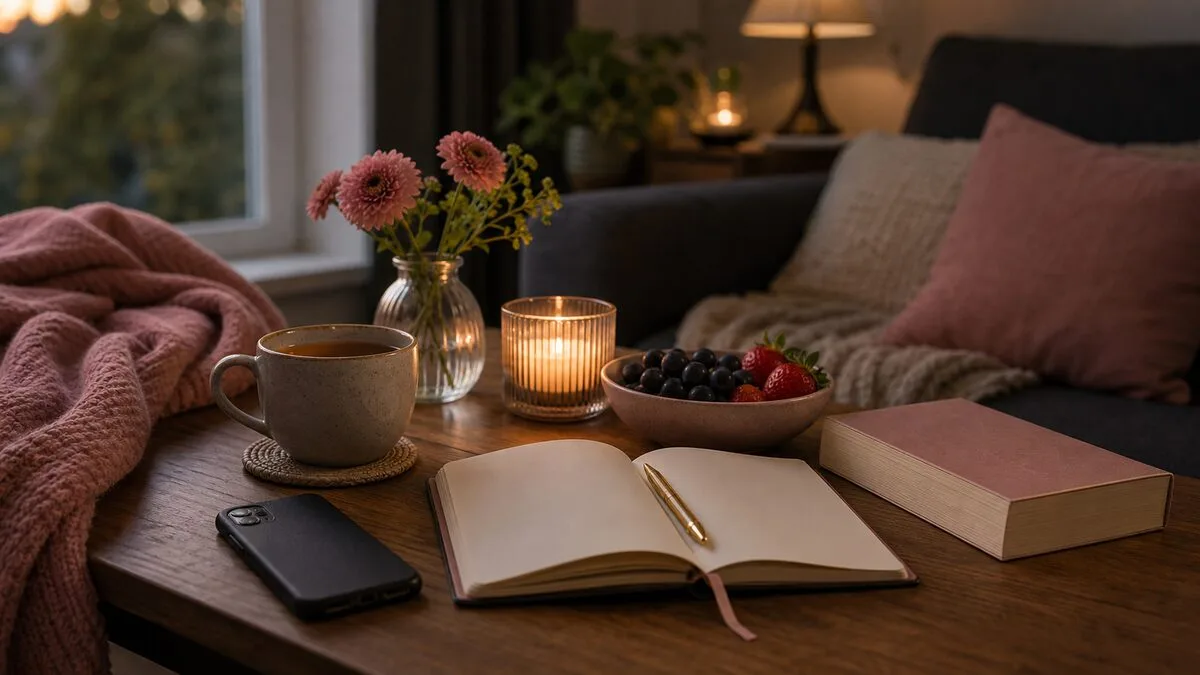
Putting the phone down works better when the replacement feels warmer. I trade the scroll for prep, a walk, or a book within reach.
Why most detoxes fail
A simple digital detox works when you replace the scroll with something warmer, not when you simply ban it. That's the whole secret, and it's why most detoxes fail. Framed as pure deprivation, you'll be back in the feed within twenty minutes, and you'll feel worse for the failed attempt on top of everything else.
I've done the dramatic version. The weekend with the phone in a drawer, the app deleted in a fit of resolve, the grand announcement. It never lasted. By Sunday night I'd reinstalled everything and binged twice as hard to make up for it.
The problem was never willpower. It was that I'd removed something my brain used for comfort and put nothing comforting in its place. A vacuum doesn't last. Something always rushes in to fill it, and if you haven't chosen what, the old habit wins by default.
So I stopped trying to quit and started trying to redirect. The phone fills a real need: rest, distraction, the small hit of novelty when you're bored or tired. Take that away and you have to meet the need another way, or you're just white-knuckling until you cave.
What I'm actually trying to fix
I want to be clear about the goal, because "digital detox" can mean anything from deleting all social media to throwing your phone in a lake. Mine is modest. I want my attention back at the edges of the day, the first hour and the last, and I want the scroll to be a thing I choose rather than a reflex I fall into.
I'm not anti-phone. My phone is genuinely useful and I'm not going to pretend a flip phone would make me a better person. What I'm against is the reflex: the way my hand reaches for it in any gap, any silence, any moment of mild discomfort, before I've even decided to.
That reflex is the thing worth softening. Not the device, the reflex. And reflexes change through environment and replacement, not through lectures to yourself at midnight.
The shame cycle that keeps you stuck
There's a particular loop I want to name, because naming it helped me break it. You scroll too long, you feel bad about scrolling, the bad feeling is uncomfortable, and the easiest way to escape an uncomfortable feeling is, you guessed it, to scroll. The shame about the habit feeds the habit. It's beautifully circular and completely self-defeating.
I got out of that loop by dropping the shame, not the phone. When I stopped treating an hour of scrolling as a moral failure and started treating it as a tired brain reaching for the nearest comfort, the heat went out of it. And without the heat, the escape-scroll lost its fuel.
This is the same gentleness I bring to food and rest. Self-punishment is a terrible engine for change. It feels productive, like you're taking the problem seriously, but mostly it just adds a second problem on top of the first. Curiosity works better than contempt, every time.
Notice what the scroll is really for
Before you can replace a habit you have to understand what job it's doing. For me, the scroll does several jobs in disguise. Sometimes it's rest, when I'm too tired to do anything that requires me. Sometimes it's avoidance, when there's a task or a feeling I don't want to face. Sometimes it's just transition, a way to mark the gap between two things.
Each of those jobs has a better tool. Tiredness wants actual rest, not the fake rest of a feed that leaves you more frazzled. Avoidance wants the thing faced, or at least named. Transition wants a small ritual, a cup of tea, a stretch, a step outside. Once I could see which job the scroll was doing in a given moment, I could often hand it to a better tool instead.
Owning fewer, better clothes helped more than I expected, which is why I built a proper capsule wardrobe.
It's the replacement, not the rule
If you take one idea from this, take this one: every screen-free border you draw needs a warmer thing waiting on the other side of it. The rule is the easy part. The replacement is what makes the rule survive contact with a tired Tuesday.
When I stopped scrolling in bed, I didn't just stop. I put a book on the nightstand, within reach in the dark, so the easiest thing to grab wasn't the phone anymore. When I stopped scrolling before dinner, I started chopping something instead, because prep is calming and the kitchen pulls me in. The border held because the alternative was right there and felt good.
You don't beat the scroll by wanting to. You beat it by making something warmer easier to reach.
This is the same logic that runs through my cozy home rituals: a lit candle, music from a speaker, something on the stove. Those aren't decoration. They're the warm things that make putting the phone down feel like a gain rather than a loss.
Why warmth beats discipline
Discipline runs out, usually around the time you most need it, late at night, when you're depleted. Warmth doesn't ask anything of you. A book by the bed requires no resolve to pick up. A walk you actually enjoy doesn't need to be forced. The whole game is to stack the deck so the better choice is also the easier one.
I learned this from food first. My approach to eating isn't about banning things, it's about making the good thing the convenient thing. Same brain, same trick, different screen. Make the better option the path of least resistance and you barely have to decide at all.
Friction in both directions
The apps are built to remove friction: one tap, infinite scroll, autoplay, the next thing loaded before you've finished the last. My whole strategy is to add a little friction back to the phone and remove friction from everything else. Make the scroll a few seconds harder to reach and the book a few seconds easier, and the balance tips on its own.
A few seconds doesn't sound like much, but it's the difference between a reflex and a choice. The reflex happens in under a second, before the thinking part of you wakes up. A few seconds of friction is just enough time for the thinking part to catch up and ask whether you actually wanted to do this. Often the honest answer is no.
So I bury the feeds and surface the alternatives. The book is on the arm of the sofa, not the shelf. The phone is in another room, not my pocket. The kettle is on, the candle's by the matches. Small frictions, stacked in the right directions, do most of the work that I used to expect willpower to do.
Three soft borders I keep
These are the three that have actually stuck for years. I call them soft borders because I cross them sometimes and the world doesn't end. They're defaults, not walls. A default you keep 90 percent of the time is worth far more than a wall you resent and eventually tear down.
- The phone lives on a hallway shelf overnight, not on the nightstand. It charges out there, away from the bed.
- The first hour of the day, no apps. Music is fine. A timer is fine. The feed is not.
- One evening a week, no scrolling at all, replaced by a cozy ritual I look forward to.
Why these three
They cover the moments when the phone does the most damage and gives the least back. Late at night, when one more video turns into an hour and worse sleep. First thing in the morning, when the feed sets an anxious tone before I've even stood up. And one protected evening, which proves to me each week that I can still entertain myself without a screen.
I didn't start with all three. I started with the overnight one, because it was the easiest and it improved my sleep almost immediately, which gave me the motivation to try the next. Stack them slowly. One border, made automatic, then the next, is how this works without becoming a project you abandon.
The morning hour, screen-free
If I could only keep one of the three borders, it would be the morning. The first hour sets the weather for the whole day, and handing it to the feed means starting tired, comparative, and slightly behind before I've done anything at all.
So the phone stays out in the hall, and the first hour is mine. I make coffee, I sit, I sometimes read, I sometimes just look out the window like a person from before the internet. It sounds precious written down. In practice it's just calm, and the calm carries surprisingly far into the day.
Most of how this works lives in my morning wellness habits piece, but the digital part is the simplest bit: don't bring the feed into the morning. Everything it has for you will still be there at nine. None of it needed you at seven.
The alarm problem, solved cheaply
The usual objection is "but my alarm is on my phone." Mine was too. A cheap, ugly little alarm clock fixed it for the price of a sandwich, and it's one of the best small purchases I've made. The phone charges in the hall, the clock wakes me up, and the reflex to check the feed in bed has nothing to grab.
That's the pattern with most of this. The friction is usually one small object or one small rearrangement away. You don't need an app to break a phone habit. You usually need a shelf and a clock.
What the morning gives back
The first week of protecting the morning, I felt slightly bored and a little twitchy, like I was missing something. By the second week, the twitch was gone and I'd started to guard the hour jealously. It turns out a slow, undisturbed start is something you can quickly come to need once you've felt it.
The concrete payoff is a steadier mood. When I open the feed first thing, I absorb a hundred small inputs (news, other people's wins, things to want, things to worry about) before I've formed a single thought of my own. The day starts reactive. When I don't, the day starts from somewhere inside me instead, and I'm far less jangled by lunchtime.
It also makes the morning longer. The same sixty minutes, given full attention, feels like ninety. That's the recurring lesson of all of this: attention is what makes time feel generous, and the feed is the single biggest thief of attention I let into my house.
Designing the phone to be boring
Rather than relying on willpower against a device engineered by very smart people to be irresistible, I've spent more effort making the phone itself less compelling. A boring phone is one you put down on your own.
- Notifications are nearly all off. The phone almost never lights up unasked. Almost nothing earns the right to interrupt me.
- The home screen has no feeds on it. The apps that scroll are buried in a folder, on a second page, so opening one is a deliberate act rather than a thumb-reflex.
- Greyscale, sometimes. When I want a stricter week, I turn the screen black and white. It's astonishing how much less a feed pulls when it isn't bright and colourful.
- Screen edges left empty. The thumb-reachable spots hold dull, useful things like the camera and notes, not the feeds.
None of this is about hating technology. It's about taking back the small design decisions the apps made for me, on purpose, to keep me scrolling. They engineered the pull. I'm just engineering a little resistance back.
It's worth remembering the asymmetry here. There are teams of clever people whose actual job is to keep you in the app a little longer. You are one tired person at the end of a long day. Willpower alone is a deeply unfair fight, and losing it doesn't mean you're weak. So I don't fight fair either. I change the environment, because the environment is the one part of the fight I actually control.
The reflex test
Here's a quiet little test I use. When I notice my hand reaching for the phone, I ask: am I reaching for something specific, or just reaching? If it's specific (a message to send, a thing to look up), fine, do it. If it's just reaching into a gap, that's the reflex, and I let the gap stay a gap.
The gaps are where life happens, honestly. Waiting for the kettle. The walk to the shop. The two minutes before a friend arrives. Those used to be scroll-time by default. Now they're just small empty moments, and I've come to like them. Boredom, it turns out, is mostly fine, and occasionally it's where the good ideas come from.
One app at a time, not a clean sweep
I never deleted everything at once. When one app was clearly costing me more than it gave, I'd move it off the phone for a fortnight and see what I actually missed. Usually the answer was: very little, and the bits I missed I could get on a laptop, deliberately, once a day. So it stayed off.
The ones I kept, I kept honestly, because they earn their place. Messaging with people I love. Music. The camera. I'm not interested in a pure phone, I'm interested in a useful one. The clean sweep is a tempting fantasy, but it tends to snap back. The slow, app-by-app edit is what actually held.
What to do instead of scrolling
This is the practical heart of it. A detox is only as strong as its replacements, so here's the actual list of warmer things I reach for, in roughly the order I reach for them.
- Cook, or prep something for later. Chopping is meditative and you end up with food. The meal prep habit eats a surprising amount of would-be scroll time.
- Walk, with no destination. Ten minutes outside resets more than ten minutes of feed ever did.
- Read a real book that lives within reach. The within-reach part is the whole trick.
- Sit with a cup of tea and do nothing. Genuinely nothing. This is harder than it sounds and worth practising.
- Call someone instead of scrolling past them. A five-minute call beats an hour of watching strangers' lives.
The common thread is that these are warmer and slower than the scroll, which is the entire point. They feed the same needs (rest, novelty, comfort) in a way that leaves me better rather than vaguely worse. This is where the digital detox quietly becomes the slow living routine, because the unhurried thing is usually the nourishing one.
The evening swap, in detail
My one no-scroll evening a week looks ordinary. Dinner cooked slowly, a candle, music from the speaker, a film or a book or a long meandering conversation. It's not a wellness ceremony. It's just an evening I'd have wanted anyway, with the phone deliberately out of the room so it can't quietly steal it from me.
Afterwards I always feel like the evening was longer than usual, which it wasn't. It just had my full attention in it, and attention is what makes time feel rich. That's the thing the scroll takes that you don't notice it taking: not the hours exactly, but the texture of them.
Replacements for the in-between moments
The big blocks are easy to fill. It's the small gaps that catch you out, the thirty seconds in a queue, the minute waiting for the lift, the dead time between tasks. Those are where the reflex pounces, and a book on the bedside table doesn't help in a supermarket queue.
For those, I keep a few tiny defaults. Look around and actually notice where I am. Take a breath, the slow kind. Think about the next thing I'm doing, or nothing at all. It feels absurdly small written down, but the alternative is feeding the reflex twenty times a day, and twenty fed reflexes is what keeps the whole habit alive.
The goal isn't to fill every gap with something productive. That's just trading one compulsion for another. The goal is to let some gaps stay empty, comfortably, so that being unstimulated for a minute stops feeling like an emergency to solve.
The honest caveats
I'm wary of the holier-than-thou tone that creeps into a lot of writing about this, so let me be straight about the limits.
I still use my phone a lot, and for good things. It's my camera, my map, my way of staying close to people far away, my music. I'm not detoxing from those, and you shouldn't either. The goal isn't less phone for its own sake. It's less mindless phone, at the edges where it costs the most.
I'm also not against the internet, obviously, you're reading me on it. I just want to be the one deciding when I'm here, rather than arriving by reflex and looking up an hour later wondering where the evening went. Intentional and on the internet is a perfectly good place to be. Pulled here against your own quiet wishes is the only part I'm trying to fix.
I also slip constantly. There are weeks the borders collapse, usually stressed or sad weeks, when the scroll is the easiest comfort to reach. I don't treat that as failure. I treat it as information: I'm depleted, and I reach for the phone when I'm depleted. The fix is rest, not self-flagellation. Then I just start the borders again, no penance required.
It's not a substitute for the real stuff
A digital detox won't fix loneliness, anxiety, or a life that's genuinely too full. Sometimes the scroll is a symptom, not the disease, and putting the phone down just leaves you alone with whatever you were avoiding. That's worth knowing going in.
When the reaching-for-the-phone feeling is really a reaching-for-comfort feeling, the kinder move is to meet the actual need: rest, connection, a walk, sometimes proper support. Some of that lives in my stress-relief rituals piece. The phone is often just the nearest exit from a feeling, and the feeling is the thing that actually wants tending.
It's harder if your work lives on the screen
I'll also own that my situation makes this easier than it is for some. If your job is on the phone, or you're a carer who has to stay reachable, or you're far from the people you love and the screen is how you see their faces, the borders look different and some of them won't apply.
In that case I'd aim the effort at the clearly optional scrolling, the feeds and the doom-reading, and leave the necessary stuff alone. A digital detox isn't about a number on a screen-time report. It's about the difference between the phone use that connects you to your life and the phone use that quietly drains it. Cut the drain, keep the connection. The report is nobody's business but yours.
A week you can actually try
If you want to start, don't do the dramatic version. Don't delete everything, don't announce it, don't aim for a perfect week. Do this small, boring, achievable thing instead, because the boring version is the one that lasts.
- Tonight: charge the phone somewhere that isn't your bedroom. Buy a cheap alarm clock if you need one.
- Tomorrow morning: don't open a single feed for the first hour. Music and the kettle only.
- This week: put a book where the phone used to be, by the bed and on the sofa.
- Pick one evening: no scrolling, replaced by something warm you'd enjoy anyway.
That's it. Four small moves, none of them heroic, none requiring you to hate technology or become a different person. Keep the ones that make your days feel calmer and quietly drop the ones that don't. This is a thing you tune, not a test you pass.
Give it two weeks before you judge it. The first few days will feel like something's missing, because something is, and then it won't, because you'll have something better in its place. That's the whole arc, and it's quicker than you'd think.
The aim was never a phone-free life. It was getting the edges of the day back, the first hour and the last, and turning the scroll from a reflex into a choice. After years of trying it the hard way, the soft way is the only one that's stuck. If you want to keep going from here, the everyday balance habits are the natural next read, because a calmer relationship with the phone is really just one corner of a calmer relationship with the whole week.
What to expect, week by week
Week one feels slightly empty and a bit twitchy. That's normal and it passes. You're not broken, you're just used to constant input, and a quiet mind takes a few days to feel comfortable again. Don't read the twitch as failure. Read it as withdrawal from a thing engineered to be habit-forming, which is exactly what it is.
By week two or three, the borders start to feel like relief rather than restriction. The morning hour becomes something you protect. The phone-in-the-hall becomes the obvious place for it to live. You stop counting and start just preferring it. That's the shift you're aiming for, from rule to preference, and once it lands it tends to stay.
If you fall off
You'll have weeks where it all collapses. A stressful stretch, a sad patch, a holiday where the routine dissolves. The scroll comes roaring back. This is not a relapse to feel ashamed of. It's just what tired people do, and you're allowed to be tired.
The whole system is designed to be picked back up without ceremony. There's no streak to mourn and no fresh start to wait for. You put the phone back in the hall tonight, you protect tomorrow morning, and you're back. The forgiveness built into that is, weirdly, the thing that makes it durable. A habit you can resume gently is a habit that survives a real life, and a real life is the only kind any of us are living.
Common questions
How long will this take, honestly?
The reading is 10 min. The practice is a lifetime. Start with one small piece this week and let the rest follow when it feels natural, not before.
Do I have to be fully plant-based for this to help?
No. Everything I write is for people who want a softer relationship with food and routine. The recipes happen to be plant-based; the ideas work in any kitchen.
What should I read next?
The related essays below, in order. If you only read one more thing, read Cozy home rituals that ground the day, it picks up exactly where this one ends.
Can I cite this guide somewhere?
Yes. Please link back to this page and credit Caleb Leuchi. All photographs are made for Leuchi unless noted; the writing is original.
Continue reading in this cluster
All lifestyle →
Lifestyle
Cozy home rituals that ground the day
Lifestyle
A slow living routine for modern days

Lifestyle
A minimalist vegan lifestyle that still feels warm

Lifestyle