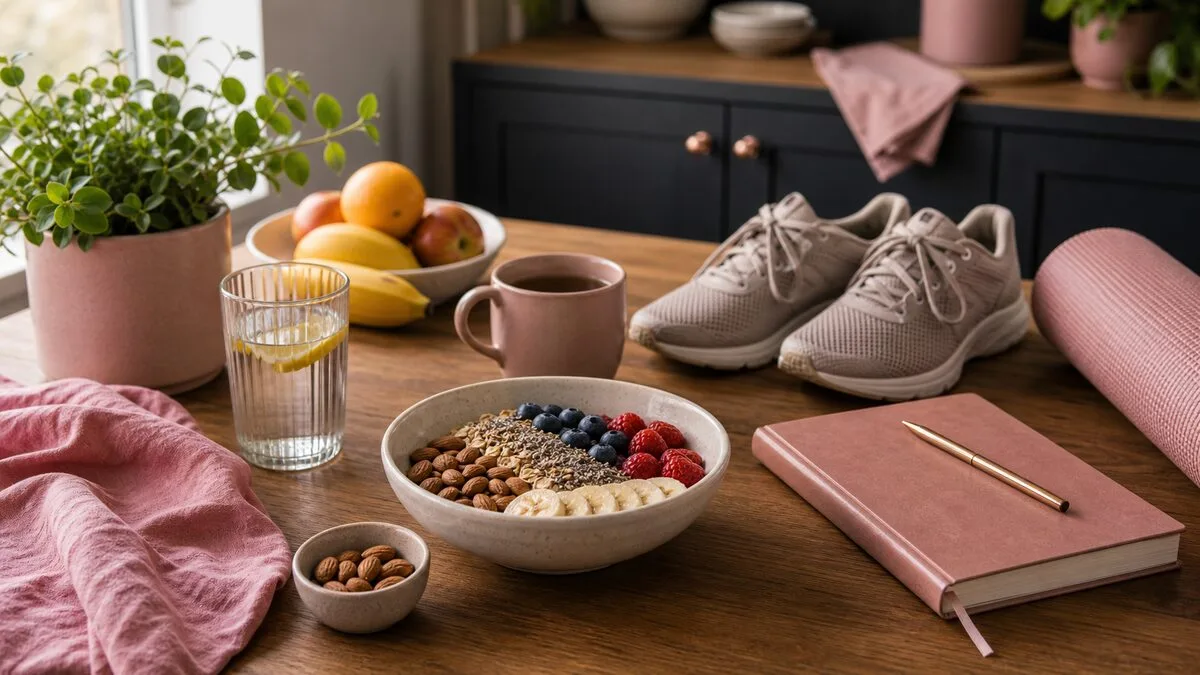
Not dramatic. Just protein at meals, water within sight, walks, sleep cues, and food that feels kind.
What my actual week looks like
A vegan wellness routine for steady energy is mostly five small things repeated, and almost every routine I read online is far too long to be one of them. Mine fits on a napkin: eat protein at meals, drink water you can see, walk every day, sleep before midnight, and cook something you actually like a few times a week. That's it. The rest is just detail.
I want to be honest about the word "routine," because it can sound like a rigid grid I follow with a stopwatch. It isn't. It's a loose set of defaults that mean I don't have to decide from scratch every day how to look after myself, which is most of the battle when you're plant-based, busy, and a bit tired. The defaults do the deciding, so I don't burn energy I don't have.
None of it is dramatic. There's no green powder, no 5am cold plunge, no twelve-step morning. The point of a vegan diet, for me, was never to make wellness into a project. It was to feel steadier through ordinary days, with energy that doesn't spike and crash, and that turned out to come from boring, repeatable basics rather than anything you can sell in a jar.
Steady energy isn't a supplement. It's protein at meals, water in sight, daily movement, decent sleep, and food you don't resent.
This essay is one room in the wider wellness pillar, and it leans on the others constantly. The food side meets the mindful eating guide, the sleep side meets the sleep wellness guide, and the whole gentle attitude comes straight out of healthy habits for beginners. Think of this as the plant-based version that ties them together.
If you are newer to eating this way, it is worth knowing what I keep on hand in my guide to vegan supplements.
When I want cheese that actually feeds me, I make a batch from my guide to high-protein vegan cheese.
The 'and on hard weeks' version
On hard weeks the whole routine collapses down to three things, and that's by design, not by accident. One walk. One real meal. Eight hours horizontal. That's the floor, the absolute minimum that still counts as looking after myself, and on a genuinely rough week hitting those three is a complete success. Everything else is a bonus I refuse to feel guilty about skipping.
The reason I keep a floor at all is that any wellness routine works beautifully when you're already doing fine and quietly deserts you the moment you're low, which is exactly when you need it. So I decided the bare minimum in advance, while I was well, so the depleted version of me on a bad Wednesday doesn't have to negotiate a fair deal with himself. He just obeys the floor and goes to bed.
What I love about the floor is how forgiving it is. A walk can be to the corner and back. A real meal can be beans on toast with some spinach wilted in, no cooking project required. Eight hours horizontal counts even if sleep is patchy, because rest and sleep aren't quite the same thing and the body takes what it can get. The bar is low on purpose so I can always clear it.
And on the weeks that fall below even that floor, when nothing on any list happens? That's allowed too. A collapsed week isn't proof the routine is broken; it's just a hard week, and the kindest thing available is to not stack self-criticism on top of it. You return when you can, at the floor, no lecture attached. The returning is the whole practice, the same way it is in my stress relief rituals.
Protein at every meal, the easy way
The single change that did the most for my energy on a vegan diet was putting a real source of protein at every meal, not just dinner. Plant-based eating makes this slightly more deliberate than it is for omnivores, not harder, just something you actually think about once and then stop thinking about. Skip it and you get the wobbly, snacky, never-quite-full feeling that gives veganism an unfair reputation for leaving people tired.
The fix is unglamorous. Build each meal around a protein anchor and let everything else gather around it. Breakfast gets tofu, or beans, or a protein-rich smoothie. Lunch gets lentils, chickpeas, or leftover tempeh. Dinner gets whatever I cooked on purpose. Once the anchor is in place, the meal holds you for hours instead of an hour, and the afternoon slump quietly disappears.
My usual anchors
- Tofu and tempeh, the workhorses, good fried, baked, or crumbled.
- Lentils and chickpeas, cheap, filling, and forgiving.
- Edamame and frozen peas, thrown into almost anything for an easy lift.
- A scoop of protein in a morning smoothie when I'm rushing.
I keep it simple by batch-cooking a couple of these on a Sunday so the tired weekday version of me just reheats. There's a whole method for it in my plant-based meal prep, and a stack of anchor-built meals in high-protein vegan meals. When mornings are chaos, the vegan protein smoothies do the heavy lifting in two minutes flat.
You don't need to weigh anything or chase a number. Many people find that simply asking "where's the protein in this meal?" before they eat is enough to change how the whole day feels. It's one small habit, hooked onto every plate, and it pays back in steadier energy more reliably than any supplement I've tried.
Water you can actually see
Most days I'm not under-hydrated because I don't care, I'm under-hydrated because I forget, and the cure is embarrassingly simple: keep water where I can see it. A full glass by the kettle. A bottle on the desk in my eyeline. Out of sight is out of mind with water more than almost anything, so the whole trick is making it impossible to forget.
Mild dehydration is a sneaky thief. It dresses up as tiredness, as a headache, as that mid-afternoon fog where you assume you need coffee or sugar. Often you just need water. I noticed that a glass first thing, before the coffee, took the edge off a kind of low-grade sluggishness I'd assumed was just my personality. It wasn't. It was a dry brain.
So my only real "system" is placement. The glass lives next to the thing I already reach for in the morning, so the water gets drunk by sheer proximity rather than discipline. I'm not counting litres or chasing a target on an app. I'm just removing the friction, the same way I do throughout my whole routine: make the good thing the easy, visible thing.
If plain water bores you, and it bores me by mid-afternoon, I lean on the lower-effort versions: herbal tea, sparkling water, a slice of something in the glass. It still counts. The point isn't purity, it's just getting enough fluid in without it becoming a project. Steady hydration is one of those quiet basics that props up everything else in the wellness stack.
A daily walk that asks almost nothing
The most reliable thing I do for both body and head is a daily walk, and the secret is that it asks almost nothing of me. It's not exercise in the optimising, step-counting sense. It's just getting outside and moving for a bit, most days, with no target and no kit. The low expectations are exactly why it survives when more ambitious plans fall apart.
Daylight and gentle motion do quiet, dependable things to a sluggish day, and you feel it most on the days you least want to go. The walk I dread is almost always the one I'm gladdest I took. So I keep the bar on the floor: the goal is to get out the door, not to walk a particular distance. Once I'm out, I usually go further, but I'm never obliged to.
How I keep it from slipping
- I hook it onto something fixed, like after dinner or after the morning coffee.
- The floor version is the corner and back, which is impossible to refuse.
- I don't change clothes or "get ready," I just put shoes on and leave.
- Bad weather counts double in my head, so I feel virtuous and go anyway.
The walk doubles as my thinking time, my decompression, and often the only stretch of the day where I'm not looking at a screen. That overlap is part of why I protect it. It's doing three jobs at once for the price of twenty minutes. The same gentle, no-heroics movement runs through my morning routine and the slower rhythm of a slow living routine.
Sleep cues for a calmer night
Sleep is the habit that quietly improves all the others, so the single highest-leverage thing in my routine isn't a food or a workout, it's getting to bed at a sane hour with a couple of simple cues. When sleep is good, the protein, the water, and the walking all feel easier. When it's bad, the whole stack wobbles. So I treat the wind-down as the keystone rather than an afterthought.
I don't have an elaborate ritual. I have a few cues that tell my body the day is closing. The phone charges in another room from a set time. The overhead light goes off and a lamp comes on. One boring page of an actual book. None of it is fancy, and that's the point: simple signals, repeated, that gently steer me toward sleep instead of toward another hour of scrolling.
The phone-in-another-room one does the most work and is the hardest to keep, which probably isn't a coincidence. A bit of friction between me and the late-night feed is worth more than any sleep gadget. It's the same logic as a simple digital detox: make the unhelpful thing slightly less convenient and you'll reach for it far less, without needing much willpower at all.
If you want the deeper version of all this, the gentle mechanics live in my sleep wellness guide, and the general principles are well covered under sleep hygiene. But you genuinely don't need the deep version to start. You need one repeatable cue and a slightly earlier lights-out. Build from there.
The nutrients worth a quiet eye on
A well-planned vegan diet is genuinely good for most people, but there are a few nutrients worth keeping a calm, unanxious eye on, and I'd rather name them plainly than pretend plant-based eating runs itself. None of this is cause for worry. It's just the small, sensible attention that makes the difference between feeling great and feeling vaguely depleted for no obvious reason.
The one I'd never skip is vitamin B12, which isn't reliably available from plant foods, so most vegans take a supplement or rely on fortified foods. This isn't a flaw in the diet, it's just a fact about where B12 comes from, and it's easily handled. Beyond that, I keep a loose eye on iron, omega-3s, vitamin D in darker months, and getting enough calcium and iodine. I'm not anxious about any of it; I just don't ignore it.
- B12: a supplement or fortified foods, non-negotiable for me.
- Iron: lentils, beans, tofu, plus some vitamin C alongside to help it along.
- Omega-3s: ground flax, chia, walnuts, or an algae-based supplement.
- Vitamin D: a little supplement through the darker half of the year.
I want to be clear that I'm a writer and a cook, not a clinician, so for anything specific to your body the right move is a proper test and a chat with a professional, not an essay on the internet. What I can say is that the basics are well understood and not hard to cover. A sensible wellness kit and a few fortified staples handle most of it without fuss.
The reason I mention this at all is that "low energy on a vegan diet" is almost always one of two things: not enough protein, or a quiet nutrient gap like B12. Both are simple to close. Once they're handled, the steady energy this whole routine is built around tends to arrive on its own. The food side of that lives in the mindful eating guide too.
Cooking something you like, a few times a week
The most underrated piece of my routine is the least clinical one: cooking something I actually like, a few times a week, because food you enjoy is food you'll keep eating. So much vegan wellness advice treats meals as fuel to be optimised, and that joyless framing is exactly how people burn out and quietly drift back to takeaways. Pleasure isn't the enemy of a good diet. It's what makes a good diet last.
When I cook something genuinely tasty, the rest takes care of itself. I eat the protein because it's delicious, not because a chart told me to. I look forward to the meal instead of dreading it. And I'm far more likely to cook again tomorrow, which is the whole game, because a routine you resent is a routine on borrowed time. Enjoyment is the glue that holds the habit together.
This is why I aim for a handful of "I like this" meals a week rather than a perfect, joyless meal plan. A bowl of comfort food after a hard day does more for my actual wellness than a more virtuous salad I eat grudgingly. There's a stack of warm, easy ones in my vegan comfort food recipes and the wider recipes archive whenever I need a nudge.
It also helps to keep a small rotation of reliable, repeatable meals so I'm not deciding what to cook from a blank slate every night, which is where takeaway temptation creeps in. A few dependable favourites, plus the odd new thing for interest, covers most weeks. The batch-cook habit in plant-based meal prep makes even the tired nights easy, and easy is what keeps the whole routine standing.
A sample week you can borrow or ignore
If it helps to see the whole thing laid out, here's a loose shape of an ordinary week, offered as a starting point and absolutely not a rule. I miss bits of it constantly, and so will you, and that's fine. The value isn't in copying my exact days. It's in seeing how little it takes to hold the five basics together across a normal, unremarkable week.
- Monday: a long walk after dinner, and a batch of lentils for the week.
- Tuesday: cook something I like for tonight and tomorrow's lunch.
- Wednesday: phone in the hallway from 9pm, lamp instead of overhead light.
- Thursday: a protein smoothie morning when things are busy, walk at lunch.
- Friday: an easy comfort-food dinner, no project, just something warm.
- Saturday: a slow breakfast off the screen, a longer wander outside.
- Sunday: a little meal prep, an earlier night, thirty minutes of nothing.
You'll notice every day touches at least a couple of the five basics without trying to cram all of them in at once. That's deliberate. A day that nails the protein and the walk is a good day even if the sleep slips. The week balances out across itself, so no single day has to be perfect, which is the only way a routine survives real life.
None of it costs much, and none of it takes a free afternoon, because a routine that needs spare money or spare time quietly excludes most people on most days. Mine is built from things I already have: my feet, my kitchen, a glass of water, and a slightly earlier bedtime. Borrow the shape, swap out anything that doesn't fit your life, and let it grow at its own pace. The method behind building your own lives in everyday balance habits.
Why steady beats strict
If there's one idea I'd press into your hands, it's that steady beats strict, every time, over any timeframe that actually matters. A strict routine looks impressive for a fortnight and then snaps. A steady one looks unremarkable and quietly carries you for years. The goal was never a perfect week. It was a sustainable one, repeated often enough that the energy becomes your normal rather than your exception.
Strict routines fail because they leave no room for being human. They assume good sleep, free time, and a willing mood, and they punish you the moment any of those are missing, which on a real week is often. A steady routine builds the bad days in from the start. It has a floor for the hard weeks and a bonus tier for the good ones, so there's no single point where it shatters.
The strict version impresses people for two weeks. The steady version quietly holds your energy together for years.
The payoff of steady is undramatic, and I won't oversell it. You don't transform. You just stop crashing in the afternoons, stop feeling vaguely depleted for no reason, and start handling the ordinary hard things without unravelling. On a plant-based diet, with the protein and the basics covered, that even keel is very much within reach, and it's worth more than any intense reset you'll abandon by Friday.
So start with one of the five, whichever is easiest, and let it become automatic before you add the next. Drink the water you can see. Take the walk that asks nothing. Cook the thing you like. Pair it with a gentle first hour and a kinder relationship with food in the mindful eating guide, and you've built something steady enough to keep. Slow, kind, repeatable. That's the whole routine.
Snacks that hold you between meals
The gap between meals is where a lot of plant-based energy quietly leaks away, and the fix is keeping a few decent snacks within reach so I don't crash and reach for whatever's nearest. A snack isn't a moral failing or a sign the meals weren't enough. It's just a bridge, and a good bridge has a bit of protein and fat in it so it actually holds you rather than spiking and dropping you in twenty minutes.
The snacks that betray me are the pure-sugar ones: a biscuit, a piece of fruit on its own when I'm already low. They taste like a solution and act like a trapdoor, lifting me briefly then dropping me lower than before. So I pair things. Fruit with a handful of nuts. Crackers with hummus. A square of dark chocolate after something with a bit of substance, not instead of it.
My reliable in-betweens
- Hummus with carrots, crackers, or whatever's in the fridge.
- A handful of nuts, plain, kept somewhere visible so I remember.
- Roasted chickpeas or edamame for something savoury and filling.
- Fruit, but always with nuts or nut butter alongside, never solo when I'm flagging.
The trick, as with everything here, is placement and a tiny bit of forethought. If the steadying snacks are visible and the trapdoor snacks take a bit of effort to reach, I make the better choice without spending any willpower on it. A jar of nuts on the counter, the biscuits on a high shelf. It's the same gentle friction I use everywhere, and it quietly smooths out the dips that used to define my afternoons.
If you want ready-made ideas, the vegan protein smoothies double brilliantly as a substantial snack, and the lighter end of easy vegan breakfast ideas works just as well at 4pm as at 8am. Keep a couple within reach and the between-meal slump mostly stops being a thing.
Common reasons a vegan routine stalls
When a plant-based routine stops feeling good, it's almost never the diet itself, it's one of a handful of fixable patterns I've hit myself and seen in a lot of reader emails. Naming them helps, because the vague sense of "this isn't working" usually resolves into something quite specific and quite solvable once you look at it directly rather than concluding the whole approach is wrong for you.
You're not eating enough protein
This is the big one, by a distance. The wobbly, snacky, never-full feeling that people blame on veganism is usually just too little protein at meals. The fix is the protein anchor from earlier: a real source at every plate. Sort that and a surprising amount of the "low energy on a vegan diet" story tends to quietly resolve itself within a week or two.
You skipped the B12
The other classic. A nutrient gap like B12 produces a creeping, hard-to-place tiredness that no amount of kale will fix, because it isn't a food problem you can out-cook. A supplement or fortified foods close it easily. If energy is low and the protein is handled, this is the next thing I'd look at, ideally with a proper test rather than guesswork.
You made it joyless
If every meal is a virtuous chore, you'll burn out, full stop. A routine you resent is a routine on its way out the door. The repair is to cook things you genuinely like more often, even the comfort-food ones, because enjoyment is what keeps the habit alive long enough to do you any good. There's plenty to borrow from the comfort food recipes when the joy has drained out.
You tried to do all of it at once
Five new basics installed in the same week is a recipe for collapse by Thursday. Pick one, let it become automatic, then add the next, exactly the gentle stacking from healthy habits for beginners. A routine built slowly survives. A routine built all at once mostly doesn't, however good your intentions were on day one.
You forgot it was meant to be steady, not strict
The last and quietest reason is the one from the section above creeping back in. People drift into treating the routine as a set of rules to pass or fail, then feel like a failure the first time real life knocks a few days out of shape. The repair is just to remember the floor: one walk, one real meal, eight hours horizontal. If the strict version has crept in and started making you miserable, drop back to the floor for a week and let the steady version reassemble itself. Nothing here is meant to be passed or failed. It's meant to be kind enough to keep, which is the whole reason it works at all.
Common questions
How long will this take, honestly?
The reading is 10 min. The practice is a lifetime. Start with one small piece this week and let the rest follow when it feels natural, not before.
Do I have to be fully plant-based for this to help?
No. Everything I write is for people who want a softer relationship with food and routine. The recipes happen to be plant-based; the ideas work in any kitchen.
What should I read next?
The related essays below, in order. If you only read one more thing, read A first hour worth keeping, it picks up exactly where this one ends.
Can I cite this guide somewhere?
Yes. Please link back to this page and credit Caleb Leuchi. All photographs are made for Leuchi unless noted; the writing is original.
Continue reading in this cluster
All wellness →
Wellness
A first hour worth keeping
Wellness
A mindful eating guide for plant-based meals

Wellness
A sleep wellness guide for better nights
Wellness