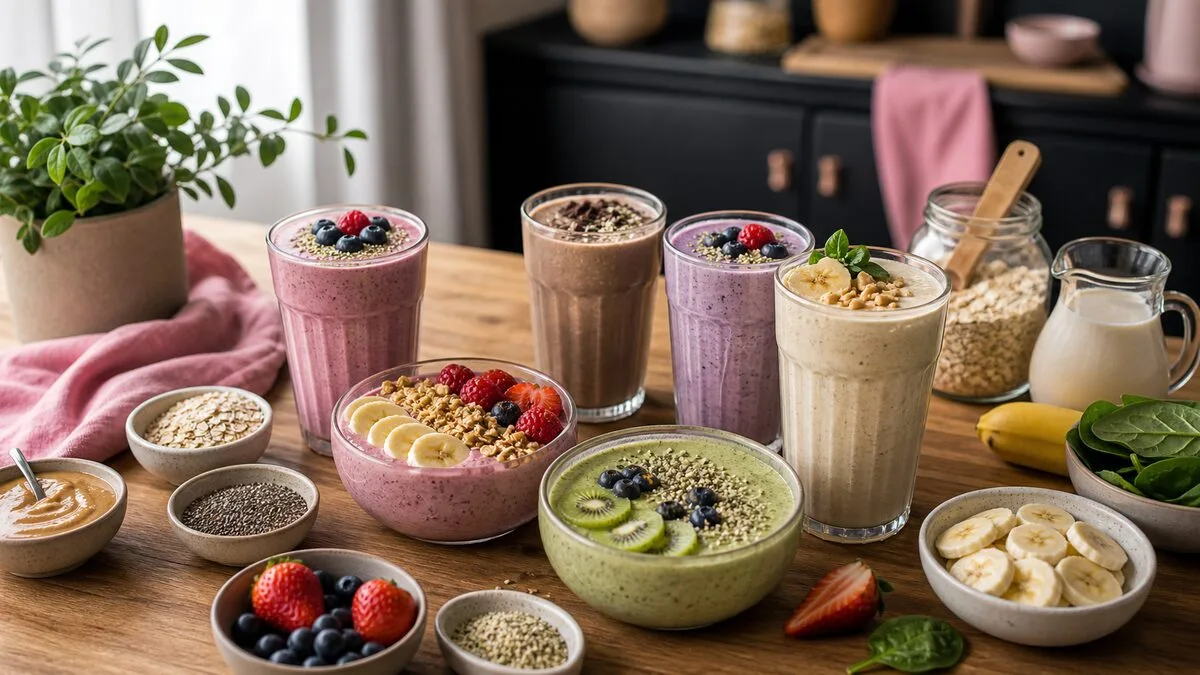
A smoothie should not leave you hungry in an hour. Mine has protein, fiber, fat, and one flavour I'm actually excited about.
The formula that finally worked
For a long time I drank smoothies like dessert, frozen fruit, juice, maybe a banana, and then ate three breakfasts because I was hungry by 10am. The version I drink now is closer to a built plate: there's protein, fiber, fat, and one ingredient I genuinely like.
You're going to swap things constantly. The formula is the part to keep. Master the structure and you can build a satisfying smoothie out of whatever's in the fridge, without ever measuring or following a recipe again.
This piece is everything I worked out the hard way, why the fruit-and-juice version left me starving, how much protein actually makes a difference, which plant proteins are worth your money, the fat and fiber that turn a drink into a meal, and the texture tricks that separate a good smoothie from a gritty disappointment. The recipe card lower down has my exact go-to. Everything around it is the thinking.
On the mornings I have three soft bananas going dark, they turn into a loaf of easy vegan banana bread before lunch.
When I want something sweet without much fuss, I blend up my fudgy chickpea brownie recipe.
When I want my first meal to actually hold me, I work from my high-protein vegan breakfast recipes.
When I want the week handled in one calm session, I follow my step-by-step method for vegan meal prep for the week.
Why was I always hungry an hour later?
I was hungry an hour later because my smoothies were basically liquid sugar, fast carbohydrate with nothing to slow it down. Fruit and juice spike your blood sugar, it crashes just as fast, and your body comes knocking for more food almost immediately. There was no protein, no fat, and barely any fiber to keep me full.
A smoothie can be a genuine meal or it can be a sweet drink pretending to be one. The difference is entirely structural. A glass of blended fruit is delicious and has its place, but it digests in minutes and leaves nothing behind. That's fine as a treat and useless as breakfast.
What changed everything was treating the smoothie like a plate of food I happened to drink. A real meal has protein, fat, fiber, and some carbohydrate. Once I started building my smoothies with all four, the mid-morning hunger simply stopped. Same convenience, same four minutes, completely different afternoon.
A smoothie that leaves you hungry isn't a small smoothie. It's a smoothie missing three of the four things a meal needs.
That reframe is the whole article in one idea. Stop thinking "fruit drink," start thinking "drinkable meal," and build accordingly. The fruit becomes the flavour, not the foundation. Everything below is just the detail of how to do that well.
Build it in this order
Order matters more than people think. Liquid first protects your blender's blades and gets things moving; the heavy frozen bits last stops them jamming at the bottom. Here's the sequence I use every single time.
- Liquid (300ml soy milk, oat, or water plus half a frozen banana)
- Protein (one heaped scoop of pea or soy isolate, around 20g)
- Fat (one tablespoon almond butter, or a small handful of cashews)
- Fiber (two tablespoons rolled oats or chia)
- Flavour (frozen berries, cocoa, espresso, vanilla, or miso, yes, miso)
- Blend until it almost stalls. That thick, the-motor-changes-pitch moment is the texture you want.
Each slot is a category, not a fixed ingredient. The liquid can be any plant milk or water. The protein can be powder, silken tofu, or a generous scoop of nut butter doing double duty. The fiber can be oats, chia, flax, or a handful of greens. Keep the five slots filled and the smoothie will satisfy, no matter what you put in them.
I think of it the same way I think about building a bowl in plant-based meal prep without the pressure: a base, a protein, a fat, a flavour. The container changes from bowl to glass, but the logic of a balanced meal doesn't.
How much protein do you actually need?
The honest answer is that a single smoothie doesn't need to hit some big number, it needs to contribute a real chunk toward your day. I aim for around 20 to 30 grams in a meal-replacement smoothie, which is roughly what a proper breakfast would give you, and that's plenty to keep hunger away until lunch.
Most adults do well somewhere in the range of 0.8 to 1.2 grams of protein per kilogram of body weight a day, more if you're very active. You don't need to track it obsessively. The point of a protein smoothie is to make one of your meals carry its weight, so you're not relying on snacks to make up a shortfall later. There's a balanced overview at the protein entry if you want the science.
Where does the 20-plus grams come from? A scoop of pea or soy isolate is usually 15 to 20 on its own. A tablespoon of nut butter adds three or four. Oats and soy milk chip in a couple more. Stack a few sources and you're comfortably there without anything tasting like a supplement.
One thing worth knowing: plant proteins vary in their amino acid profiles, so mixing sources (say, pea plus the soy milk plus the oats) gives you a more complete spread than relying on a single one. You don't need to engineer this carefully. Just varying what you use across the week does it naturally, and I go deeper on combining plant proteins in high-protein vegan meals for real life.
Choosing a plant protein you'll enjoy
The best protein powder is the one you'll actually drink, so flavour and texture matter as much as the numbers on the tub. I've poured a lot of grim, chalky smoothies down the sink over the years. Here's what I've learned about the main options.
Pea protein
My everyday choice. It's neutral, blends smooth, and doesn't have a strong taste once there's fruit and nut butter around it. The cheaper ones can be a touch gritty, so it's worth trying a couple of brands. It's my default for the plain berry smoothie.
Soy protein
The most complete plant protein, with a full amino acid profile, and it makes a creamy smoothie. It has a slightly beanier note than pea, which disappears entirely behind cocoa or coffee. Good value, too.
No powder at all
You can skip the tub entirely. Silken tofu blends into a smoothie completely undetectably and adds real protein plus a luxurious creaminess. A big spoon of nut butter, a handful of nuts, or a couple of tablespoons of hemp seeds all push the protein up the natural way. Some of my favourite smoothies have no powder in them at all.
If you do buy powder, get an unsweetened or lightly sweetened one. The heavily flavoured tubs are cloying once you add fruit, and they take the control away from you. You want to be the one deciding how sweet the glass ends up.
The fat and fiber that make it a meal
Protein gets all the attention, but fat and fiber are what actually keep you full, and they're the two things missing from almost every disappointing smoothie. They slow everything down, which is exactly what turns a quick sugar hit into steady, hours-long fuel.
Fat is easy and delicious. A tablespoon of almond or peanut butter, a small handful of cashews or walnuts, a spoon of tahini, half an avocado, or a splash of coconut milk. Any of these adds richness and that satisfying mouth-coating quality that makes a smoothie feel like a treat rather than a chore. Don't fear it, fat is half the reason the drink satisfies.
Fiber comes from oats, chia, flax, or vegetables. Two tablespoons of rolled oats blend in smoothly and add body and slow-release carbohydrate. Chia and flax bring fiber plus omega-3s, and they thicken the drink as they sit. A handful of spinach or kale disappears into a darker smoothie and you genuinely won't taste it behind banana and cocoa.
Get all three (protein, fat, fiber) into the glass and the smoothie stops being a snack and becomes a meal that holds. Skip them and you're back to the sweet drink that leaves you rummaging in the cupboard by mid-morning. The four minutes of blending are the same either way; the difference is entirely in what you put in.
Three I keep coming back to
Here are the three I make on rotation, each balanced across the formula, each one I genuinely look forward to. Treat them as starting points and swap freely once you've got the idea.
Berry oat, plain
Soy milk, pea protein, almond butter, oats, frozen blueberries, a pinch of salt. Tastes like a milkshake at 7am, and the salt is what makes the berries taste more like themselves. My most-made by a mile.
Coffee chocolate
Oat milk, soy protein, cashews, oats, cold espresso, cocoa, half a date. Make it the morning before a long walk. It's basically a frappe that happens to be a balanced breakfast, and the date sweetens it without any refined sugar.
Green, but warm
Oat milk, pea protein, tahini, banana, spinach, cinnamon, a pinch of salt. Don't add ice, let the frozen banana do the chilling. The cinnamon makes the green taste cosy rather than grassy, which is the trick to a green smoothie you'll actually want.
None of these are precious. The salt and the cinnamon are the two seasonings I'd never skip, they do for a smoothie what they do for any dish, which is make everything taste more like itself.
If you want a fourth, try a mango-ginger one in summer: oat milk, soy protein, frozen mango, a small knob of fresh ginger, a squeeze of lime, and a spoon of cashew butter. It's bright and warming at once, and it proves the formula travels well beyond berries and chocolate. Once you trust the structure, the flavours are wide open, and that's the part that keeps a daily habit from getting dull.
Getting the texture you actually want
Texture is the thing that quietly ruins more smoothies than flavour ever does. Too thin and it feels like a drink you'll be hungry after; too thick and you're chewing it with a spoon; gritty and you'll never make it again. Here's how I hit thick-but-pourable every time.
Frozen fruit, not ice, is the single biggest lever. Ice waters the drink down as it melts and dulls the flavour. Frozen banana, frozen berries, or frozen cubes of leftover smoothie chill and thicken without diluting anything. I keep peeled, frozen banana chunks in the freezer permanently for exactly this.
For thickness, frozen banana and oats are your friends; a few extra oats or a spoon of chia (left a minute to swell) will thicken a thin smoothie fast. To loosen one that's too thick, just add liquid a splash at a time while it blends. And blend longer than you think, the difference between gritty and silky is often another thirty seconds of patience.
If grittiness is your problem, it's usually the protein powder or under-soaked nuts or oats. A more powerful blender helps, but soaking the oats and nuts in the liquid for a few minutes before blending fixes a lot. The drink should pour slowly and coat the glass. That's the target.
Troubleshooting a bad smoothie
A few quick fixes for the usual disappointments, so a bad glass becomes a one-time thing rather than a reason to give up on the whole idea.
It tastes chalky or like a supplement
Too much powder, or a harshly flavoured one. Cut the powder back and lean on nut butter and fruit for body. A pinch of salt and a squeeze of acid (a little lemon) also push the chalkiness into the background.
It's too sweet
You've over-fruited it. Pull back the banana and dates, add more liquid, oats, or a pinch of salt. Salt counterintuitively makes an over-sweet drink taste balanced rather than just sugary.
It left me hungry anyway
You're light on protein, fat, or fiber. Add a spoon of nut butter and a scoop more protein. Hunger an hour later is almost always a structure problem, not a portion problem.
It separated while I drank it
Normal, especially with chia or oats. Give it a stir, or drink it a bit faster. A thicker smoothie holds together longer if you're sipping slowly at a desk.
Make-ahead, freezer packs, and waste
The thing that made smoothies a daily habit rather than an occasional faff was prepping them ahead, and it takes almost no effort. A little Sunday assembly means a four-minute breakfast every weekday with no decisions to make when I'm half awake.
Freezer packs are the move. Portion the dry, freezable bits (banana chunks, berries, oats, a spoon of nut butter, the greens) into bags or jars and freeze them. In the morning you tip a pack into the blender, add liquid and protein, and blend. It feels like cheating. It's just thinking ahead.
This is also a brilliant way to rescue fruit before it turns. Bananas going spotty, berries about to go soft, a half-bag of spinach wilting in the drawer, all of it goes into a freezer pack instead of the bin. Smoothies have cut my fruit waste to almost nothing, which is a quiet win I didn't expect.
A blended smoothie keeps in the fridge for a day if you fill the container to the top to limit air, though it's best fresh and may need a stir. For the freezer-pack system and the wider waste-saving habits, it all sits inside the same gentle, low-waste kitchen I describe in a vegan wellness routine for steady energy.
A drink that finally holds me to lunch
The whole journey here was from a sweet drink that left me starving to a meal I happen to drink that holds me clean through to lunch. The change wasn't a fancy ingredient or a special blender. It was understanding that a smoothie is a meal, and building it like one.
Keep the five-slot formula, lean on frozen fruit over ice, season with salt, and make sure protein, fat, and fiber are all in the glass. Do that and you've got a four-minute breakfast that does the job of a proper plate. Everything else, the specific fruit, the powder, the flavour, is yours to play with endlessly.
I still drink the plain berry one most mornings, the same one in the recipe card below. It's not exciting and that's the point: it's reliable, it's quick, and it means I don't think about food again until I'm genuinely ready for lunch. If you want the broader picture of building real meals around plant protein, that's the thread in high-protein vegan meals for real life. But honestly, a good smoothie is the easiest first step there is. Start there tomorrow morning.
Add-ins worth bothering with (and ones that aren't)
The wellness aisle is full of powders promising the earth, and most of them are an expensive way to colour your smoothie. A few add-ins genuinely earn their place. Most don't. Here's my honest sorting of the ones I've actually tried.
Worth it: ground flax and chia, for real fiber and omega-3s at pennies a spoon. Cocoa powder, for flavour and a little antioxidant bonus. Hemp seeds, for protein and a pleasant nuttiness. A pinch of salt, which costs nothing and improves everything. Frozen spinach, for nutrients you genuinely won't taste.
Probably not worth it: the pricey "superfood" blends, most of which you'd need to eat in far larger quantities than a smoothie holds to notice anything. A spoon of açaí powder colours the drink beautifully and does little else for the money. If you enjoy them, fine, but don't believe they're doing heavy nutritional lifting in the amounts you're using.
My rule is simple: an add-in has to bring flavour, texture, or a meaningful amount of a real nutrient (protein, fiber, fat). If it only brings a marketing claim and a colour, it stays on the shelf. The smoothie's job is to feed you, not to make you feel like you bought wellness. Whole ingredients beat expensive powders almost every time, and they taste better too.
Sweetness, and how little you actually need
Once you've got fruit in a smoothie, you usually need no added sweetener at all, and that surprised me. A ripe banana and a cup of berries bring plenty. The drinks that taste like dessert are nearly always overdoing it, and your palate adjusts faster than you'd think.
When I do want a touch more, I reach for whole-food sweeteners that bring something besides sugar. Half a date adds caramel depth and fiber. A spoon of maple has a flavour of its own. A very ripe banana is sweeter than a firm one, so freezing them at their peak does double duty. These beat refined sugar or syrups that only add sweetness and nothing else.
The salt trick is worth repeating here, because it's the thing most people miss. A tiny pinch of salt makes a smoothie taste sweeter and more rounded without any extra sugar. It's the same principle as salting caramel or a fruit crumble. Try one smoothie with a pinch and one without, side by side, and you'll never skip it again.
If your smoothie habit started as a way to eat more healthily, getting the sweetness down is one of the easiest wins. A meal-replacement smoothie really shouldn't taste like a milkshake from a chain. Aim for "pleasant and balanced," let the fruit do the sweetening, and lean on salt and spice for the rest. Your afternoon energy will thank you for it.
Turning it into a smoothie bowl
Some mornings I want to chew my breakfast rather than drink it, and the same formula makes a brilliant smoothie bowl with one small change. It's the same nutrition, just thicker and eaten with a spoon and toppings, which makes it feel like more of an occasion.
The only trick is to make it much thicker than a drinkable smoothie. Use less liquid, more frozen fruit, and let the blender work harder, stopping to scrape down the sides. You want it the consistency of soft-serve, thick enough to hold a spoon upright for a second. Frozen banana is essential here; it's what gives that ice-cream texture.
Then the fun part: toppings. Granola for crunch, fresh fruit, a scatter of seeds or nuts, a drizzle of nut butter, a few cacao nibs or coconut flakes. The toppings add texture the smooth base lacks, which is half the pleasure. They also add a little more protein and fat, so the bowl holds you just as well as the drink.
A smoothie bowl is the same balanced meal dressed up for a slower morning. I make them at weekends when there's time to sit and eat properly, and the leftover berry-oat base from a busy week becomes a treat. If a slow, considered breakfast is what you're after, the wider idea lives in easy vegan breakfast ideas for busy mornings, where the same components turn up in a dozen forms.
The kit, the cost, and keeping it simple
You need almost nothing to do this well, which is part of why it became a habit. The one piece of kit that matters is a blender, and even there you don't need the expensive one, though it does help with the texture.
A high-speed blender gives the silkiest results and handles nuts, oats, and frozen fruit without complaint. But a cheaper one works fine if you soak the oats and nuts first, blend a little longer, and don't overload it. I made smoothies for years on a budget blender before I upgraded, and the drinks were perfectly good. Don't let the lack of a fancy machine stop you starting.
On cost, this is genuinely cheap if you build it from whole ingredients. Oats, frozen fruit, plant milk, a bag of seeds, and the occasional tub of protein or jar of nut butter cost a fraction of the bottled smoothies and meal-replacement drinks they replace. Buying fruit frozen is cheaper than fresh and lasts indefinitely, so nothing goes to waste.
Keep a small, fixed set of staples and you'll never be stuck: a couple of plant milks, frozen banana and berries, oats, chia, a nut butter, and one protein source. That's a fortnight of varied breakfasts for not much money. The whole point of this drink is that it's easy, fast, and kind to both your morning and your budget. Overcomplicating it defeats the purpose. Keep it simple, keep it balanced, and drink it tomorrow.
When to drink it, and when not to
A smoothie isn't always the right call, and knowing when it shines makes it more useful, not less. I drink mine as a full breakfast, as a post-walk or post-workout refuel, or as a genuine meal on a day too busy to sit down. Those are the moments it earns its keep.
As a refuel after exercise it's close to perfect, the protein helps recovery and the carbohydrate from fruit and oats restocks your energy, all in a form that's easy to get down when you don't feel like chewing. I'll often make a slightly larger one on the days I've been moving a lot.
Where I'd push back is on drinking one alongside an already-full meal, or as a sugary "treat" between meals that leaves you more hungry. A meal-replacement smoothie is a meal. Treat it as a snack on top of everything else and it's just extra calories. The whole value is in it replacing something, not adding to it.
The other gentle caution: drinking your calories digests faster than chewing them, so a smoothie satisfies a little less per calorie than the same food on a plate. That's exactly why the protein, fat, and fiber matter so much, they slow it down and close that gap. Build it well and a smoothie holds you like a meal. Build it lazily and it's a glass of sugar with good intentions. The difference, as with everything here, is entirely in how you put it together.
So pick a morning this week, fill the five slots, add your pinch of salt, and see how you feel at eleven. That single test taught me more than any article could, and it's how I'd encourage you to start: not by trusting me, but by trusting your own afternoon. A smoothie that gets you to lunch without a thought is a small thing that quietly improves every day it happens.
The recipe
Berry oat smoothie, plain
Ingredients
- 300 ml unsweetened soy milk
- 1 scoop pea protein (≈20 g)
- 1 tbsp almond butter
- 2 tbsp rolled oats
- 1 cup frozen blueberries
- ½ frozen banana
- tiny pinch sea salt
Method
- Add liquid to the blender first, then protein, then everything else.
- Blend on high for 30 to 40 seconds until the motor changes pitch.
- Pour into a tall glass; eat the last spoonful with a spoon.
Common questions
How long will this take, honestly?
The reading is 8 min. The practice is a lifetime. Start with one small piece this week and let the rest follow when it feels natural, not before.
Do I have to be fully plant-based for this to help?
No. Everything I write is for people who want a softer relationship with food and routine. The recipes happen to be plant-based; the ideas work in any kitchen.
What should I read next?
The related essays below, in order. If you only read one more thing, read High-protein vegan meals for real life, it picks up exactly where this one ends.
Can I cite this guide somewhere?
Yes. Please link back to this page and credit Caleb Leuchi. All photographs are made for Leuchi unless noted; the writing is original.