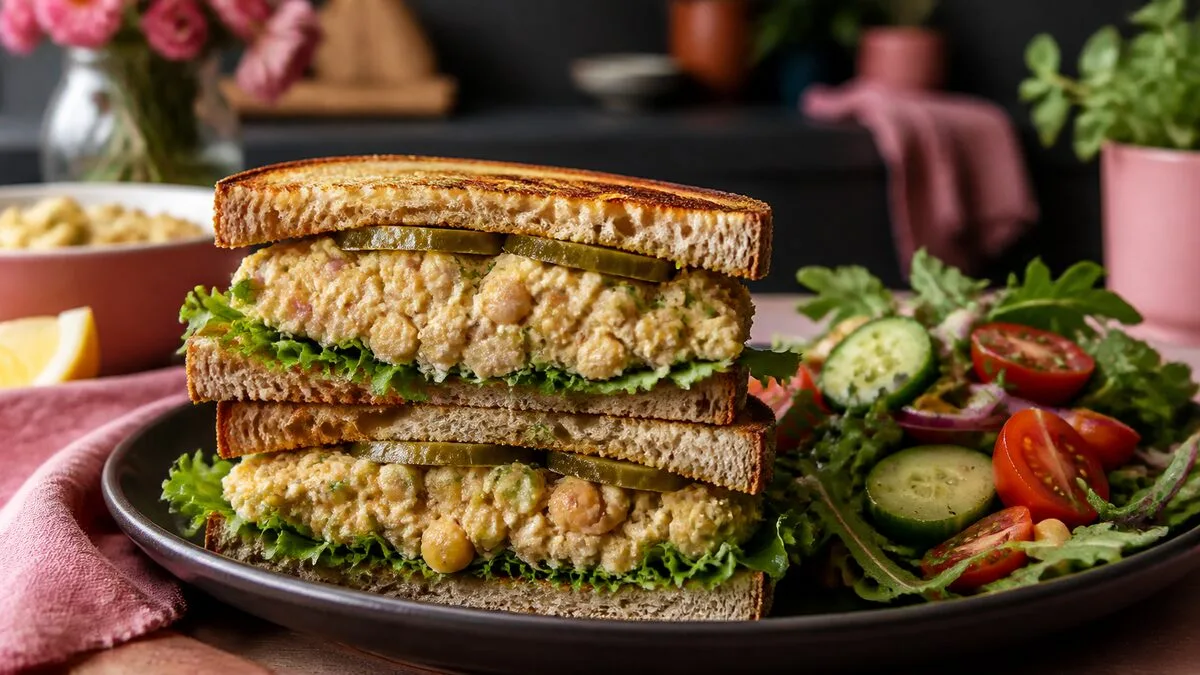
Mashed with lemon, celery, a kiss of dijon, the deli comfort I missed for years without realising it.
The lunch I stopped eating
Before I went plant-based I lived on a tuna sandwich. Two slices of rye, mayo, a little celery for crunch. When I gave up fish it took me three years to stop missing that lunch, until I realised the things I missed (the mash, the lemon, the brine) were never really about the tuna.
Chickpeas do the structural work. The seasoning does the emotional work. This is the version I make most weeks, and once I worked out the few small things that matter, I never went back to mourning the fish.
This piece is the whole story of how I got there, the texture trick that makes or breaks it, the seasonings that recreate the flavour I missed, the way I build it so it doesn't turn to mush by lunchtime, and a handful of variations once you've got the base in your hands. The recipe card lower down has the exact quantities. Everything around it is the why.
If tofu has ever let you down, the fix is mostly technique, which is why I wrote down exactly how to cook tofu so it crisps every time.
For the gap between meals, I lean on a few high-protein vegan snack recipes kept ready in the fridge.
Why do chickpeas work as a tuna stand-in?
Chickpeas work because the thing we love about a tuna salad was never really the fish, it was the flaked, tender texture and the bright, briny dressing wrapped around it. Mashed chickpeas hit that texture almost exactly, and they're a blank, friendly canvas for the seasoning that does the rest.
When you crush a cooked chickpea with a fork, it breaks into soft, irregular flakes with a few half-whole pieces left behind. That's startlingly close to flaked tuna, both in look and in the way it sits in the mouth. The skin gives a faint chew, the inside is creamy, and the whole thing holds a dressing the way fish does. It's not an impression of tuna so much as a parallel route to the same sandwich.
There's substance behind it too. A standard tin gives you real protein and fiber, so this isn't a sad lunch that leaves you raiding the cupboard at three. The chickpea is one of the oldest cultivated legumes in the world, and its sturdiness is exactly what makes it perfect here, it holds up to mashing, dressing, and a few hours in a lunchbox. If you like the deep background, the chickpea entry is a good read.
I should be honest: this won't taste like fish if you're expecting fish. It tastes like a very good chickpea sandwich that scratches the exact same itch. Once I stopped looking for the tuna and started enjoying it on its own terms, it became one of my favourite lunches full stop.
Recipe notes I would tell a friend
If you texted me right before making this for the first time, here's what I'd fire back. These four notes are the difference between a fine version and the one you'll actually crave.
- Don't fully smash the chickpeas. You want some still half-whole, like flaked fish. A smooth paste reads as hummus, not tuna salad.
- A spoon of pickle brine is the not-so-secret ingredient. It brings the briny, faintly oceanic note that you'd otherwise be missing entirely.
- If you toast the bread, toast it dry, no oil, and let it cool one minute so it doesn't sog the moment the filling lands.
- Pair it with a green side and you've got a real protein lunch, not just something to tide you over.
None of these are hard. They're the kind of thing nobody tells you and everybody works out eventually. I'm just saving you the eventually.
Getting the texture right (the part that matters most)
Texture is where this sandwich is won or lost, so it gets its own section. Get it right and the seasoning has something to cling to. Get it wrong and you've made a slightly odd dip, no matter how good the flavours are.
I mash with a fork, never a food processor. The processor is too violent, it turns the whole tin to paste in two seconds and you lose the flaked structure you're after. The fork lets you control it. I aim for about two-thirds broken down into flakes and one-third left in recognisable pieces. That ratio reads as flaked fish to the eye and the tongue.
Drain the chickpeas well, but don't rinse them bone-dry, a little of their own moisture keeps the mix from being claggy. If your chickpeas are very firm, warm them for thirty seconds first; they mash far more willingly when they're not fridge-cold. Soft chickpeas flake, hard ones bounce away from the fork.
A fork and a bit of patience beat any machine here. You're flaking, not pureeing, and the difference is the whole sandwich.
One more thing: mash the chickpeas before you add anything else. If you mash with the mayo and celery already in, you can't see what you're doing, and you'll overwork it. Flakes first, then fold in the rest gently. That order keeps everything where it should be.
Seasoning: where the missing flavour actually lived
When I finally pinned down what I'd been missing about the old tuna sandwich, almost none of it was the fish. It was the salt, the acid, the brine, and the little hits of sharpness. That's all seasoning, and seasoning is something a chickpea takes happily.
The base is vegan mayo and a teaspoon of dijon, which gives you the creamy, faintly tangy backbone. Then come the flavour-makers: lemon juice for brightness, chopped capers for pops of salt, a tablespoon of pickle brine for that briny depth, and fresh dill, which more than anything else makes the whole thing smell like the deli sandwich I remembered.
Salt and pepper at the end, tasting as you go. Chickpeas are mild, so they need more salt than you'd think, and underseasoning is the most common reason a version falls flat. If it tastes boring, it almost always wants salt and a touch more acid, not more mayo.
A few optional extras I rotate through: a sheet of toasted nori crumbled in for a genuinely oceanic note (this is the closest you'll get to a fishy hit), a dash of kelp granules for the same reason, or a little finely diced red onion for bite. None are essential. The dill, lemon, capers, and brine are the load-bearing four.
The bread, the build, and not making it soggy
A good filling deserves bread that can hold it, and a build order that keeps everything where it belongs. Sogginess is the enemy, and it's entirely preventable with two or three small habits.
I use a sturdy sourdough. The open, chewy crumb stands up to a wet filling far better than soft sandwich bread, which collapses into paste. If I toast it, I toast it dry (no oil or butter) and then let it sit for a minute so the surface firms up before the filling goes on. Hot bread plus cold filling equals steam, and steam equals sog.
The build, in order
- Bottom slice, then a layer of butter lettuce. The leaf is a moisture barrier between bread and filling.
- The chickpea mix, spread to the edges.
- Cucumber and sliced pickle on top of the filling, not against the bread.
- Top slice. Press once, gently, then slice on the diagonal because it just tastes better that way.
That lettuce-as-barrier trick is the single best thing I know for a packed lunch. It keeps the bread dry long enough that a sandwich built at eight in the morning is still good at one in the afternoon. If you're making it to eat right away, you can be looser about all of this. For the lunchbox, follow the order.
Why this sandwich travels well
It survives a packed lunch better than almost any other plant-based recipe I make. The chickpeas hold their shape, the dressing tightens as it sits, and the bread holds up if you build it close to lunch instead of at seven in the morning, or use the lettuce barrier if you can't.
There's no fish to worry about going off, no temperature anxiety, nothing that turns grim by midday. The filling, kept separate from the bread until you're ready, is genuinely happy in a container for three days. That makes this a meal-prep hero, not just a one-off lunch.
Lunch came back when I stopped trying to replace the fish and started building around the flavours I missed.
This is exactly the kind of component thinking I lean on all week, make the filling once, build the sandwich fresh each day. It slots straight into the system I describe in plant-based meal prep without the pressure, where the filling is just one more part waiting in the fridge to become lunch.
Variations once you've got the base down
Once the base recipe is second nature, it becomes a launchpad. The flaked, dressed chickpea mix wants to be lots of things beyond a sandwich. Here's where I take it when I want a change.
- The "curried" version: swap dijon for a teaspoon of mild curry powder and add a few raisins or chopped grape. Sweet, savoury, and excellent in a wrap.
- Loaded on toast: skip the top slice entirely, pile the mix on one piece of toasted sourdough, and finish with sliced tomato and a crack of pepper. An open-faced lunch in two minutes.
- As a salad topper: a scoop over a bowl of greens, grains, and roast veg turns it into a proper plate. No bread required.
- In a lettuce cup: spoon it into crisp little gem leaves for a lighter, lower-carb version that still scratches the itch.
- White-bean version: cannellini beans instead of chickpeas give a creamier, softer mix. Worth trying if you find chickpeas a touch firm.
I drift between these depending on the week. The curried one is my summer favourite; the loaded toast is what I make when I'm too hungry to be patient. The base never changes much. The flavours around it do all the travelling.
What to serve alongside it
A sandwich on its own is a fine lunch. A sandwich with one good side becomes a meal you look forward to. I keep the sides simple, because the sandwich is doing the heavy lifting and I don't want to be cooking three things for lunch.
My defaults: a handful of dressed greens, a few cherry tomatoes, or some quick-pickled vegetables straight from a jar in the fridge. In winter I'll have it with a cup of tomato soup, which is the platonic pairing and turns it into something properly comforting. A small handful of crisps if I'm being honest about what I actually want.
For more protein and staying power, a side of crisped chickpeas or a spoon of leftover lentils rounds it out into the kind of lunch that gets you through to dinner without a single snack. If protein through the day is on your mind, the broader thinking lives in high-protein vegan meals for real life, but truthfully this sandwich plus a green side is already there.
The point of a side here isn't to fuss. It's to add a little freshness, a little crunch, and maybe a little warmth so the whole lunch feels considered rather than thrown together. One side, chosen well, does that.
If I'm making a lunch for someone else, I'll go a touch further: a small bowl of olives, a few crackers, a wedge of something. It turns the sandwich into a plate, and a plate feels like a meal somebody bothered with. That small shift, from "here's a sandwich" to "here's lunch," costs almost nothing and lands every time.
Storage, batch-making, and budget
This recipe is kind to a busy week and kinder still to a budget, which is a large part of why it's become a regular rather than a novelty. Here's how I handle it across a few days.
The filling keeps three days in a sealed container in the fridge, and it arguably improves on day two as the flavours settle and the dressing tightens. I make a double batch on the day I'm already in the kitchen and it covers lunches without another thought. Keep the filling and the bread separate, always; a pre-built sandwich won't survive the way the components will.
I wouldn't freeze the dressed mix, the mayo and fresh veg don't love it, but plain cooked chickpeas freeze perfectly, so I keep a stash for when I want to make this from scratch. Cooking dry chickpeas costs a fraction of tinned and gives a slightly better texture if you've soaked them overnight.
On cost, this is about as cheap as a good lunch gets. A tin of chickpeas feeds two, the celery and lemon are pennies, and the mayo, dijon, and capers are bought once and last for months. Compared to a shop-bought sandwich, you're saving real money every single day you make this instead. That arithmetic added up fast for me.
The lunch, finally, came back
It took me three years to stop missing that tuna sandwich, and about an afternoon to realise I'd been mourning the wrong thing the whole time. The fish was never the point. The mash, the brine, the lemon, the dill, the satisfying weight of a proper lunch, that was the point, and all of it survives the swap intact.
What I love most is how ordinary it is now. It's not a special-occasion recipe or a clever party trick. It's just lunch, the kind I make on autopilot, the kind that's waiting in the fridge when I need it. That's the highest thing a recipe can become, in my book: not impressive, just reliable.
So make the filling, taste it, add more salt and lemon than feels right, and build it on good bread with a leaf of lettuce holding the line. Then eat it slowly, ideally not at your desk. If it leaves you wanting the warmer, slower end of plant-based cooking next, I'd point you toward vegan comfort food that feels like home. But honestly, some weeks this sandwich is all I need, and that's been true for years now.
The mayo question, and how to make your own
Vegan mayo gets a lot of questions, so let's deal with it. The shop-bought jars are good now, genuinely good, and that's what I reach for on a normal week. But if you want to make your own, it's easier than you'd guess, and it lets you control the flavour exactly.
The quickest homemade version uses aquafaba, that chickpea brine you'd otherwise tip down the sink. Blend three tablespoons of it with a teaspoon of mustard, a splash of vinegar, and a pinch of salt, then drizzle in neutral oil very slowly while the blender runs. It emulsifies into a thick, pale mayo in about a minute. There's a satisfying symmetry to making the dressing from the same tin that gave you the chickpeas.
If you'd rather skip oil entirely, a softer dressing works too: blend silken tofu with lemon, mustard, and salt for something creamy and lighter. It's not quite mayo, but in this sandwich it does the job and adds a little extra protein besides. Both routes keep the recipe entirely whole-food if that matters to you.
Whichever you use, the principle holds: the mayo is the creamy backbone, not the star. Don't drown the chickpeas in it. You want enough to bind and enrich, not so much that the brightness and brine get muffled. Start with less than you think and add more only if the mix looks dry.
Where this sandwich came from for me
I want to say a little about how I actually landed on this, because recipes rarely arrive fully formed and this one certainly didn't. It came out of a long stretch of getting it wrong, which I think is worth admitting.
My first attempts were too smooth, basically a savoury hummus on bread, and I couldn't work out why they felt off. Then they were underseasoned, pleasant but forgettable. For a while I leaned too hard on nori, chasing a fishiness that made the whole thing taste of the sea in a way nobody actually wanted in a lunchbox. Each version taught me to take one thing out or add one thing back.
The breakthrough was the pickle brine. A friend who'd been plant-based far longer than me watched me fuss over a batch, reached past me, and tipped a spoonful of brine straight from the pickle jar into the bowl. That single sour, salty note was the thing I'd been circling for months. It's the closest the sandwich gets to the deli flavour I remembered, and it costs nothing.
I tell that story partly because it's true and partly because I think it's the right way to approach any recipe like this. You're not following instructions so much as chasing a memory of a flavour. Taste constantly, adjust shamelessly, and trust your own tongue over any measurement, including mine.
The other lesson buried in there: ask people who've been doing it longer. The plant-based cooks I've learned the most from didn't hand me recipes, they handed me single moves, a spoon of brine here, a different bread there. This whole site is partly an attempt to pass those small moves along, because they're the bits that never make it into a printed recipe but make all the difference at the bowl.
Making it for people who aren't plant-based
This sandwich has quietly converted more skeptics at my table than almost anything else I make, and that's because it doesn't announce itself as a substitute. I don't put it down and say "it's like tuna." I just hand someone a good sandwich and let it speak.
The trick, if there is one, is not to oversell it. Calling it a "tuna replacement" sets up a comparison the sandwich doesn't need to win, and primes people to hunt for what's missing. Calling it a chickpea sandwich, or a deli-style sandwich, lets them meet it on its own terms. Nine times out of ten they go back for more before they've thought about what it isn't.
It's also a genuinely easy thing to make for a mixed household where not everyone eats the same way. There's nothing to keep separate, nothing anyone's squeamish about, no special shopping. It's just lunch that happens to be plant-based, which is exactly the kind of food that wins people over without a lecture attached. For the broader art of feeding a mixed table without friction, I got into it properly in plant-based family life without the drama.
That's been the real win for me. Not converting anyone, just making something good enough that the question of whether it's vegan stops being interesting. The sandwich is the argument. It doesn't need me talking over it.
A few last small things
To close, the odds and ends that don't fit anywhere else but are worth knowing. Small refinements that turn a good sandwich into your sandwich, the one you make without thinking.
- Texture contrast wins: the celery and pickle aren't optional garnish, they're the crunch against the soft mash. Don't skip them, or the sandwich goes one-note.
- Let it sit ten minutes: if you have the time, the filling tastes better after a short rest in the fridge while the flavours marry. Not essential, but noticeable.
- Fresh herbs over dried: dill is the one place I insist on fresh. Dried dill tastes of nothing here. If you can't get it, fresh parsley or chives are better than dried anything.
- Don't fear the lemon: acid is what keeps this from feeling heavy. If a batch ever tastes flat or claggy, a fresh squeeze almost always fixes it on the spot.
And that, genuinely, is everything I know about this sandwich. It's a small recipe carrying a slightly outsized place in my week, the one that finally closed the gap between the lunches I missed and the way I eat now. Make it once, tweak it twice, and I suspect it'll quietly become a regular for you too. Most weeks, it still is for me.
Why it actually keeps you full
One thing I didn't expect when I switched from the tuna version was how much better the chickpea sandwich holds me through the afternoon. The old one was protein and white bread, and I'd be hungry again by three. This one has a quiet staying power I've come to rely on.
The reason is fiber. A tin of chickpeas brings a serious amount of it alongside the protein, and fiber is the thing that slows digestion and keeps the energy steady rather than spiking and crashing. Pair that with a wholegrain or sourdough bread and you've built a lunch that releases its fuel gently over hours instead of all at once.
It's not a coincidence that I stopped snacking in the afternoons around the same time I started eating this regularly. A lunch that combines protein, fiber, and a little fat (the mayo, any seeds you add) is doing the same job as a properly built dinner plate, just in sandwich form. That combination is the whole secret to a meal that satisfies.
I'm wary of turning a sandwich into a health lecture, so I'll leave it there. The point isn't that it's virtuous. The point is that it tastes good and it works, which is a rarer combination than it should be. If steady energy through the day is something you're chasing more broadly, the food and the rhythm around it both matter, and I worked through that in a vegan wellness routine for steady energy. The sandwich is a small, reliable piece of a larger, calmer puzzle.
If you only remember three things
I've gone long here, so let me boil it down to the three moves that matter, the ones I'd tattoo on the inside of a beginner's apron if they'd let me.
- Flake, don't puree. Two-thirds broken, one-third whole, mashed with a fork. That single ratio is most of the recipe.
- Season harder than feels right. Salt, lemon, capers, and a spoon of pickle brine. Chickpeas are mild and reward a confident hand.
- Protect the bread. Dry-toast it, let it cool, and lay a lettuce leaf between bread and filling. That's how it survives until lunch.
Everything else in this piece is refinement. Those three things will get you a sandwich you're proud of on the very first try. The rest you'll discover slowly, the way I did, one batch at a time, until one day you realise you haven't thought about the tuna in months. That's the whole arc of it, and it's a quietly happy one.
The recipe
Chickpea tuna sandwich
Ingredients
- 1 × 400 g tin chickpeas, drained
- 2 stalks celery, finely diced
- 2 tbsp vegan mayo
- 1 tsp dijon mustard
- 1 tsp capers, chopped
- 1 tbsp pickle brine
- ½ lemon, juiced
- Salt, pepper, fresh dill
- 4 slices good sourdough
- Butter lettuce, cucumber, sliced pickle
Method
- Mash chickpeas in a bowl with a fork, leave some half-whole.
- Stir in celery, mayo, dijon, capers, brine, lemon, and dill. Season.
- Toast bread dry and let cool one minute.
- Build: lettuce, chickpea mix, cucumber, pickles, top slice. Press once and slice.
Common questions
How long will this take, honestly?
The reading is 12 min. The practice is a lifetime. Start with one small piece this week and let the rest follow when it feels natural, not before.
Do I have to be fully plant-based for this to help?
No. Everything I write is for people who want a softer relationship with food and routine. The recipes happen to be plant-based; the ideas work in any kitchen.
What should I read next?
The related essays below, in order. If you only read one more thing, read High-protein vegan meals for real life, it picks up exactly where this one ends.
Can I cite this guide somewhere?
Yes. Please link back to this page and credit Caleb Leuchi. All photographs are made for Leuchi unless noted; the writing is original.