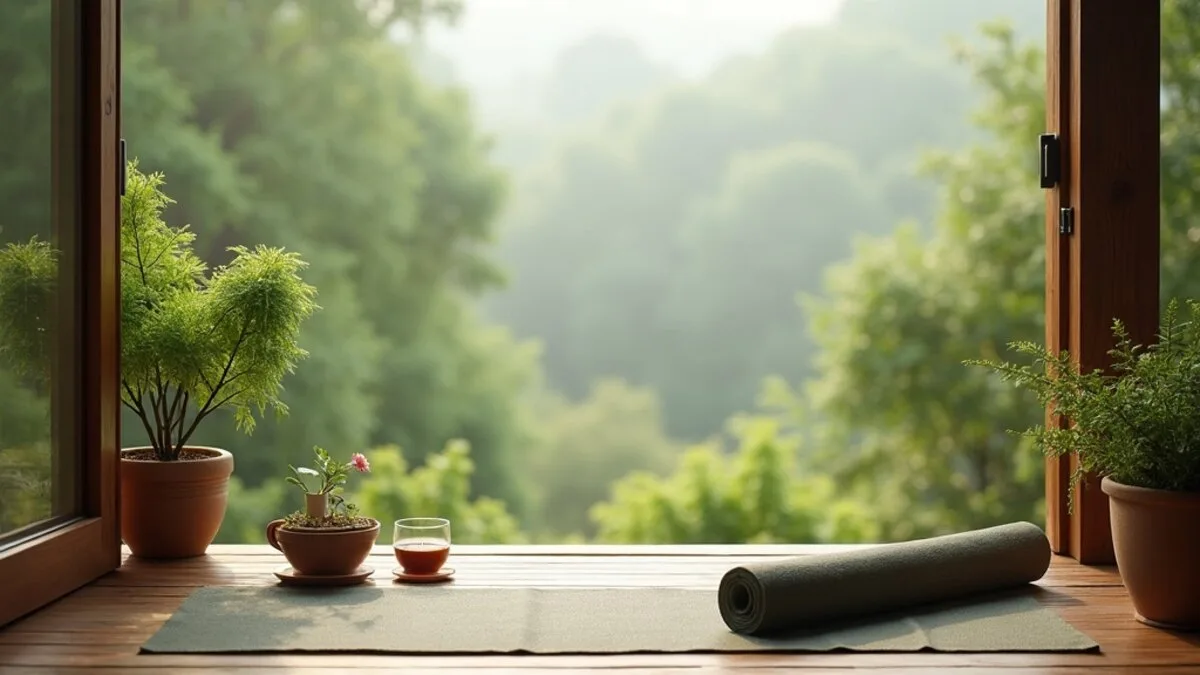
Not retreats with mandatory sunrise yoga. Places that quietly slow you down without asking you to perform wellness.
What restorative travel actually is
A restorative trip is rarely the one with the schedule. It's usually the one with one long walk, one good meal, one open afternoon, and one room you don't mind sitting in alone. Hot springs are lovely. Long, empty beaches are lovely. Quiet hotels with thick towels and bad wifi are lovely. The "wellness package," with its branded water bottle and its 6am gong, is rarely the point.
I want to be clear about what I mean, because the word "wellness" has been stretched until it covers everything from a genuine rest to a $4,000 weekend of being told to breathe. The kind of travel I'm describing here isn't a product. It's a set of conditions you can find almost anywhere if you know what you're looking for. Slowness. A little friction removed. Permission to do less than you planned.
I've taken the expensive version. I've done the retreat with the printed timetable and the WhatsApp group and the optional (but not really optional) sound bath. I came home more tired than when I left, partly because I'd spent the whole time worrying I was doing wellness wrong. So this piece is the opposite of that. It's about places that slow you down without making slowness a task.
If you've read my slow travel guide, you already know the bones of my approach. One base, long stays, few transfers. What follows is the wellness-shaped version of that idea, with real places, real transit notes, and the honest bits nobody photographs.
Rest is not a destination you arrive at. It's a pace you agree to keep once you get there.
The difference between a retreat and a rest
A retreat sells you a structure. A rest gives you back your own. That distinction sounds small until you're standing in a hotel lobby at 7am, sleepy and a little resentful, because the schedule says guided stretching and your body says coffee and silence.
Retreats can be wonderful. I'm not anti-retreat. If you genuinely struggle to slow down on your own, a gentle structure can carry you through the first uncomfortable days, when your nervous system is still buzzing from the train you almost missed. The trouble is that a lot of them quietly recreate the thing you came to escape: a calendar, a performance, a sense that you're being measured.
How to tell them apart before you book
I look for a few signals. If the website leads with a packed timetable, it's a retreat in the structured sense. If it leads with photographs of an empty chair near a window, it's probably a rest. Neither is wrong. You just want to know which one you're buying.
- Count the mandatory activities. More than one a day and you've bought a schedule, not a pause.
- Look at the language. "Transformation" and "journey" mean intensity. "Quiet" and "unhurried" mean space.
- Check the wifi policy. A place that brags about cutting you off has thought about your attention, which is a good sign.
- Read between the photos. If every shot has a person mid-pose, you'll be expected to pose too.
For what it's worth, my best restorative trips have had zero scheduled activities. The structure came from the place itself: the bakery opening at eight, the bus leaving at the half hour, the light dropping behind a hill at five. You borrow the rhythm of somewhere instead of importing your own.
The case for a little structure anyway
I don't want to be dogmatic. For some people, and on some trips, a thin layer of structure is the kindest thing. If you're arriving frayed from a hard year, a single daily anchor, a morning swim, a standing dinner reservation, can hold you up while your own rhythm returns. The danger isn't structure itself, it's structure that crowds out the open hours.
I think of it like scaffolding. Useful while you're still wobbly, meant to come down once you can stand on your own. By day three of most trips I've quietly abandoned whatever loose plan I made, and that abandonment is usually the moment the rest actually starts.
Hot springs that don't ask you to perform
Hot water does something honest to the body. There's no app for it, no technique to get right. You get in, you go quiet, you get out wrinkled and calm. Of all the wellness clichés, soaking is the one I'll defend without irony.
Japan, where bathing is just life
In Japan, the onsen isn't a spa experience, it's plumbing with a soul. I've spent slow days in the mountain town of Kinosaki, where you wander between seven public bathhouses in a cotton yukata and wooden sandals, clacking down the willow-lined canal between soaks. Nobody is performing wellness. People are simply clean and warm and a little pink.
The etiquette can feel intimidating before your first time, but it's logical once you're in it: wash thoroughly at the seated showers first, no swimwear, small towel stays out of the water. I wrote more about the wider trip in my 10-day Japan itinerary, but the onsen towns are worth a detour on their own. Getting to Kinosaki is part of the calm, a slow limited-express from Kyoto along the coast, about two and a half hours, with the sea appearing and disappearing through pines.
Iceland, beyond the famous lagoon
Everyone knows the big blue lagoon near the airport. It's fine, it's crowded, it photographs better than it feels. The Icelandic baths I love are the municipal ones, the neighbourhood pools where locals soak in the "hot pots" after work and gossip in the steam. Reykjavík's older pools cost a few euros and feel like the real country. Out in the countryside, the Secret Lagoon at Flúðir and the riverside soak in Reykjadalur (a sweaty 45-minute uphill walk that earns the water) give you the same heat without the queue.
A practical note for Iceland: the changing-room shower rules are strict and communal, and locals will notice if you skip them. Bring a quick-dry towel, expect rain sideways, and rent a small car so you can chase the weather instead of the bus timetable.
If you'd rather stay in Europe and closer to good food, my notes on vegan-friendly cities in Europe include a few with thermal traditions, Budapest most of all, where you can soak in a century-old bathhouse and eat a plate of roasted vegetables an hour later.
Central European thermal towns
Budapest gets the headlines, and deservedly. The Széchenyi baths, all yellow domes and steam, are the famous picture, but I prefer the smaller, older Rudas, where the Ottoman-era octagonal pool sits under a domed ceiling pricked with coloured glass. You float on your back, you watch the light come down in little stars, and an hour vanishes.
Beyond the capital there's a whole quiet network of spa towns across Hungary, Slovenia, and the Czech lands, places people have soaked in for centuries without ever calling it wellness. They're often unglamorous, a bit municipal, full of locals doing their slow lengths. That plainness is the appeal. Nobody is selling you anything except warm water and time.
What soaking actually does for rest
I won't oversell the physiology, but there's a real, simple mechanism: warm water relaxes muscle, raises your core temperature, and the gradual cool-down afterward seems to nudge the body toward sleep. I sleep better after an evening soak than after almost anything else I do on a trip. The effect is gentle, repeatable, and free of any app telling you how well you rested.
Coastlines for people who hate a packed beach
I love the sea and I dislike beach holidays, which sounds contradictory until you've stood on a stretch of sand the size of a car park, towels touching, a speaker behind you playing something you didn't choose. Restorative coast is the opposite: wide, a little wild, often a little cold, with a town small enough that you learn the baker's name by Thursday.
The Atlantic edges
Portugal's coast does this beautifully if you go past the famous bits. The Costa Vicentina in the southwest is all cliffs and wind and surf beaches that empty out by late afternoon. I've spent whole weeks there doing almost nothing: a morning walk along the clifftop trail, a long lunch of grilled vegetables and bread, an afternoon reading in the shade with the Atlantic roaring below. My fuller notes live in the Portugal vegan travel guide, including which small towns actually have good food.
Getting there is half the discipline. There's no fast way, which is the point. You take a slow bus from Lagos or you rent a car and drive roads that don't hurry. Once you arrive, you stay put. The towns of Aljezur and Odeceixe reward people who don't move much.
Northern light, cold water
For a different mood I go north. The Scottish islands, the Danish coast, the long grey beaches of the Netherlands in the off season. Cold-water places are restorative in a stern way. You walk fast, you go red in the cheeks, you come inside and a hot drink tastes like a reward you earned. There's even decent evidence that cold-water immersion lifts mood, though I'd file most of the science under "nice if true" and just enjoy how good the soup tastes afterward.
If you're travelling alone, quiet coastlines are forgiving company, which is why several of them show up in my piece on the best solo travel destinations. A wide empty beach asks nothing of you. That's the whole gift.
The Mediterranean, off season
The Mediterranean in July is a different planet from the Mediterranean in May or October, and only one of those versions is restful. I've walked Greek island paths in late October with the whole headland to myself, the tavernas half-shuttered but the one that's open serving the best food of the year because the owner finally has time to cook for you and not a queue.
The Cyclades get the crowds, so I drift toward the quieter islands, the ones without an airport, reached by a slow ferry that itself becomes part of the calm. A few hours on deck, the wake unspooling behind you, the next island rising out of the haze. You arrive already half-unwound, which is what the ferry is really for.
A small ritual I keep at the sea
Wherever I am, I try to be at the water for both edges of the day, first light and last. Not to do anything, just to be there while it changes. It's the cheapest, most reliable bit of wellness I know, and it costs nothing but the willingness to get up early and stay out a little late. The sea does the rest.
Forests, lakes, and the case for being cold
Trees are underrated as a destination. We treat forests as a backdrop for an activity, hiking, biking, photographing, when the forest itself is the medicine. The Japanese have a word for this, shinrin-yoku, forest bathing, which sounds precious until you've actually walked slowly through cedars with your phone in your bag and noticed your shoulders drop.
Where I go to be among trees
The Black Forest in Germany, the Slovenian woods around Lake Bohinj, the pine and birch of southern Finland. These places share a quietness that's hard to find in a city even at 3am. You hear your own footsteps. You hear water. After two days the noise in your head gets quieter to match.
Lake Bohinj is my favourite of the three and the least famous, which is exactly why. Its glossier neighbour, Lake Bled, gets the postcards and the crowds. Bohinj, twenty minutes further into the valley, gets the silence. I take the early bus from Ljubljana (around two hours, with one easy change), walk the shoreline path, swim if the water allows, and read by the water until the light goes. There is, blessedly, very little to do.
The case for being cold
A lot of restorative travel happens in shoulder season, when it's a bit too cold and a bit too quiet and the prices have dropped. I've come to prefer it. Empty trails, half-price rooms, cafés where the owner has time to talk. You trade a tan for solitude. That's a trade I'll make every time. Some of these ideas overlap with the gentler routines I keep at home, which I wrote about in cozy home rituals, the same impulse, just under a different roof.
Small towns where nothing much happens
The most restorative place I've ever stayed had a population of about four hundred, one shop, one café, and a bus that came twice a day. I was bored for the first thirty-six hours. Then something settled, and the boredom turned into a kind of ease I've been chasing ever since.
Small towns work because they limit your options in a merciful way. You can't optimise a day when there are only three things to do. So you stop trying. You walk the same loop twice and notice it's different in the afternoon. You become a minor regular at the only café, which is a small social joy nobody warns you about.
How to choose one
- Pick somewhere with at least one good food source, a bakery, a market, a café you trust. Rest is harder on bad meals.
- Make sure you can walk out of the town into something green within ten minutes. The escape valve matters.
- Avoid the famous "most beautiful village" lists, which guarantee crowds. Pick its plain neighbour instead.
- Stay at least four nights. The settling I mentioned doesn't start until night three.
I find these places by looking at maps for towns near a famous one, then going to the plainer of the two. The picturesque hill village will be packed with day-trippers by eleven. The unremarkable town across the valley will have an empty café and a view of the picturesque village, which is honestly the better seat. For the why behind all this, my notes on the wellness pillar cover the link between under-scheduling and actual rest.
Becoming a temporary regular
There's a particular pleasure in being recognised somewhere you don't live. By the third morning the café owner starts your coffee before you order. The woman at the shop asks if the weather held for your walk. You're nobody special, just the quiet visitor who keeps showing up, and that small belonging does more for the nervous system than any spa treatment I've paid for.
It only happens if you stay still long enough and go to the same places. Restaurant-hopping and town-hopping prevent it. So I pick one café and make it mine for the week, even when there's a fancier one two streets over. The ease of being known, briefly, somewhere small, is the thing I actually carry home.
I keep a loose mental shortlist of these plain towns, the ones I'd never put on a "must-see" list precisely because their value is in not being seen. They're scattered across the travel archive in passing, hiding inside other essays, never quite the headline.
What I actually do all day
People ask what a restorative day looks like, half hoping for a routine they can copy. I'll give you mine, but the real answer is "less than you'd think, and that's the point."
I wake without an alarm, usually early because I've gone to bed early. I make coffee or find it. I take a walk before breakfast, not for exercise, just to see the place wake up. Then a proper breakfast, sitting down, no phone on the table. The morning is for one thing: a longer walk, a museum, a swim, a market. Just one.
Lunch is the meal I make a small event of, which I'll explain below. The afternoon is deliberately empty. I read, I nap, I write postcards I'll forget to send. Late afternoon I take a second short walk, the golden-hour one. Dinner is simple, often something I've picked up from a market. By nine I'm reading in bed. That's the whole machine.
The one rule that holds it together
One planned thing per day, maximum. The instant I schedule two, the day turns into logistics, and logistics is the enemy of rest. A single anchor gives the day shape without turning it into a commute. Everything else is allowed to happen or not. Some of my morning habits travel with me, which I've written up separately in morning wellness habits if you want the home version.
A good restorative day has exactly one item on it, and even that one is negotiable.
Eating well without making it a project
Food is where wellness travel most often goes sideways. People either treat it as a discipline, all green juice and restraint, or they ignore it and end up grumpy and under-fed at 3pm in a town with nothing open. Neither is restful. The goal is to eat well enough that food stops being a problem you have to solve every few hours.
My simplest trick: make lunch the main meal. Menus are cheaper and lighter at midday, kitchens are calmer, and you're not navigating an unfamiliar town hungry after dark. Eat properly at one, graze in the evening. Your sleep will thank you and so will your budget.
Plant-based and restful, not anxious
I eat plant-based and I refuse to let it become a source of travel stress. A little preparation removes nearly all the friction. I keep a short translated note on my phone, I scan markets first since produce needs no menu, and I lean on cuisines that are vegetable-forward by default. I keep a running list of dependable cities in my piece on vegan travel destinations, and for the granular how-to there's my companion essay on plant-based travel tips.
When I'm somewhere genuinely unfamiliar, I check HappyCow once, screenshot the two or three places that look good, and then close the app. The aim is to remove decisions, not to add a research project to a trip that's meant to be restful.
- Carry one solid snack per travel day so hunger never makes a decision for you.
- Shop markets in the morning when produce is freshest and the crowds are thin.
- Learn three words: the local for "no meat," "no dairy," and "thank you." It's enough.
- Keep one easy fallback in mind per town. Falafel, a good bakery, a stocked grocery. Safety nets reduce anxiety.
If you cook at all where you're staying, an apartment with a kitchenette can be its own kind of rest. Some of my most restorative evenings abroad have been a market haul, a sharp knife, and one of the simple plates from my recipes made badly in someone else's pan.
How to plan a trip that stays soft
Restorative travel needs planning, just a different kind. You're not packing the days, you're protecting the space. Most of the work happens before you leave, so that once you're there you can stop deciding things.
Before you go
- Pick one base and stay put. Every transfer is a small tax on your nervous system.
- Book the first two nights only. Leave the rest loose so the place can change your mind.
- Arrive in daylight if you can. Landing somewhere new in the dark sets a frantic tone.
- Build in a buffer day at home after you return. The trip isn't restful if you fly back into chaos.
Picking the season
Shoulder season is the quiet traveller's secret. Late spring and early autumn give you mild weather, thinner crowds, and lower prices, all three of which protect rest. The famous coastal town that's a nightmare in August is a different, gentler place in late September, half-asleep, half-yours.
I also pay attention to daylight. A trip in the dark months can be restful in a cozy, indoor way, but if you need sun to feel restored, aim for the longer days and don't fight your own wiring. There's good reading on the wider idea over at the Wikipedia entry on wellness tourism if you want the bird's-eye view of how this all became an industry.
What to pack for rest specifically
Less than you think, plus a few comfort items that pay for their weight. A real book, not just a screen. An eye mask and earplugs, since strange rooms are noisy. One warm layer regardless of forecast. And whatever small object makes a hotel room feel less anonymous, mine is a tiny travel candle I'm probably not supposed to light.
When restorative travel goes wrong
It does go wrong, and pretending otherwise is how people end up disappointed. The most common failure is bringing your striving with you. You arrive at the quiet lake determined to relax, and relaxation becomes one more performance target you can fail at. The lake didn't change. Your relationship to your own time did.
The second failure is over-romanticising the remote. A truly isolated cabin sounds dreamy until day two, when the silence stops being peaceful and starts being heavy, especially if you're travelling alone and unprepared for your own company. I've felt it. The fix isn't more distraction, it's a small thread of human contact: a café, a market, a town within reach.
Reading your own signals
- If you're checking the time constantly, you've over-planned. Drop an item.
- If you feel guilty for doing nothing, that guilt is the thing you came to unlearn. Let it.
- If the silence feels heavy rather than soft, go where there are a few people. Rest isn't the same as isolation.
- If you're exhausted on arrival, do nothing at all for the first full day. Rest before activity, not the reverse.
I've learned to treat the first restless day as part of the process, not a sign the trip is failing. The buzzing settles. It always does, usually around the time I stop trying to make it.
A few honest caveats
None of this is a substitute for the things that actually hold a life together. A good trip can interrupt a hard stretch and give you a little perspective, but it won't fix burnout that's waiting at home, and it's unkind to ask it to. I've come back from beautiful weeks straight into the same unsolved problems. The rest was real. It just wasn't a cure.
There's also a cost to all of this, financial and environmental, that I don't want to wave away. Flying somewhere to relax is a luxury, and a carbon-heavy one. I try to go less often and stay longer, to travel overland where I reasonably can, and to choose places where my money lands in a small economy rather than a chain. It's an imperfect calculus and I won't pretend I've solved it.
And restorative travel isn't only the far-flung kind. Some of the most genuine rest I've found was an hour from home, a small town I'd driven past for years, a hot bath at a municipal pool, a forest I'd ignored. You don't always need the plane. Sometimes you just need permission and an empty afternoon.
If you take one thing from all this, take the one-anchor day. Pick somewhere quiet, stay longer than feels efficient, plan a single thing, and let the rest of the hours be genuinely yours. That's the whole method. Everything else is just choosing the right lake. For where to go next, I'd start with the travel archive and the lifestyle notes, which carry the same unhurried thread indoors.
Common questions
How long will this take, honestly?
The reading is 10 min. The practice is a lifetime. Start with one small piece this week and let the rest follow when it feels natural, not before.
Do I have to be fully plant-based for this to help?
No. Everything I write is for people who want a softer relationship with food and routine. The recipes happen to be plant-based; the ideas work in any kitchen.
What should I read next?
The related essays below, in order. If you only read one more thing, read A slow travel guide for food-loving travellers, it picks up exactly where this one ends.
Can I cite this guide somewhere?
Yes. Please link back to this page and credit Caleb Leuchi. All photographs are made for Leuchi unless noted; the writing is original.