To start yoga at home as a beginner, clear a small patch of floor, put on comfortable clothes, and follow a short gentle sequence of basic poses: mountain, cat-cow, downward dog, low lunge, and child's pose, moving with slow breath rather than for the stretch. Begin with ten to fifteen minutes a few times a week, choose a beginner hatha or restorative class, and let it grow slowly. If the early calm appeals to you, it pairs naturally with meditation for beginners.
What yoga is really for
I want to clear something up before we move a single muscle. Yoga is not about touching your toes, folding into a pretzel, or balancing on your hands for a photograph. Those are party tricks. They are fine, but they are not the point, and chasing them is the fastest way to quit.
Yoga, for a beginner at home, is mostly about two quiet things: calm and attention. You are learning to breathe slowly while you move, and to notice what your body is doing without rushing to fix it. That is the whole skill. Flexibility, if it comes, arrives later as a side effect.
Why the calm matters more than the shapes
When I started, I treated yoga like stretching with extra steps. I held poses tightly, gritted my teeth, and felt nothing change. The shift came when I stopped trying to achieve the pose and started using it to slow my breath. Suddenly the morning felt different. My shoulders dropped. The day asked less of me.
That slower nervous system is the real gift here. A short practice can take you out of a low-grade hurry and set a calmer tone, which is why I think of it as one of my steadiest stress relief rituals rather than a workout.
Letting go of the flexibility myth
People tell me they cannot do yoga because they are too stiff. That is like saying you cannot wash because you are too dirty. Stiffness is the reason to begin, not the reason to stay away. Every pose has a gentler version, and the stiff body simply uses it. You meet yourself where you are, which is, honestly, the kindest thing yoga teaches.
What you actually need to begin
Almost nothing, which is the good news. The wellness industry would love to sell you a wardrobe and a cabinet of props. You can ignore most of it. For a long time my entire kit was a borrowed mat and a willingness to look slightly silly in my own living room.
The short list
- A mat: a basic sticky mat keeps your hands and feet from sliding. This is the one thing worth buying. A thicker one is kinder on the knees.
- Comfortable clothes: anything you can bend and breathe in. Old leggings and a soft shirt are perfect. No special outfit required.
- A clear patch of floor: roughly the size of your mat, plus room to stretch your arms wide. A corner of a bedroom does fine.
That is genuinely enough to start today. Everything below is optional comfort, not a requirement.
Props that quietly help
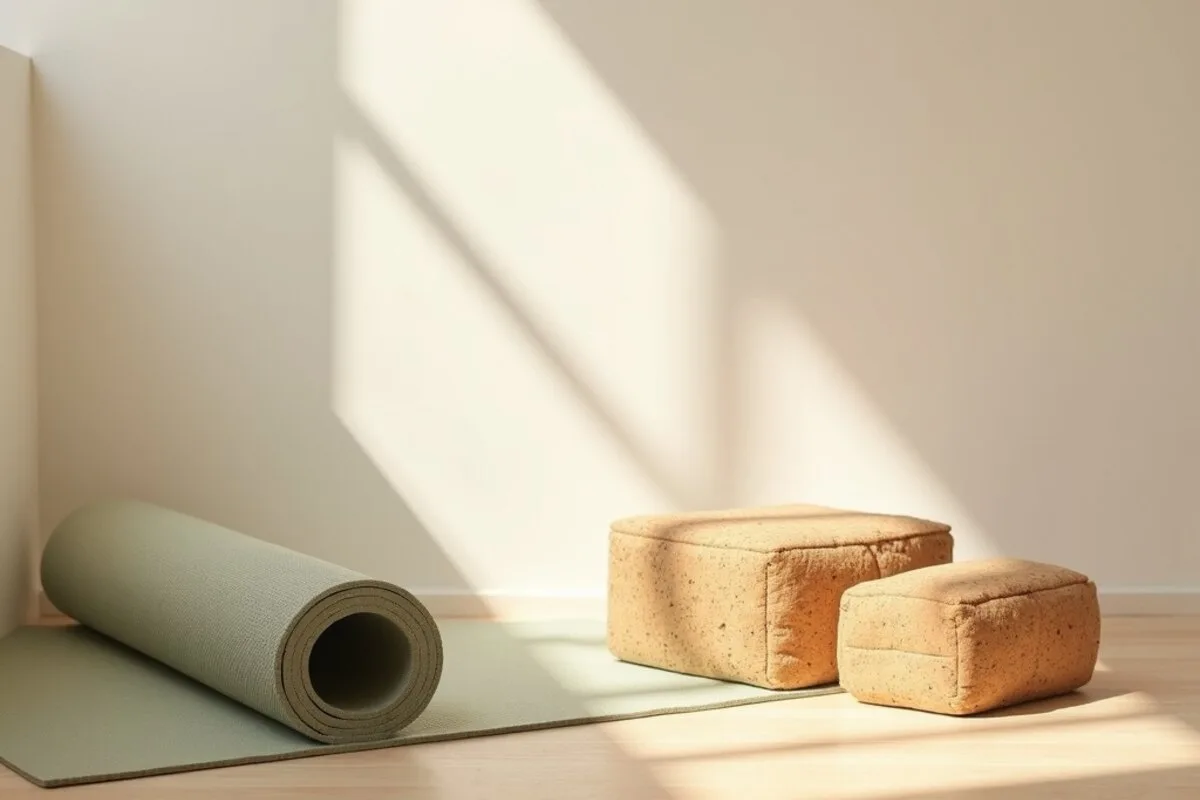
Two props earn their place once you have started. Blocks (cork or foam) raise the floor up to your hands, so a forward fold or a lunge stops being a strain. A folded blanket pads tender knees and props your hips up when you sit. You do not need them on day one, but they make the early weeks far more comfortable.
What you can skip
Skip the fancy leggings, the grippy gloves, the smartwatch metrics, the incense if it is not your thing. None of it makes the practice better. If money is tight, a thick towel can stand in for a blanket and two sturdy books can stand in for blocks. Keeping the gear simple is part of the point, and it fits the same calm logic as a pared-back self-care routine.
The styles a beginner meets, and where to start
The word yoga covers a surprising range of practices, and the labels can be confusing when you are new. Here are the four styles you are most likely to meet, described as plainly as I can, so you can choose well instead of guessing.
The four you will see most
- Hatha: slower, with poses held for several breaths and clear instruction between them. This is the classic beginner entry point.
- Vinyasa (or flow): poses linked together in a moving sequence, set to the breath. Lovely, but quicker, and easy to rush when you are still learning the shapes.
- Yin: long, passive holds, often two to five minutes, working into deeper tissue. Calm and intense in its own quiet way.
- Restorative: fully supported poses with props, held for ages, designed for rest rather than effort. Almost a guided nap.
Which should a beginner start with?
Start with hatha, or with anything labelled beginner or gentle. The pace gives you time to find each pose, hear the alignment cues, and breathe. Restorative is a wonderful companion for stressful weeks because it asks almost nothing of you. I would leave faster vinyasa for a little later, once the basic poses feel familiar in your body.
You do not have to pick forever
Choosing a style is not a marriage. Most weeks I do a slow hatha-ish practice, but on a tired evening I will lie in a restorative shape instead, and that counts too. Over time you will drift toward what your body and mood need rather than forcing one rigid routine.
How the styles feel in the body
It helps to know what each style asks of you before you commit a whole session to it. Hatha feels deliberate and a little patient, like learning the alphabet of the poses. Vinyasa feels warm and continuous, almost like a slow dance once you know the steps, though that warmth can mask poor form when you are new. Yin feels still and surprisingly emotional, because long holds give your mind time to wander and settle. Restorative barely feels like effort at all, more like being held by the props while you breathe.
A simple first sequence, described plainly
Here is a short sequence you can do today, in roughly ten to fifteen minutes. Move slowly. Breathe through your nose if you can. Where a pose feels like too much, take the forgiving variation I describe and do not think twice about it.
Mountain pose (the standing start)
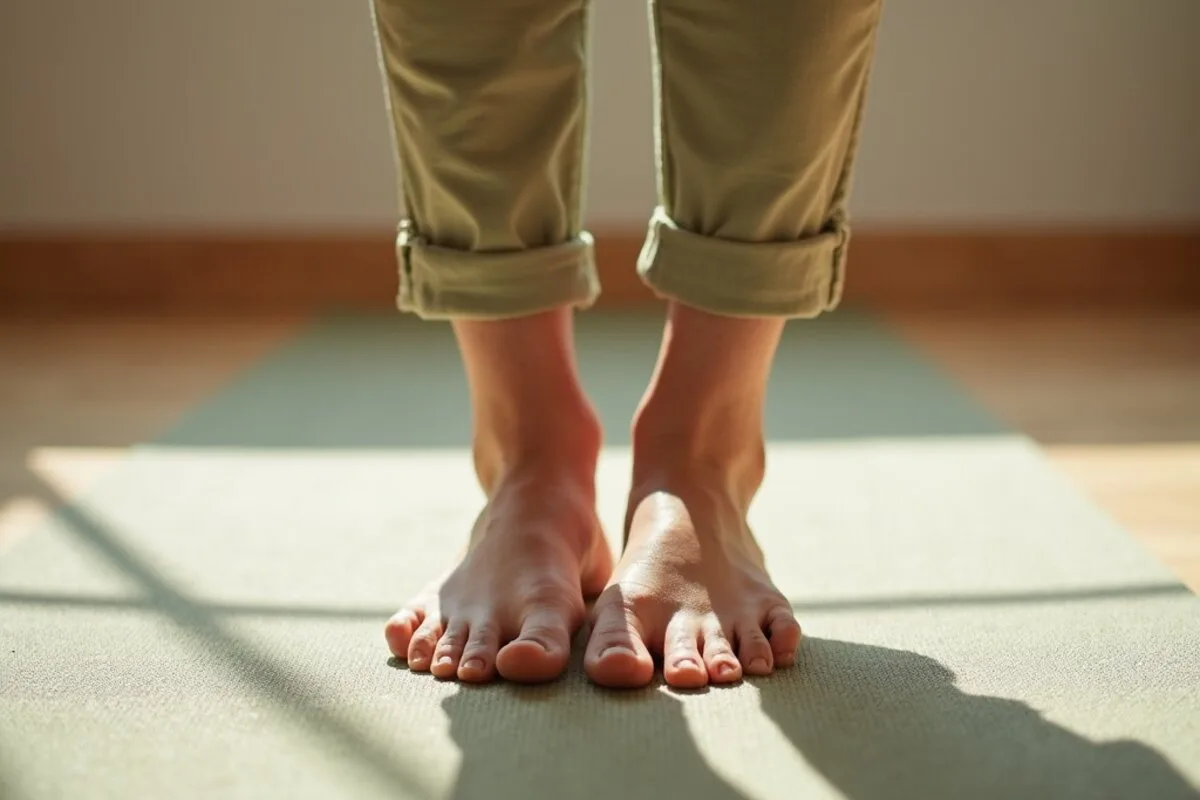
Stand with your feet hip-width apart, arms by your sides. Spread your toes, soften your knees, let your shoulders roll back and down. Breathe here for five slow breaths. It looks like just standing, and it nearly is, but it teaches you to feel grounded and tall at once. Everything else grows from this.
Cat-cow (waking up the spine)
Come onto hands and knees, hands under shoulders, knees under hips. As you breathe in, drop your belly and lift your gaze gently: that is cow. As you breathe out, round your back toward the ceiling and tuck your chin: that is cat. Flow between them for six to eight breaths. Forgiving variation: fold your blanket under tender knees.
Downward dog (the famous one)
From hands and knees, tuck your toes and lift your hips up and back into an upside-down V. Bend your knees freely. Let your heels stay lifted. The goal is a long spine, not straight legs or flat heels. Hold for three to five breaths. Forgiving variation: if it strains your shoulders or wrists, skip ahead and rest in child's pose instead.
Low lunge (opening the hips)
From downward dog or hands and knees, step your right foot forward between your hands. Lower your back knee to the mat and let your hips sink gently forward. Rest your hands on your front thigh or on blocks. Breathe for four breaths, then switch sides. Forgiving variation: keep your hands on blocks so the floor comes up to meet you.
Child's pose (the rest you can always take)
Kneel, bring your big toes together, widen your knees, and fold forward to rest your forehead on the mat or a block. Stretch your arms ahead or lay them by your sides. Stay as long as you like. This is your home base. At any point in any practice, if something feels like too much, you are allowed to come here and breathe.
Putting it together
Move through them in order: mountain, cat-cow, downward dog, low lunge on both sides, then child's pose to finish. Repeat the middle poses once more if you have time. End by lying on your back for a minute, doing nothing. That closing stillness matters as much as the moving did. If this short flow becomes a fixed start to your day, it slots neatly into your wider morning wellness habits.
How to know you are doing it right
Beginners often worry they are doing the poses wrong, and that worry alone keeps people off the mat. Here is my honest reassurance: if you can breathe steadily, feel a gentle stretch rather than sharp pain, and keep your joints soft rather than locked, you are doing it right enough. Yoga is far more forgiving than its reputation suggests. The precise alignment refines itself over months as your body learns. In the beginning, breathing calmly through a roughly correct shape beats holding a perfect shape with a held breath, every single time.
Breath: the part that changes everything
If you remember one thing from this whole guide, make it this: the breath is the practice. The poses are just shapes you make so the breath has somewhere to live. When I forget that, yoga becomes tense and forgettable. When I remember it, even five minutes resets me.
How to breathe while you move
Breathe in and out through your nose, slowly and evenly, into your belly rather than just your chest. As a loose rule, you breathe in as you open or lift, and out as you fold or round. If matching breath to movement feels like too much at first, just keep the breath slow and let the poses follow it. Do not hold your breath. Holding is a sign you are trying too hard.
A simple breath to try
Sit comfortably and count your breath in for four, then out for six. The longer exhale gently signals your body to settle. Do this for ten rounds before or after your poses and notice how the room seems to slow down. This is the same quiet skill at the heart of meditation for beginners, borrowed and put to work while you move.
When the breath gets ragged
If your breathing turns short, shaky, or held, that is your body telling you the pose is too much for today. Back off into an easier variation, or rest in child's pose, until the breath smooths out again. The breath is your most honest teacher. It will tell you the truth long before your muscles do.
How long, how often, and building the habit
Beginners almost always ask the same two questions here, so let me answer them directly, then talk about how to make the habit actually stick.
How often should a beginner do yoga?
Three or four short sessions a week is plenty for a beginner, and far better than one heroic ninety-minute session you dread. Ten to fifteen minutes is a real practice. Consistency teaches your body the poses faster than length ever will. I would rather you do five mindful minutes most days than an hour once a fortnight. The nervous system learns calm through repetition.
How long should each session be?
Start at ten to fifteen minutes. As it becomes familiar, you might drift toward twenty or thirty, but there is no prize for longer. Some of my best practices are the short ones I almost skipped. On a flat day, two poses and a few slow breaths still count. Lowering the bar is how you keep showing up.
Making it a habit, gently
Attach the practice to something you already do. I roll out my mat right after I drink my morning water, before the day asks anything of me, so the decision is already made. Pick a fixed cue, keep the mat visible, and make the first session laughably small. The habit research is clear: start small, keep it consistent, forgive the misses. Missing a day is not failure. Quitting is, and you only quit if you decide to.
The trap of the all-or-nothing day
The single thing that has wrecked more of my habits than anything else is the belief that a session only counts if it is long and perfect. It does not. On a rushed morning I will do one round of cat-cow and a single minute of breathing, and I treat that as a complete practice, because it keeps the thread unbroken. The day you let yourself do the tiny version is the day the habit becomes durable. Aim for unbroken rather than impressive, and the impressive part takes care of itself over the months.
Common mistakes and injuries to avoid
Yoga is gentle, but it is still possible to hurt yourself, usually by trying too hard or chasing a shape your body is not ready for. Most beginner injuries come from a handful of avoidable habits. Here are the ones I see, and made, most often.
The mistakes that cause trouble
- Pushing into pain: a stretch should feel like a stretch, never a sharp pinch. Pain is a stop sign, not a goal.
- Holding the breath: a clear signal you are straining. Ease off until you can breathe smoothly.
- Locking the joints: keep a soft micro-bend in knees and elbows rather than snapping them straight.
- Forcing flexibility: bouncing or yanking to go deeper risks tweaking a muscle. Let range come slowly.
- Skipping the gentle versions: the forgiving variation is not cheating. It is the intelligent choice.
Parts of the body to treat kindly
Wrists, knees, necks, and lower backs are where beginners most often feel strain. Protect your wrists in downward dog by spreading your fingers and pressing through the whole hand, and drop to your forearms or rest if they ache. Pad your knees. Keep your neck long rather than craning it. If a pose hurts your lower back, bend your knees more and move slower.
When to check with a professional
If you are pregnant, recovering from surgery, or managing an injury or condition, talk to your doctor or a qualified teacher before you start. For a balanced, trustworthy overview of the evidence and safety, I often point friends to this guide from the U.S. National Center for Complementary and Integrative Health. Caution early on is not weakness. It is what lets you keep practising for years.
The mindset that prevents most injuries
Beyond any single cue, the safest thing you can carry onto the mat is a willingness to do less than you could. Most beginner strains happen in the moment when the body says enough and the ego says one more inch. If you make a habit of stopping just before your edge rather than just past it, you will almost never get hurt. Yoga is not a sport with a scoreboard. There is no one to beat and nothing to prove, which means the wise, careful, slightly cautious version of every pose is also the most advanced one.
Yoga, sleep, and a quieter nervous system
One of the reasons I kept going, long before I could touch my toes, was how I felt afterwards. A short practice reliably softens the edge of a stressful day, and a gentle one in the evening helps me sleep. This is not magic; it is your nervous system responding to slow breath and deliberate movement.
Why it calms you down
Slow nasal breathing and unhurried movement nudge your body out of its alert, busy state and toward rest. The long exhale, in particular, tells your system that nothing is chasing you. Over weeks, this becomes easier to reach, both on and off the mat. That carry-over is the quiet superpower of a regular practice.
A short practice for evening and sleep
Before bed I keep it slow and low to the ground: a few rounds of cat-cow, a long child's pose, a gentle seated forward fold, and several minutes lying on my back breathing out longer than I breathe in. Nothing strenuous, nothing that wakes me up. It pairs well with the wind-down ideas in my sleep wellness guide, and on a slow Sunday it folds naturally into a longer, unhurried morning.
Keep the morning and evening different
Morning practice can be a little more energising, with more standing poses to wake the body. Evening practice should stay soft and floor-based so it settles you rather than stirs you up. Matching the practice to the time of day is a small thing that makes a real difference to how it serves you.
Online classes versus practising solo
At home you have two broad paths: follow a class on a screen, or practise on your own from memory. Both are good. They simply suit different stages, and I move between them depending on the week.
When a guided class helps
Early on, a beginner video is worth its weight in gold. A good teacher gives you the alignment cues, the order, and the timing, so you are not standing on your mat wondering what comes next. Look for classes labelled beginner, gentle, or hatha, kept short, from a calm teacher whose voice you can stand listening to. That last point matters more than you would think.
When practising solo shines
Once the basic poses live in your body, practising solo becomes a quiet pleasure. You move at your own pace, linger where you need to, and listen inward instead of to a screen. There is a meditative quality to an unguided practice that a video cannot quite give you. It becomes less like following and more like a conversation with yourself.
How I blend the two
I use guided classes when I want to learn something new or when my motivation is low and I need someone to lead. I practise solo when I know what my body wants and just need the space. There is no purity test here. Use whatever gets you onto the mat, and treat both as forms of attention in how they ask you to check in with yourself.
Choosing a class without overthinking it
The choice of which video to follow can become its own form of procrastination. I have stood on my mat scrolling for longer than I would have spent practising. To avoid that, I keep a couple of trusted beginner sessions saved and simply press play, rather than searching fresh each time. Look for a teacher who explains the why behind a pose, who offers easier options out loud, and who is not in a hurry. A calm, clear voice you can return to is worth more than endless variety, and it removes one more small decision from the morning.
What gentle progress looks like over months
Progress in yoga is slow and mostly invisible from the outside, which is exactly why it lasts. If you are expecting to fold in half by month two, you will be disappointed. If you watch for the quieter signs, you will see change everywhere.
Do I need to be flexible to start?
No, and this is worth repeating because it stops so many people. You do not need any flexibility to begin yoga. Flexibility is something a regular practice slowly gives you, not a prerequisite you must arrive with. The stiffest beginner has just as much right to the mat as anyone, and often more to gain. Start exactly as stiff as you are.
The signs to actually watch for
- You reach for child's pose without judging yourself for needing it.
- Your breath stays smooth in a pose that used to make you hold it.
- You notice tension in your shoulders during the day, and let it go.
- Getting onto the mat feels normal rather than a negotiation.
- A pose that felt impossible quietly becomes ordinary, months later.
None of these will impress anyone on social media. All of them matter far more than the photogenic shapes.
A realistic timeline
In the first few weeks, you are mostly learning where the poses are and how to breathe through them. Over a couple of months, the shapes feel less foreign and the calm comes faster. After half a year of showing up a few times a week, you will likely notice more ease in your body and a steadier mind. There is no finish line, which I have come to find comforting.
Keep it kind
The beginners who last are not the most flexible or the most disciplined. They are the ones who stayed gentle with themselves, kept the practice small enough to repeat, and forgave the days they skipped. Yoga is a long, quiet relationship, and it works best as one steady thread in a wider, plant-forward vegan wellness routine rather than a project to finish. Roll out the mat. Breathe. That is already the practice.
Common questions
How do I start yoga at home as a complete beginner?
Clear a small patch of floor, wear comfortable clothes, and follow a short gentle sequence: mountain pose, cat-cow, downward dog, low lunge, and child's pose. Move slowly with steady nasal breathing and take the easier variation of any pose that strains. Begin with ten to fifteen minutes a few times a week, ideally with a beginner hatha or gentle class to learn the alignment, and let it grow from there.
How often should a beginner do yoga?
Three or four short sessions a week is plenty, and far more useful than one long session you dread. Ten to fifteen minutes counts as a real practice. Consistency teaches your body the poses and trains a calmer nervous system faster than length does, so five mindful minutes most days beats an hour once a fortnight.
Do I need to be flexible to start yoga?
No. Flexibility is a slow side effect of a regular practice, not something you need before you begin. Every pose has a gentler version that a stiff body can use, often with the help of blocks or a blanket. The stiffest beginner has just as much right to the mat, and usually more to gain, so start exactly as you are.
What do I actually need to buy to do yoga at home?
Very little. A basic sticky mat is the one thing worth buying so your hands and feet do not slide. Comfortable clothes you can bend and breathe in, plus a clear patch of floor, are all else you need. Two cork or foam blocks and a folded blanket make the early weeks more comfortable, but you can stand in two sturdy books and a thick towel if money is tight.