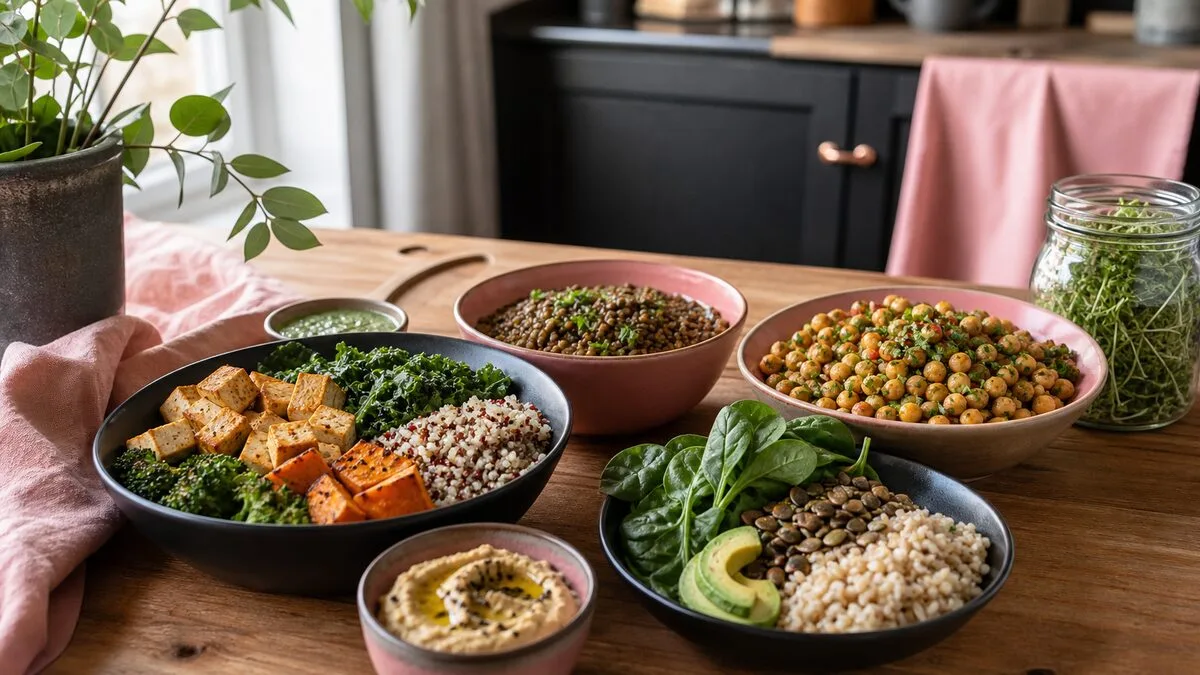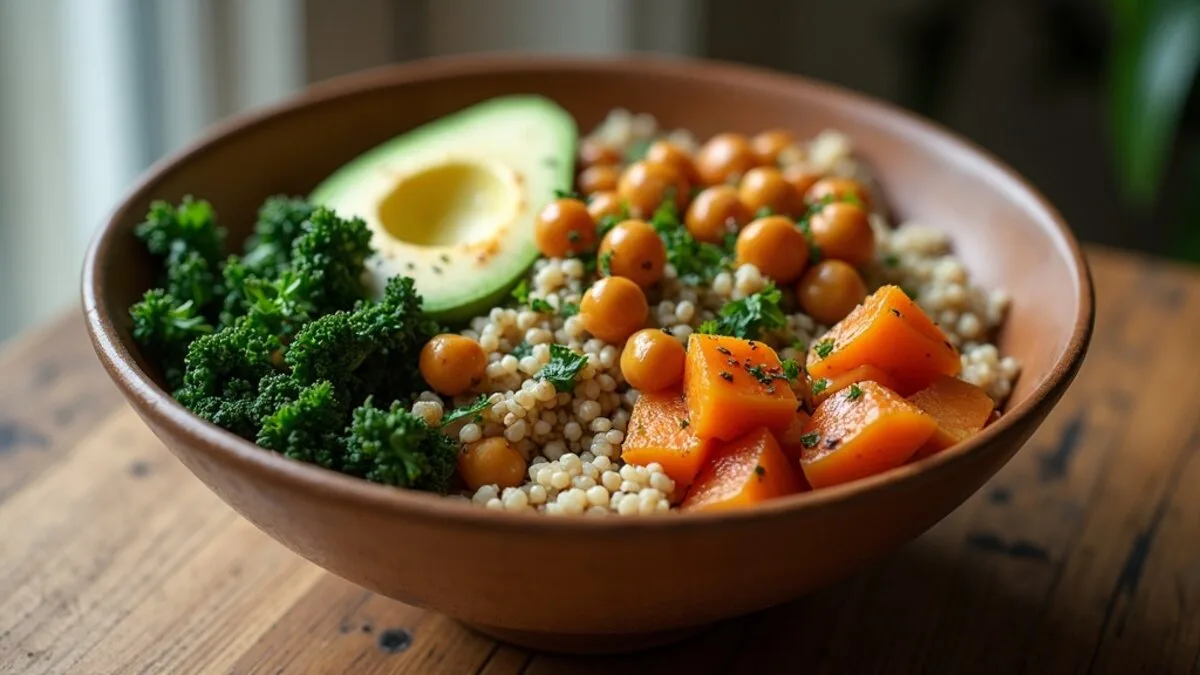
To build a vegan buddha bowl, fill the bowl in five parts: a warm grain or leafy base, a plant protein like chickpeas or cooked tofu, a tray of roasted vegetables, something raw and crunchy, and a thick dressing that ties it together. I work in rough quarters by volume, then finish with seeds, herbs, and a little fat. Once you hold the ratio in your head, you can build a good bowl from almost anything in the fridge.
The bowl is a ratio, not a recipe
A buddha bowl is not a recipe so much as a ratio. Once you know the ratio, you stop needing recipes. I build mine in five parts: a base, a protein, a roasted vegetable, a raw element, and a dressing. The amounts shift with the season and with what is in the fridge, but the shape stays the same. That is the whole trick. You learn one structure, and then you improvise inside it for the rest of your life.
I think in rough quarters by volume. A quarter of the bowl is the base. A quarter is protein. A quarter is roasted vegetable. The last quarter is split between something raw and the finishing touches. The dressing sits on top and counts as its own thing. None of this needs to be precise. The point of a ratio is that it frees you from measuring.
Why a ratio beats a recipe
A recipe tells you what to make once. A ratio tells you how to make a category of meals forever. When I cook from a ratio, I shop differently. I buy a good grain, a protein, whatever vegetables look honest at the market, and one bright thing for crunch. I am never stuck wondering what to cook, because the structure decides for me. This is the same logic behind sane plant-based meal prep: build components, then assemble.
What goes in a vegan buddha bowl?
A vegan buddha bowl holds a cooked whole grain, a plant protein such as chickpeas, tofu, tempeh, edamame, or lentils, a portion of roasted vegetables, a raw crunchy element, and a thick plant-based dressing. It is finished with seeds, fresh herbs, and a little fat like avocado. Nothing in it is mandatory by name. Every slot can be filled by several ingredients, which is exactly why the bowl survives any season.
The five slots, and how I weigh them
I think of the bowl as five slots, not a list of forty possible ingredients. That smaller number is what makes it sane to cook on a tired Tuesday. Base, protein, roasted vegetable, raw crunch, dressing. When I open the fridge, I am only asking five questions, and each one has an easy answer. The slots also mean nothing is ever truly missing. If I have no roasted vegetable, I roast something while the grain reheats. If I have no fresh herb, I lean harder on the pickle. The structure tells me what to reach for.
It helps to picture the bowl from above as a clock. Grain fills the slice from twelve to three. Protein runs from three to six. Roasted vegetable holds six to nine. The raw crunch and the finishing touches share nine to twelve. The dressing crosses the middle. I do not arrange it that neatly in real life, but holding the clock in my head keeps the proportions honest, and proportion is most of what makes a bowl satisfying rather than lopsided.
When I want dinner to stay light on carbs, I lean on the low-carb ideas in my collection of keto tofu recipes.
For the gap between meals, I lean on a few high-protein vegan snack recipes kept ready in the fridge.
When I want the week handled in one calm session, I follow my step-by-step method for vegan meal prep for the week.
Start with the base: grains and leaves
The base is the floor of the bowl. It is what everything else sits on, and it sets the mood. A warm grain base feels grounding and full. A leafy base feels lighter and faster. Most days I do both: a scoop of warm grain pushed to one side, a handful of leaves on the other, so each forkful can lean whichever way I want. The base should be about a quarter of the bowl, no more, or the bowl tips toward feeling like a plate of plain rice.
Grains worth keeping cooked
- Brown rice: nutty, sturdy, holds dressing well. My default.
- Quinoa: faster, fluffier, with a little protein of its own. Rinse it first or it turns bitter.
- Farro or barley: chewy and satisfying in cold months. Not gluten-free.
- Millet or buckwheat: soft, mild, good for gentler stomachs.
I cook a big pot of one grain at the start of the week and keep it in the fridge. Whole grains keep their bran and germ, so they carry more fiber and steadier energy than their polished versions. That difference is small per bowl and large over a year of bowls.
Leaves and the no-grain option
Some days I skip grain entirely and build on a bed of leaves: massaged kale, baby spinach, shredded romaine, or rocket. Massaging kale matters. I tear it off the stem, add a pinch of salt and a few drops of oil, and squeeze it in my hands for a minute until it softens and darkens. Raw kale straight from the bag is tough and a little mean. Massaged kale is tender and willing. If you want the bowl warmer and heavier, do half grain and half leaves.
Cooking grains so they keep all week
The trick to grains that survive five days in the fridge is to undercook them slightly and to cool them fast. I drain the grain a minute or two before it goes fully soft, spread it on a tray so the steam escapes, and only box it up once it has stopped steaming. Grain put away hot turns gummy and sour faster. Cooled and spread, it stays separate and pleasant. A teaspoon of oil tossed through the cooked grain also keeps it from clumping into a single block in the box.
I salt the cooking water for grains the way I would for pasta, because seasoning from the inside is something you cannot fully add back later. A bowl built on bland grain always tastes like it is missing something, even when every other component is good. Reheat with a splash of water, covered, so it steams back to life rather than drying out. Cold grain is also completely fine in an assembled lunch, which is part of why this base is so forgiving.
Add a real plant protein
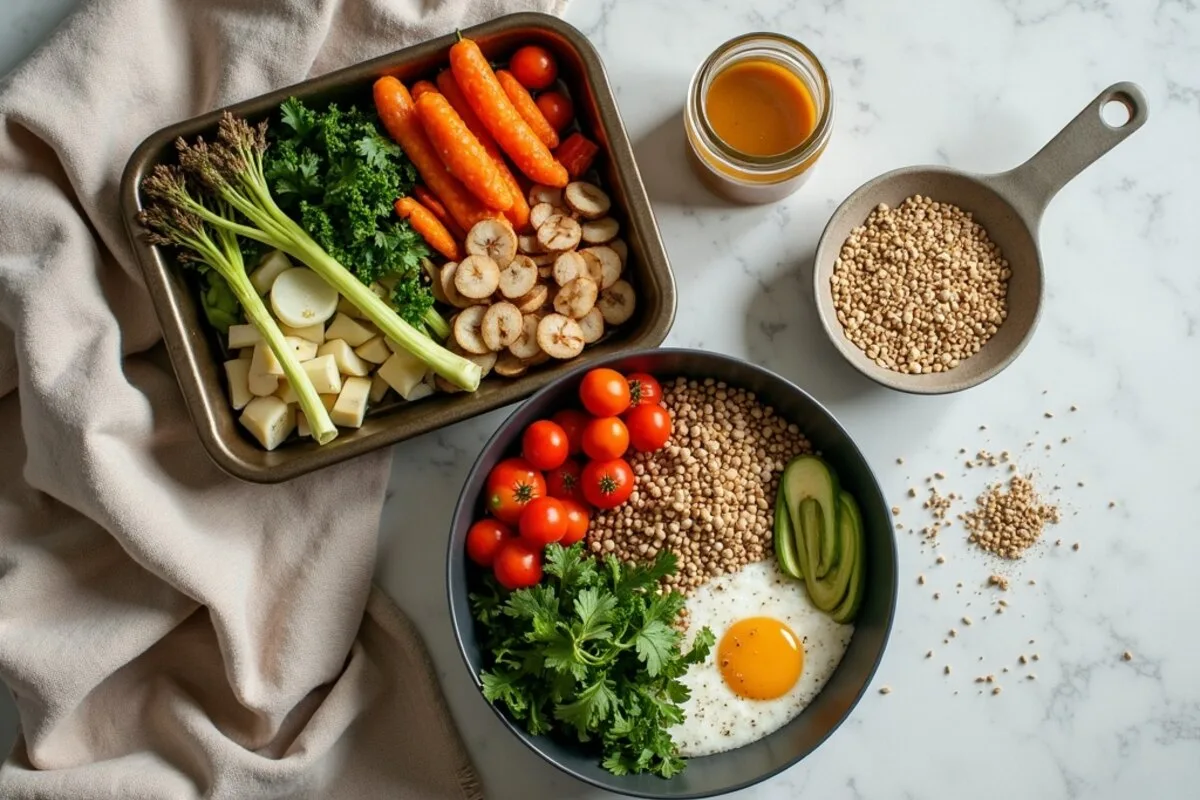
This is the slot people skimp on, and it is the slot that decides whether the bowl holds you until the next meal. A bowl without real protein is a snack that looks like dinner. I aim for a generous quarter of the bowl here, roughly a cup of cooked protein per serving. For more on getting this right across meals, I keep a longer note on high-protein vegan meals that pairs well with this section.
The proteins I rotate
- Chickpeas: the easiest win. Drain a tin, dry them well, toss with oil and salt, roast at 220C for 25 minutes until crisp. One tin feeds two bowls.
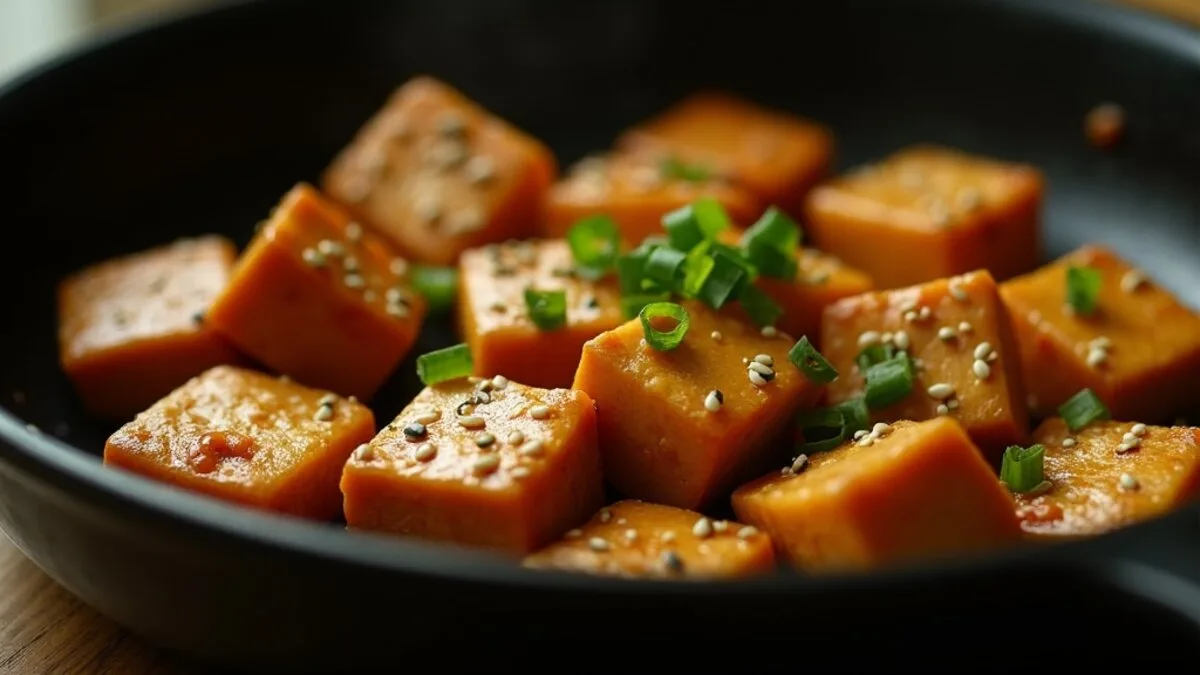
- Tofu: press it, cube it, roast or pan-fry until golden. My full method lives in the how to cook tofu guide.
- Tempeh: steam it for ten minutes to remove bitterness, then slice and pan-fry. Nuttier and firmer than tofu.
- Edamame: shelled, boiled for three minutes, then cooled. Almost no work and very high protein.
- Lentils: green or brown lentils simmered until tender but not mushy, about 20 minutes. They soak up dressing beautifully.
How much protein per bowl?
Aim for roughly one cup of cooked plant protein per bowl, which lands near 15 to 20 grams depending on the source. Combining a grain with a legume covers a fuller spread of amino acids, which is the practical heart of plant protein. Harvard's overview of protein is a calm, sane reference if you want the reasoning rather than the hype.
Roast a tray of vegetables
Roasting is where a bowl gets its depth. Raw vegetables are bright but flat. Roasted vegetables turn sweet and a little smoky at the edges, and they give the bowl a warm anchor against the cool dressing and crunch. I roast one tray and use it across several bowls, so this step costs me almost nothing per meal once it is done.
My method is plain. I cut everything into similar-sized pieces so they cook evenly. I toss with a tablespoon of oil and a good pinch of salt, spread them out so they are not touching, and roast at 220C for 25 to 35 minutes. Crowding is the enemy. Vegetables piled together steam and go soft; vegetables given room caramelize. If your tray is full, use two trays.
Different vegetables want different times, so I group them by how long they take rather than throwing everything on at once. Dense roots like sweet potato, beets, and parsnips want the full 30 to 35 minutes. Cauliflower and broccoli sit in the middle at around 25. Quick, watery vegetables like courgette, peppers, and cherry tomatoes are done in under 20. If I want to roast a mix, I start the slow ones first and add the fast ones partway through, so everything finishes browned at the same moment instead of half burnt and half raw.
Vegetables that roast well
- Sweet potato: cubed, sweet, the backbone of my autumn bowls.
- Cauliflower: florets that crisp at the tips and turn almost nutty.
- Broccoli: 20 minutes is plenty; the little buds char nicely.
- Beets, carrots, parsnips: slow, sweet, deeply satisfying in winter.
- Courgette, peppers, cherry tomatoes: quick summer roasters, ready in 18 to 20 minutes.
Roast once, eat several times
I almost never roast for a single bowl. A full tray of sweet potato and cauliflower carries me through three or four bowls across two days. Roasted vegetables reheat well and also taste good cold, straight from the fridge, which makes them ideal for an assembled lunch. This is the quiet efficiency that makes weekday vegan dinner recipes feel effortless instead of like a nightly project.
Keep something raw and crunchy
Every bowl needs a moment of resistance. Without it, a bowl of grain, protein, and roasted vegetables becomes a soft, uniform thing your fork moves through without noticing. The raw element wakes the whole bowl up. It adds crunch, freshness, and usually a little acidity or bite, which cuts through the richness of the dressing. I treat this as non-negotiable, even when I am tired.
Raw elements I reach for
- Shredded red cabbage: holds its crunch for days and adds color.
- Grated carrot: sweet, quick, cheap.
- Cucumber: cool and clean, sliced thin.
- Radish: peppery and sharp, sliced into coins.
- Quick-pickled red onion: thin slices in vinegar with a pinch of salt and sugar for 15 minutes. This single thing improves almost any bowl.
Why raw crunch matters so much
Contrast is what keeps a bowl interesting to eat all the way to the bottom. The raw element gives texture against the soft grain and roasted veg, and its freshness balances the cooked, savory parts. A small handful is enough; this is seasoning more than substance. If I had to cut one component to save time, it would never be this one. It is the cheapest way to make a plain bowl feel composed.
The quick pickle that fixes most bowls
If you do one extra thing for your bowls, make a quick pickle. I slice half a red onion as thin as I can, pack it into a small jar, and pour over enough vinegar to cover, with a pinch of salt and a pinch of sugar. Cider or rice vinegar both work. Fifteen minutes later the onion is soft, pink, and sharp, and it keeps in the fridge for two weeks. That single jar of bright acid lifts a tired bowl more than almost any other addition, and it costs pennies.
The same method works on shredded cabbage, sliced radish, or thin coins of carrot. A quick pickle is not preserving in any serious sense; it is just a fast way to add the acidity that makes everything else taste clearer. I keep a jar going most weeks. When a bowl tastes flat at the table, a forkful of pickle almost always turns out to be the missing note, more than salt and more than extra dressing.
The dressing is the whole point
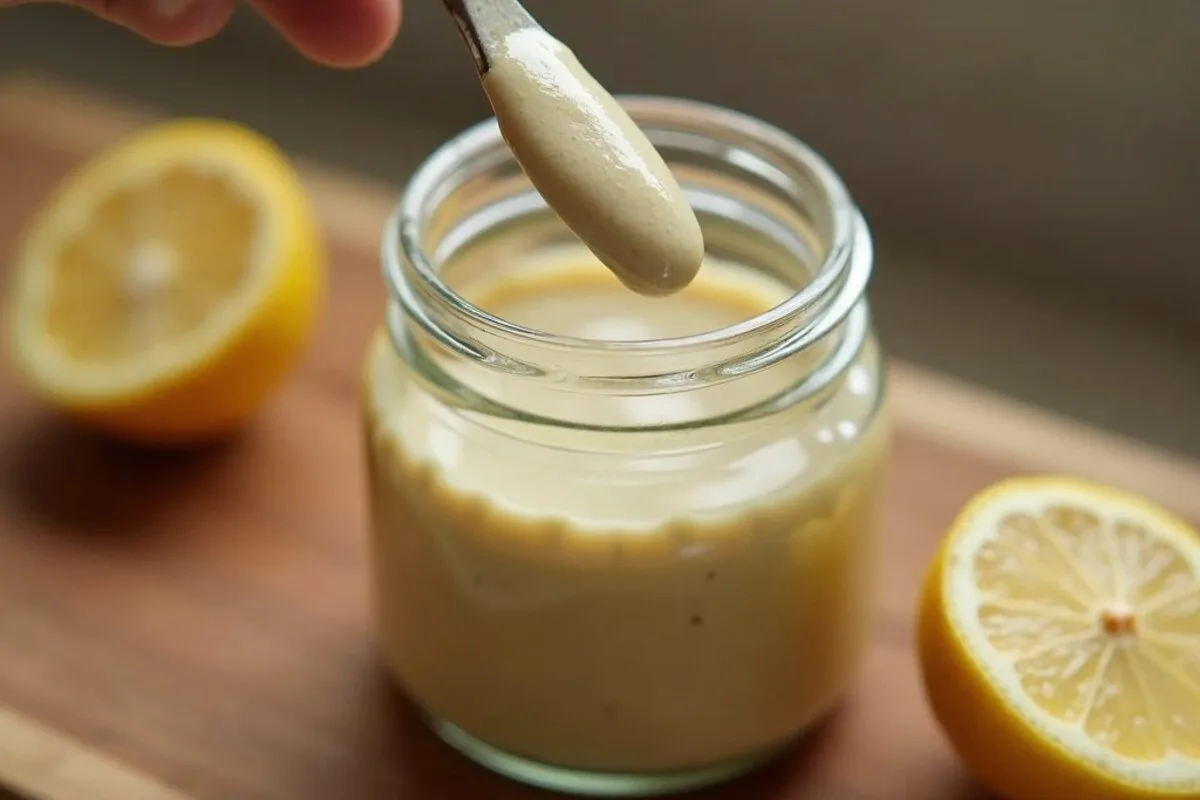
If the bowl is a ratio, the dressing is the sentence that makes the ratio read as a meal. A dry bowl is just ingredients in proximity. A dressed bowl is a dish. I make the same one most often: a tahini lemon dressing, thick enough to coat and bright enough to lift everything it touches. It takes two minutes and turns the most ordinary components into something I look forward to.
My tahini lemon formula
The formula is easy to hold in your head: 3 parts tahini, 1 part lemon juice, 1 small clove of garlic, salt, and water to loosen. In practice that is 3 tablespoons tahini, 1 tablespoon lemon, one grated garlic clove, a good pinch of salt, and 2 to 4 tablespoons of water added slowly. Tahini seizes and goes stiff when the lemon hits it. Do not panic. Keep whisking and adding water a little at a time, and it relaxes into a smooth, pourable cream.
How thick should the dressing be?
Aim for a dressing that coats the back of a spoon and pours slowly, like single cream. Too thick and it clumps on the grain instead of spreading; too thin and it pools at the bottom and the bowl tastes underseasoned. Add water in small splashes and stop the moment it pours in a ribbon. Make a double batch and keep it in a jar; it holds in the fridge for about five days and only gets more useful.
Variations on the base dressing
Once the tahini lemon base is second nature, you can bend it without thinking. A teaspoon of maple syrup rounds the edges if your lemon is very sharp. A spoon of soy sauce or tamari and a little grated ginger turns it toward something savory and warming for autumn bowls. A pinch of cumin or smoked paprika makes it earthy alongside roasted roots. A spoon of harissa or sriracha whisked in gives heat. Each is a small change to a formula you already hold, which is the entire advantage of cooking from a base.
If tahini is not your thing, the same role can be played by a blended dressing of soaked cashews, lemon, and water, or by a simple whisk of olive oil, mustard, and vinegar in a 3 to 1 ratio. What matters is not the specific ingredient but the qualities: enough body to cling, enough acid to brighten, and enough salt to season. Hold those three in mind and almost any dressing you improvise will land. Taste it on a leaf before it goes on the bowl, and adjust there, not after.
Finish with fat, seeds, and herbs
The finishing touches are small and they are what separate a bowl that looks thrown together from one that looks composed. None of them take effort. They are mostly things you scatter in the last ten seconds before you carry the bowl to the table, and collectively they do more than their size suggests.
The three finishing layers
- A little fat: half a sliced avocado, a few olives, or a spoon of hummus tucked at the edge. Fat carries flavor and makes the bowl feel complete.
- Seeds and crunch: toasted sesame, pumpkin seeds, sunflower seeds, or a spoon of dukkah. Toast them dry in a pan for two minutes for far more flavor.
- Fresh herbs: a generous handful of torn coriander, parsley, mint, or basil. Herbs are the difference between brown and alive.
Do you need avocado in a buddha bowl?
No, avocado is optional, but some source of fat genuinely helps. A little fat makes the bowl more satisfying and helps your body absorb the fat-soluble vitamins in all those vegetables. If avocado is out of season or expensive, a spoon of tahini already in the dressing covers it, or scatter olives, toasted nuts, or seeds instead. The goal is a touch of richness, not avocado specifically.
I think of these finishes as punctuation. The base, protein, and vegetables are the sentence. The seeds, herbs, and avocado are the commas and the full stop that make it read clearly. Eating slowly enough to notice them is its own small practice, something I wrote more about in my mindful eating guide.
Building bowls for the week ahead
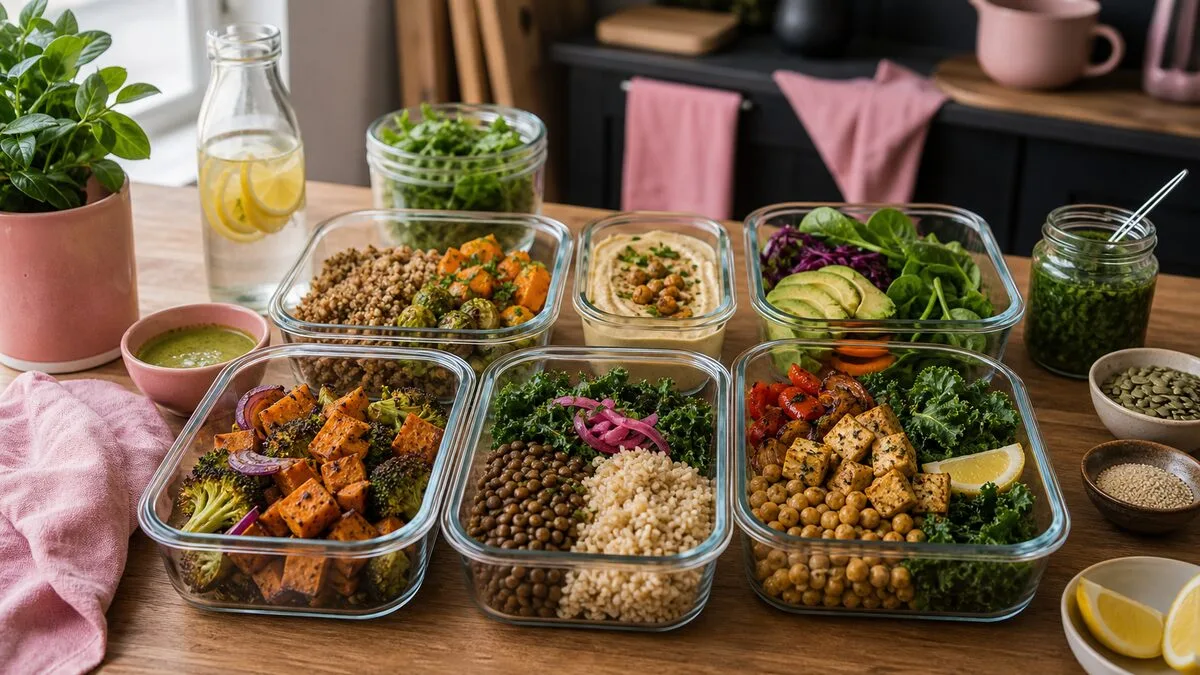
The bowl earns its place in my kitchen because it scales. Once you cook in components rather than in finished meals, a single afternoon of work becomes four or five lunches that assemble in three minutes. I do not meal-prep finished bowls. I prep parts and combine them fresh, because a pre-dressed bowl goes soggy and sad by day two.
A Sunday hour, four bowls
- Cook a big pot of one grain. Brown rice or quinoa keeps best.
- Roast two trays of vegetables while the grain simmers.
- Crisp a tin of chickpeas or roast a block of tofu on a third tray.
- Make a double jar of tahini dressing.
- Wash and dry leaves; shred a wedge of cabbage for raw crunch.
That is the whole prep. Each part goes into its own container. At lunchtime I scoop grain, protein, roasted veg, and raw crunch into a bowl, pour the dressing, and scatter seeds and herbs. The bowl tastes freshly made because, in every way that matters, it is.
How long do prepped components last?
Cooked grains and roasted vegetables keep three to four days refrigerated in sealed containers. Tahini dressing holds about five days. Crisp chickpeas lose their crunch after a day, so I roast them midweek rather than all at once, or accept they will be tender and still good. Keep the dressing separate until serving, always. This is the same component logic I lean on for broader plant-based meal prep through a busy week.
Seasonal bowls through the year
The reason I never tire of buddha bowls is that the ratio absorbs the seasons. The structure stays fixed and the contents rotate with the market, so a January bowl and a July bowl share a shape but taste like different meals. Here are four bowls I actually make, one for each turn of the year.
Spring
Quinoa base, with massaged kale folded through. Roasted asparagus and spring onions. Shelled edamame for protein. Raw radish and sugar snap peas for crunch. Tahini lemon dressing with extra lemon and a little grated zest. Finished with torn mint and toasted pumpkin seeds. It tastes green and a little sharp, which is what I want after winter.
Summer
Brown rice base, half-replaced with leaves on hot days. Roasted courgette, peppers, and cherry tomatoes. Crisp chickpeas. Cucumber and quick-pickled red onion for crunch. The same tahini dressing, thinned a touch more. A heavy handful of basil and parsley, and avocado if it is good. This is my most-made bowl from June to September.
Autumn
Farro base for chew. Roasted sweet potato and cauliflower, deeply browned. Pan-fried tempeh. Shredded red cabbage for color and crunch. Tahini dressing with a pinch of cumin stirred in. Pumpkin seeds and coriander on top. It is warm, grounding, and the bowl I crave when the light starts going early.
Winter
Brown rice or barley base. Roasted beets, carrots, and parsnips, slow and sweet. Warm lentils for protein. Massaged kale as the raw note, since lighter leaves are scarce. Tahini dressing with a little extra garlic. Toasted walnuts and parsley. This bowl leans into root vegetables and keeps me genuinely full through cold afternoons. For more cold-weather plates, my vegan comfort food recipes share the same warming instinct.
The mistakes I made first
I built bad bowls for a year before I built good ones. The failures were always the same handful of things, and naming them is faster than learning them the slow way. If your bowls feel boring or unsatisfying, the cause is almost certainly on this list.
The five I made most
- Too little protein. The bowl looked full but left me hungry an hour later. A real cup of protein fixed it.
- No dressing, or too little. A dry bowl is just ingredients sitting near each other. Be generous and make it thick.
- Crowding the roasting tray. Steamed, pale vegetables instead of caramelized ones. Use a second tray.
- Skipping the raw crunch. Everything soft and the same texture. The bowl needs one sharp, crisp note.
- Forgetting acid and salt. Bowls go flat without lemon and a real pinch of salt across the components, not just on top.
How do I make my buddha bowl more filling?
Increase the protein to a full cup, make sure there is a real source of fat such as avocado, tahini, or seeds, and keep the grain as a whole grain rather than a refined one. Protein, fat, and fiber together are what carry you to the next meal. If a bowl still leaves you hungry, the protein slot is almost always the part that was too small.
None of this is complicated, which is the point. A buddha bowl is forgiving. Get the ratio roughly right, season at each layer, dress it generously, and you will eat well from the same five ideas for years. That kind of simple, repeatable cooking is the quiet center of a calmer minimalist vegan lifestyle: fewer decisions, better meals.
Common questions
What is the basic vegan buddha bowl formula?
The formula is five parts in rough quarters by volume: a grain or leafy base, a plant protein (chickpeas, tofu, tempeh, edamame, or lentils), a tray of roasted vegetables, a raw crunchy element, and a thick dressing. Finish with seeds, herbs, and a little fat. Learn the ratio and you can build a bowl from almost anything.
Can I make vegan buddha bowls ahead of time?
Yes, but prep the components separately rather than assembling finished bowls. Cooked grains and roasted vegetables keep three to four days, and tahini dressing keeps about five. Store the dressing apart and combine everything fresh at mealtime so the bowl never goes soggy. Assembly takes about three minutes.
How much protein should a vegan buddha bowl have?
Aim for roughly one cup of cooked plant protein per bowl, around 15 to 20 grams depending on the source. Pairing a whole grain with a legume gives a fuller spread of amino acids. Too little protein is the most common reason a bowl looks full but leaves you hungry soon after.
What is the best dressing for a buddha bowl?
A tahini lemon dressing is my default: 3 tablespoons tahini, 1 tablespoon lemon juice, one grated garlic clove, a pinch of salt, and 2 to 4 tablespoons of water whisked in slowly until it pours like cream. It is thick, bright, and clings to every component. Make a double batch and keep it in a jar.