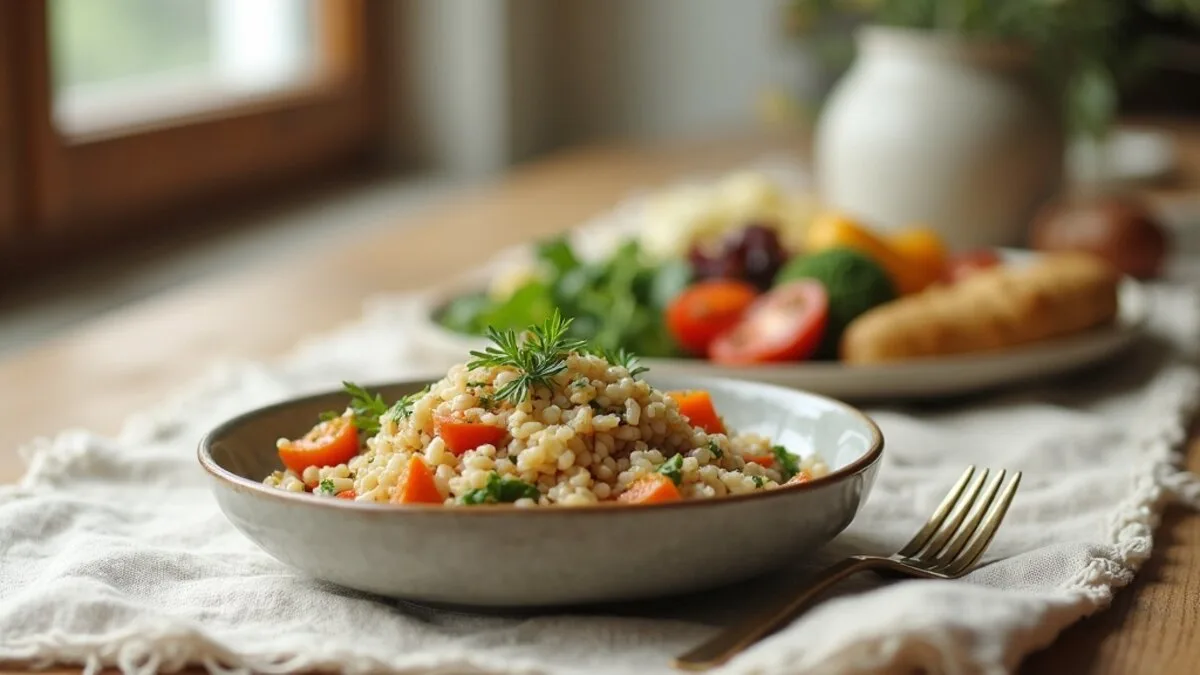
Not about chewing like a monk. For me, it means noticing enough to enjoy the meal and hear when my body is done.
Three small shifts
Mindful eating sounds bigger than it is. Three small shifts cover most of it: eat at a table when you can, put the fork down between bites, and notice the first time the food stops tasting as good as the first bite. That's almost the whole practice, and you could stop reading here and already have most of the value.
I came to this sideways, not through wellness but through greed, if I'm honest. I love food, and I realised I was barely tasting most of it. I'd cook something I was proud of, then eat it standing at the counter, scrolling, and look down to find the plate empty with no memory of the meal. That's a strange way to treat something you spent an hour making.
So mindful eating, for me, started as a way to actually enjoy my food more, not to eat less of it or police it. The calmer relationship with hunger and fullness came later, as a happy side effect. I'd rather sell you the pleasure than the discipline, because the pleasure is what made me keep doing it.
I wasn't eating too much. I was tasting too little. Those are not the same problem.
This sits in the wellness pillar as the daytime cousin of the morning habits essay. The morning is about bringing attention to the start of the day. This is about bringing the same attention to the plate. Same skill, different room.
I should be honest that I don't do this perfectly, and I don't want you holding yourself to a standard I can't meet. Plenty of my meals are still hurried and half-noticed, eaten between things. The shift wasn't from mindless to mindful, it was from never paying attention to sometimes paying attention, and that "sometimes" turned out to be enough to change how I feel about food entirely.
If you are newer to eating this way, it is worth knowing what I keep on hand in my guide to vegan supplements.
Most of what I throw away starts in the kitchen, so I keep coming back to the small habits in my zero-waste kitchen guide.
When I want dinner to stay light on carbs, I lean on the low-carb ideas in my collection of keto tofu recipes.
When I want cheese that actually feeds me, I make a batch from my guide to high-protein vegan cheese.
What mindful eating actually means
Mindful eating just means paying attention to your food while you eat it. That's the whole definition, and it's deliberately unglamorous. It isn't a diet, it doesn't ban anything, and it doesn't require an app or a special bowl. It's the radical act of noticing the meal you're already having.
It grows out of the broader idea of mindfulness, which is mostly just attention without judgement. Applied to food, that means tasting what's actually in your mouth rather than thinking about the next thing, the phone, the email, the worry. You'd be amazed how rarely most of us are actually present for our own meals.
I want to be careful not to overstate it. Many people find that eating with attention helps them feel more satisfied with less stress around food, and that's been true for me. But I'm not making medical claims, and I'm wary of how mindful eating sometimes gets repackaged as a stealth weight-loss tool. That framing tends to ruin it, because the second eating becomes a performance with a goal, the attention curdles into self-surveillance.
So here's my honest pitch. Pay attention because food is one of the genuine, reliable pleasures of being alive, and most of us are sleeping through it. The calmer body and the steadier appetite are real, and they're bonuses. The main event is that your dinner gets to taste like dinner again.
There's a reason this is harder than it sounds, and it's worth naming so you don't think you're uniquely bad at it. We've been trained out of paying attention to food. Eating has become the thing we do while doing something else, the multitasking default. Of course we can't taste our meals, we never gave them a turn. Mindful eating isn't learning a new skill so much as un-learning a distracted habit, which is its own kind of work.
I also think the quietness of plant-based food makes the practice more rewarding, not less. There's no roar of grease and sugar to coast on, so the attention pays off immediately. The first time you really taste a tomato in season, sun-warm and almost too ripe, you understand what all the noise was drowning out. That's available to anyone, any day. It just needs you to be there for it.
The first-bite trick
If you only do one thing, do this: notice the moment the food stops tasting as good as the first bite. There's almost always a point, usually a few bites in, where the flavour dims and you're eating more out of momentum than pleasure. Catching that moment is the single most useful skill in the whole practice.
The first bite of anything is the loudest. It's why the first chip is better than the fortieth, and why the first square of chocolate is an event and the rest is just chewing. Our taste buds adapt fast. Once you start noticing the fade, you can decide, consciously, whether you're still eating for the taste or just for the motion of it.
Why this isn't about stopping
I want to head off the obvious worry, because this can sound like a trick to make you put the fork down. It's not. Plenty of times I notice the fade and keep eating, because I'm hungry, or it's good company, or I just feel like it. The point isn't to stop. It's to make eating a choice again rather than an autopilot.
What I've found, though, is that simply noticing changes things on its own. When I'm actually paying attention, I tend to land at "satisfied" a little earlier and a lot more comfortably, without any rule telling me to. The body's signals were always there. I'd just been too distracted to hear them over the noise of the scroll.
The other thing the first-bite habit does is sharpen what you reach for in the first place. Once I started really tasting things, I noticed which foods were genuinely worth it and which I was eating purely out of habit or boredom. Some snacks I'd had for years turned out to taste of almost nothing when I actually checked. I didn't ban them. They just quietly fell away once I'd noticed I wasn't enjoying them anyway.
Try it once with something you love. Take the first bite of really good bread, or ripe fruit, or a square of dark chocolate, and give it your whole attention. Notice the texture, the way the flavour blooms and then fades. That single attentive bite often delivers more pleasure than the next ten distracted ones, which is a strange and useful bargain once you see it.
Eating at a table, and why it matters
Eat at a table when you can, because where you eat shapes how you eat more than any rule about how. The standing-at-the-counter meal, the desk lunch, the sofa dinner balanced on a knee in front of a screen, these aren't moral failings, but they make attention almost impossible. The setting does half the work, for better or worse.
A table is a small declaration that the meal is the thing, not the background to something else. When I sit down, properly, even for a quick lunch, the food gets to be the event. When I eat standing up, it's always the support act to whatever I'm really doing, and it disappears unnoticed.
The screen is the real obstacle
Honestly, the table matters mostly because it gets me away from the screen. The phone is the great enemy of tasting your food. You cannot be present for a meal and present for a feed at the same time, and the feed almost always wins, because it's engineered to. I started leaving the phone in another room at mealtimes, the same way I exile it at bedtime in my sleep wellness guide.
If a table genuinely isn't available, and for a lot of busy days it isn't, the next best thing is just to put the phone down and look at the food. Even a desk lunch becomes a different experience when you give it your eyes. The goal is attention, and a table is the easiest way to get it, but it's the attention that counts, not the furniture.
I'd add a word about plating, since it's part of how the table does its work. Eating off a real plate rather than out of the packet, or straight from the pan, makes a quiet difference. It frames the food as a meal rather than a refuel. I'm not talking about anything fancy, just the act of putting the food on a plate, sitting down, and treating it as something rather than nothing. Five seconds of plating buys a more present meal.
The television is the table's other great enemy, alongside the phone. A meal in front of a show vanishes the same way a meal in front of a feed does, the screen quietly eats your attention and the food goes down unnoticed. I'm not precious about it, I've had plenty of happy dinners in front of a film, but I've stopped pretending those are the meals I taste. If I want to actually enjoy the food, the screens go off, and the meal gets to be the show.
What it does for a plant-based plate
Plant-based meals can be quieter on the palate, and mindful eating amplifies that quiet beautifully. Where a heavily salted, sugary, or greasy plate shouts at you, a plate of vegetables, grains, and good oil tends to speak more softly. If you're not paying attention, you can miss most of what it's saying.
When I started actually tasting, the plant-based food I'd been eating for years opened up. You start noticing olive oil, lemon, salt, the difference between two types of bread, the way a roasted carrot is sweeter at the thin end. These are small things, and they're the whole pleasure of eating this way once you tune into them.
Seasonality is part of this, and you only really feel it when you're paying attention. The same vegetable tastes utterly different in its season and out of it, and a distracted eater never notices, while an attentive one starts to crave what's actually good right now. That's quietly changed how I shop and cook. I follow the flavour rather than the recipe, which I get into across the wider recipe pillar.
Cooking with intention and eating with attention are the same skill on opposite ends of the day. The care I put into a meal is wasted if I then inhale it without noticing, and the most attentive eating in the world can't rescue food that was thrown together carelessly. The two halves need each other.
There's a practical loop here too. Eating mindfully made me cook better, because I started noticing what was actually missing, more acid here, more salt there, more texture. My comfort food recipes got more flavourful once I was paying enough attention to taste their flaws. Attention at the table quietly trains the cook.
Texture is the part plant-based eating gets most wrong when it's rushed, and most right when it's noticed. A plate that's all soft, or all the same temperature, gets boring even if it tastes fine. Eating with attention taught me to build contrast: something crisp against something creamy, something warm against something cool. You only learn to want that contrast once you're paying enough attention to miss it when it's absent.
If you cook for other people, mindful eating is quietly contagious, too. When you slow down, put the phone away, and clearly enjoy the meal, the table tends to follow. Some of the best dinners in my house started with no rule at all, just one person actually savouring the food and everyone else, almost unconsciously, doing the same. I write more about that shared, unhurried table in a slow living routine.
Hunger, fullness, and the dial in between
Most of us eat by clock and habit, not by hunger, and mindful eating gently hands the controls back to the body. I don't mean strict rules about only eating when ravenous. I mean reacquainting yourself with a dial you probably stopped reading years ago: the slow slide from hungry to satisfied to too full.
The trouble is that fullness arrives on a delay. By the time you definitely feel full, you often overshot a few minutes ago. This is exactly why putting the fork down between bites helps, it builds in the pause that lets the signal catch up. Slower eating isn't a virtue in itself. It just gives your body time to tell you the truth.
The comfortable middle
The target I aim for isn't "full." It's a comfortable, satisfied middle, where I've clearly eaten enough but I'm not heavy or sluggish. I miss it plenty, and that's fine. The point isn't precision, it's awareness. Some meals I eat past it on purpose, because the food is too good or the table too happy to leave, and that's a fine choice when it's actually a choice.
One small practice helps me read the dial: a pause partway through the meal. I'll stop, set the fork down, and take a breath before deciding whether to keep going. Not to interrogate myself, just to check in. Often the answer is "yes, more, this is lovely," and sometimes it's "actually, I'm good." Either way it's a choice rather than a reflex, and that's the whole shift.
I'd flag one honest caveat. If your relationship with food is fraught, all this noticing can tip into anxious monitoring, which is the opposite of helpful. Mindful eating should feel like coming closer to your food, not standing guard over it. If it starts feeling like surveillance, ease right off, and if food is a genuine struggle, that's a conversation for a professional, not a blog post.
Mindful eating when life is loud
You will not eat mindfully at every meal, and chasing that is its own kind of pressure. Family dinners, working lunches, the rushed weekday breakfast, eaten while finding someone's shoes. Most meals happen inside a busy life, and a practice that only works in monastic calm isn't much use to anyone with a job or a household.
So I aim for one mindful meal a day, not all of them. Usually it's whichever meal is quietest, often dinner, sometimes a solo lunch. One meal where I sit down, put the phone away, and actually taste the food. The rest can be as chaotic as they need to be. One good meal of attention seems to reset something for the whole day.
Choosing which meal to protect is worth a moment's thought. Pick the one that's most reliably calm in your life, not the one that's theoretically nicest. For me that's dinner most days, because the morning is a scramble and lunch is at the desk. For you it might be breakfast before the house wakes, or a solo lunch on quieter days. Protect the realistic meal, and let the rest be as messy as they need to be.
On the loud meals, I keep a single anchor: the first three bites. Even at a hectic table, I can give the opening of a meal my full attention, taste it properly, and then let the conversation and the chaos take over. Three mindful bites is a real practice, not a failed one. It's the menu, not the contract, same as everything else in the wellness pillar.
This is the same lesson as my stress relief rituals and the floor version of my vegan wellness routine: keep the smallest version available so a busy life can't break the habit entirely. Mindful eating that survives a loud week is worth more than the perfect version that only exists on retreat.
Family meals deserve a special mention, because they're loud by design and also some of the best eating you'll ever do. I don't try to make a dinner with kids into a silent meditation, that would be both impossible and joyless. The attention there goes to the company as much as the food, which is its own kind of mindful. Being fully present at a chaotic, happy table counts. Presence was always the point, and people are part of the meal.
The hardest meal to do mindfully is the one eaten in a hurry, alone, stressed. That's exactly when I'm most tempted to numb out with a screen, and exactly when paying a little attention helps most. On those meals I lower the bar to almost nothing: sit, look at the food, taste the first bite. Even that small flag of attention stops the meal from vanishing entirely, and a meal you remember beats one you didn't notice having.
It is not a diet, and it is not about less
Let me say this plainly, because it's where mindful eating most often gets hijacked: this is not a diet. It doesn't forbid foods, count anything, or have a goal weight hiding in it. The moment you turn attention into restriction, you've left mindful eating and entered something harsher that just borrowed its name.
I eat dessert. I eat the second helping when I want it. I eat the slightly-too-much at a celebration and enjoy every bite. Mindful eating made those moments better, not guiltier, because I'm actually present for them instead of sneaking them while distracted and then feeling vaguely bad. Attention removes the shame more than it removes the food.
The numbers and trackers that haunt so much food advice have no place in this, and that's intentional. The moment you start logging and scoring your meals, you're no longer eating, you're auditing, and the auditing crowds out the tasting. I tried the measured, quantified version of food once. It made me anxious and worse company at dinner, and it taught me nothing my body wasn't already trying to tell me. So I deleted the apps and went back to simply paying attention, which costs nothing and works better.
The opposite of mindless eating isn't eating less. It's eating awake.
The diet framing also misses the point about pleasure. Diets treat food as the enemy to be managed. Mindful eating treats it as a friend to be enjoyed properly. Those are completely different relationships, and only one of them is sustainable for the rest of a life that includes birthdays, holidays, and the occasional very good slice of cake. I make my peace with the cake. I just try to taste it.
I think a lot of food guilt comes from eating things we never actually enjoyed, distractedly, and then carrying a vague shame about it afterwards. Attention dissolves a surprising amount of that. When I genuinely savour the treat, on purpose and without apology, there's nothing left to feel bad about. The guilt seems to feed on mindlessness. Pay attention, and it has much less to eat.
So if you've spent years at war with food, I'd gently offer this as a kind of ceasefire. You don't have to earn your meals, count them, or atone for them. You just have to show up and taste them. That's a softer relationship than most of us were sold, and in my experience it's the only one that lasts past the first hard week. The harshest food rules I ever followed all collapsed. Paying attention is the only thing that stuck.
How to start at your next meal
You can start at your very next meal, with nothing to buy and no plan to make. That's the best thing about this practice, the barrier to entry is essentially zero. Here's exactly what I'd do.
- Sit down. At a table if you have one, anywhere if you don't, just sit.
- Put the phone in another room, or at least face down and out of reach.
- Taste the first bite properly. Really taste it. Notice one specific thing about it.
- Put the fork down between the first few bites. No need to keep it up the whole meal.
- Somewhere in the middle, check: does this still taste as good as the first bite? Then carry on however you like.
That's it. You don't have to do it perfectly, or do it at every meal, or do it forever. Do it once, today, and see how the food tastes when you actually show up for it. My guess is it'll taste better than you remembered, because most of us have been eating with the lights off for years.
Then do it again tomorrow, with one meal, when you remember. The forgetting is fine. The remembering, again and again, is the whole practice, the same as it is everywhere in this corner of the site. Pair it with a steady first hour and a real sleep runway, and you've quietly built a gentler relationship with the most ordinary parts of the day.
A gentle warning about expectations, so you don't quit on day three. The first few mindful meals can feel a little awkward, even slow, like you're being self-conscious about something that used to be automatic. That fades. After a couple of weeks the attention stops feeling like an effort and starts feeling like the natural way to eat, and the distracted meals begin to feel oddly empty by comparison. Push through the awkward part. It's short.
Food was always going to be there, three times a day, for the rest of your life. Mindful eating just asks that you be there too, for at least some of it. That's a small request, and the reward is enormous: a few hundred more meals a year that you actually get to taste. Start with the next one.
Common questions
How long will this take, honestly?
The reading is 9 min. The practice is a lifetime. Start with one small piece this week and let the rest follow when it feels natural, not before.
Do I have to be fully plant-based for this to help?
No. Everything I write is for people who want a softer relationship with food and routine. The recipes happen to be plant-based; the ideas work in any kitchen.
What should I read next?
The related essays below, in order. If you only read one more thing, read A first hour worth keeping, it picks up exactly where this one ends.
Can I cite this guide somewhere?
Yes. Please link back to this page and credit Caleb Leuchi. All photographs are made for Leuchi unless noted; the writing is original.
Continue reading in this cluster
All wellness →
Wellness
A first hour worth keeping
Wellness
A vegan wellness routine for steady energy

Wellness
A self-care routine that truly helps

Wellness