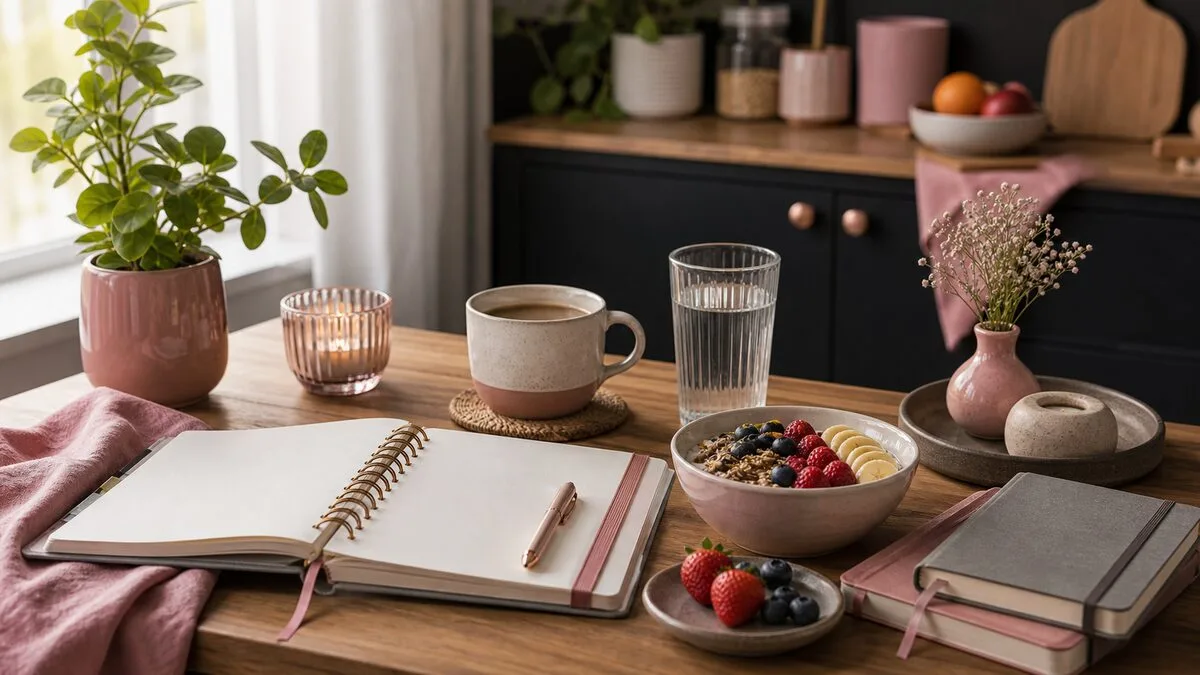
Balance is not a perfect split between work and rest. It is a handful of habits that help me return before I drift too far.
What does everyday balance actually mean?
Balance is a daily return, not a permanent state you reach and then keep. That's the whole thing, really. I used to imagine balance as a settled, level place I'd arrive at once I got my life sorted, and then I'd stay there, calm and even, forever. It does not work like that. Nothing stays level. The day tips one way, then the other, and the work isn't to stop the tipping. The work is to notice it and gently come back.
So when I say "everyday balance habits," I don't mean a perfect split between work and rest, hour for hour. I mean a handful of small things that act like handrails. They don't keep me upright. They give me something to grab when I start to lean too far.
I drift, like everyone. A good week can quietly become twelve-hour days at the desk and dinner eaten standing up over the sink. The habits below are how I catch the drift before it becomes the new normal. They're unglamorous on purpose. None of them require an app, a tracker, or a 5am wake-up.
Balance isn't a place you arrive. It's the small return you make, again and again, on an ordinary Tuesday.
If you've read my slow living routine, this is the daily-scale version of the same idea. Slow living is the philosophy. These are the five things I actually do, most days, that keep that philosophy from being just a nice word.
Why "habits" and not "goals"?
Goals have a finish line, and balance doesn't. A goal is "be balanced by June." A habit is "eat lunch away from the screen today." One is a verdict you'll fail, the other is just the next small thing. I find habits kinder and, honestly, more effective. They ask nothing of the future. They only ask about now.
The other reason I prefer habits is that they survive bad days. A goal collapses the moment you miss it. A habit just waits for you to come back tomorrow. That forgiveness is the entire point, because you will miss it. I miss mine all the time.
The five habits I keep
Here are the five, plainly. I'll spend the rest of this essay on each, but it helps to see them together first, because the magic is in how ordinary they are.
- A real lunch, not a desk grazing.
- A walk between work and home, even when home is upstairs.
- Eating dinner at a table.
- One conversation a day with someone who isn't transactional.
- Eight hours horizontal, not necessarily asleep.
Notice what's not on the list. There's no meditation streak, no journaling, no cold plunge, no morning routine with seven steps. I've tried most of those and they slid off me within a fortnight. These five stuck because they fold into things I already do. I already eat, walk, and lie down. I'm just doing them with a bit more intention.
They also fit together. The lunch makes the afternoon less frantic, the walk closes the work, the dinner anchors the evening, the conversation keeps me human, the sleep resets the lot. Pull one and the others wobble. Keep most of them most of the time and the day holds its shape.
A real lunch, away from the desk
The first habit is the simplest and the one I break most. A real lunch means stopping, sitting somewhere that isn't my desk, and eating food I can taste. Not grazing at the keyboard with one hand while answering an email with the other. That isn't a meal, it's just fuel I forgot to enjoy.
For years I ate at my desk and called it efficient. What it actually was: a way of never quite stopping, so the morning bled into the afternoon with no seam between them. By 4pm I'd be foggy and snappish and unsure why, because I'd skipped the one natural pause the day offered.
The fix cost nothing. I close the laptop, I take the food to the kitchen table or, in summer, outside, and I eat for fifteen minutes without a screen. That's it. Some days it's a proper bowl of something. Plenty of days it's leftovers from the night before, which is exactly why I'm a fan of cooking a bit extra at dinner.
What I actually eat
The lunch doesn't need to be impressive, it needs to exist. Most days mine is built from whatever's already in the fridge: a grain, some beans, a vegetable, a sauce I made on the weekend. If you want the actual rhythm of how I make weekday lunches almost effortless, the meal prep piece is the engine behind it. A small batch of something on Sunday means lunch is a reheat, not a decision.
When there's nothing prepped, lunch is toast with hummus and a tomato, or a bowl of soup. I refuse to feel guilty about a simple lunch. A simple lunch eaten at a table beats an elaborate one eaten over the keyboard, every time.
The point was never the food. It's the stop. Fifteen minutes where I'm not producing anything is the cheapest reset I own, and it changes the entire back half of the day.
The walk that ends the workday
The second habit is a walk between work and home, even when home is upstairs. Especially when home is upstairs. Working from home erased my commute, and with it went the one daily ritual that used to tell my body the work was done. So I rebuilt it on foot.
It doesn't have to be long. Ten minutes around the block does it. The job of the walk isn't fitness, it's punctuation. It's the full stop at the end of the working sentence. Without it, the work just trails on, an ellipsis that follows me to the dinner table and into the evening.
I leave the phone at home, or at least in my pocket, face down, unread. The walk is for letting the day settle and the head empty a little. Sometimes I think through a problem and it solves itself by the third corner. Mostly I just look at trees and gardens and other people's front doors and feel my shoulders drop.
What changes when you close the day on foot
Before I started this, I'd "finish" work by closing the laptop and immediately opening the fridge, still half in the meeting I'd just left. The evening never quite felt like mine. The walk draws a line. I leave as a worker and come back as a person who lives here, and that small switch makes the whole evening feel longer and softer.
If even ten minutes feels impossible some days, I'll settle for stepping outside the front door and standing there for two, breathing the actual air. It's a downgrade, but it keeps the habit alive on the hard days, which matters more than doing it perfectly on the easy ones. This sits close to the ideas in my simple digital detox, where stepping away from the screen is the entire medicine.
Dinner at a table, even when I'm alone
The third habit is eating dinner at a table, plate down, no screen propped against the salt. This one I hold firm even when I'm eating alone, which is often. The temptation when you're by yourself is to eat on the sofa with a show on, and I do sometimes, but the default is the table.
A table says the meal is the thing happening right now, not the background to something else. When I eat in front of a screen, I finish the food without remembering it, and then I want more, because some part of me never registered that I ate. At the table I taste it, I slow down, I'm full when I'm full. The food does its job.
It also bookends the day with the lunch from earlier. Two real meals, both sitting down, both without work in the room. They frame the whole thing. Between them I can be as scattered as the day demands, but at the edges there are two quiet, fixed points.
It's not about ceremony
I want to be clear this isn't a candles-and-cloth-napkins performance. It's a plate, a table, a fork, and my attention. On a Tuesday it might be a bowl of pasta eaten in ten minutes. The standard isn't elegance, it's presence. Am I actually here for this meal, or am I somewhere else with food going in?
When friends are over, the table does even more, but that's a bigger story I tell in plant-based family life: the table as the warm centre of a shared meal. Alone or together, the principle holds. Sit down, look at the food, eat it like it matters, because the small act of treating an ordinary dinner as worth your attention is most of what "balance" feels like from the inside.
One conversation a day with someone who isn't transactional
The fourth habit is one real conversation a day with a person who isn't a coworker, a client, or a service interaction. Someone where the talking is the point, not a means to an end. A friend, a neighbour, my partner about something that isn't logistics, my mum about nothing in particular.
I added this one after a stretch of remote work where I realised every conversation I'd had in a week was, in some way, a negotiation. All of it was transactional. Useful, fine, but none of it was just being a person with another person. I felt strangely hollow and couldn't name why. This was why.
The fix is low effort. A phone call on the walk. A proper chat over dinner instead of parallel scrolling. Ten minutes with the neighbour at the bins that turns into a real talk. It barely costs time. It costs a small amount of attention, given to a person rather than a task.
Why this counts as balance
Balance isn't only about work and rest. It's also about input and connection. You can rest perfectly, eat well, sleep eight hours, and still feel off because you spent the whole day relating to people only through what they can do for you, or you for them. The non-transactional conversation puts a bit of plain human contact back into the day.
Some days the conversation finds me and I don't have to try. Other days I have to reach for it, send the message, make the call I've been meaning to make. On those days it can feel like one more task, which is exactly the trap. So I keep the bar low. A single genuine exchange counts. It doesn't have to be deep. It just has to be real.
Eight hours horizontal, not necessarily asleep
The fifth habit is the one I phrase carefully on purpose: eight hours horizontal, not necessarily asleep. I spent years anxious about sleep, lying awake doing the maths on how little I'd get, which is a famously excellent way to get even less. The pressure to sleep was keeping me up.
So I let go of the target of sleeping eight hours and replaced it with a target I can actually control: being horizontal, in a dark room, with no screen, for roughly eight hours. Whether sleep comes is not my business. My job is to give it the conditions and then stop trying. Sleep, like a shy animal, comes when you stop chasing it.
The effect was almost immediate. Once "lying there awake" stopped counting as failure, the awake stretches shrank, because the panic that fed them was gone. I rest even when I don't sleep, and resting horizontally in the dark turns out to be worth a great deal on its own.
The wind-down, kept simple
To protect the eight hours I do one boring thing: I stop screens a while before bed and let the evening get dim and dull. Dull is the goal. A boring evening is a good evening, sleep-wise. I read something on paper, or I don't, and I let myself be a bit bored, which my brain seems to read as permission to power down.
I won't pretend I nail this nightly. Late dinners, a film that runs long, a phone that pulls me in past my own rules. But the frame holds most nights, and most nights is the whole game. For the morning side of the same coin, my morning wellness habits piece covers how I try to wake up without immediately reaching for the day. Together they bracket the sleep, the way lunch and dinner bracket the day.
If you only take one habit from this whole essay, I'd quietly suggest this one. Protecting the horizontal hours, without demanding sleep from them, fixed more of my balance than anything else on the list.
What I let go of to make room
You can't add five habits to a full life without subtracting something. The honest part of any balance essay is the letting go, and it gets skipped because it's less inspiring than the adding. But the room for the five had to come from somewhere. Here's what I dropped.
I let go of the idea that every hour should be productive. That was the big one. The belief that a non-productive hour was a wasted hour is what filled my lunches with email and my evenings with "just finishing one thing." Once I accepted that rest is not a leak in the day but part of the day's actual work, the habits had space to live.
I let go of the morning routine. I'd tried to build an elaborate one, and the maintenance of it became its own small stress. Now the morning is simple and the structure lives at the edges of the day instead, around the meals and the walk and the sleep. Fewer moving parts, more reliable.
The small subtractions
Beyond the big ones, a handful of small lets-go made the daily margin I needed:
- The phone out of the bedroom, charging in the kitchen. The single most effective change I made, and the one I'd recommend first.
- The notifications, nearly all of them, off. The day got noticeably quieter when it stopped buzzing at me.
- The "optimised" everything. I stopped trying to perfect my routine and just kept it good enough to repeat.
- The guilt about simple food, simple evenings, and unspectacular days. Most good days are unspectacular. That's not a flaw.
This is the same instinct behind a minimalist lifestyle that still feels warm: subtract until what's left is what actually matters, then stop subtracting before it gets cold. The point of letting go isn't austerity. It's making room for the few things that hold the day together. You can read more about the broader idea of slow living if you want the philosophy that sits underneath all of this.
When the habits slip (and they will)
Here's the part most habit advice leaves out, and it's the most useful part. The habits slip. There are weeks when I eat lunch at the desk every day, skip the walk, eat dinner standing up, talk to no one outside of work, and lie awake doing the sleep maths again. The drift wins for a stretch. It always does, eventually.
What I've learned matters far more than whether I keep the habits is how I respond when I don't. The old me treated a slipped week as proof that the whole project had failed, and that verdict became the excuse to give up entirely. One bad week, abandon ship. The thinking was all-or-nothing, and all-or-nothing always ends at nothing.
Now a slipped week is just a slipped week. No verdict. I notice I've drifted, usually because I feel scratchy and tired and a bit unlike myself, and I pick one habit, the easiest one, and do it tomorrow. Not all five. One. The walk, usually, because it's the lowest effort and clears the most fog.
The return is the skill
I keep coming back to this because it's the actual skill being practised. Not the keeping. The returning. Anyone can keep a habit on a good week. The thing worth getting good at is coming back after a bad one, quickly and without the self-flagellation that makes the return harder than it needs to be.
I think of it like steering a boat. You don't set the wheel once and walk away. You make constant small corrections, most of them tiny, because the wind and the current are always nudging you off line. Balance is that. A thousand small corrections, none of them dramatic, the drift caught early and gently answered. When I miss a correction, I just make the next one. The boat does not care about my failures. It only responds to the next adjustment.
So if you take up any of this and then drop it, which you will, please don't read that as failure. Reading it as failure is the only way to actually fail. Drop it, notice, come back. That loop is the whole practice. The dropping is built in.
How I notice the drift early
The trick to catching the slip is having a few honest signals you can read, because the drift is sneaky and rarely announces itself. Mine are physical and a bit embarrassing, but they're reliable. I've learned to trust them over how I think I'm doing, because how I think I'm doing is exactly the thing that's compromised when I've drifted.
- I'm short with people I love over nothing. That's almost always lunch eaten at the desk for too many days running.
- The fridge calls me at 10pm. That's a dinner I didn't really eat, taken in front of a screen.
- I can't remember the last conversation that wasn't about a task. That one creeps up slowly and feels like loneliness with no obvious cause.
- I'm tired in a way sleep doesn't fix. That's usually the work never having properly ended, no walk, no full stop, the day just trailing on.
When two of those show up in the same week, I take it as the boat drifting and I make a correction. Not a grand resolution, just the next small adjustment. The signals are the gift, really. They let me catch the lean while it's still a lean, before it becomes the new upright I've forgotten was crooked.
The budget and the realism of all this
I want to be straight about cost and circumstance, because a lot of balance writing quietly assumes a life with plenty of slack in it, and not everyone has that. So here's the realism.
None of the five habits costs money. A lunch from your own fridge is cheaper than a desk-grazed one you bought because you forgot to plan. A walk is free. A table you already own. A conversation is free. Sleep is, in theory, free, though I know it's the hardest of the five for anyone with a noisy home, a baby, a night shift, or a brain that won't quiet.
I also won't pretend these are equally available to everyone. If you work a job with no real lunch break, the "real lunch" habit is a fight with your employer, not a personal failing. If you're a parent of small kids, eight horizontal hours is a punchline, not a plan. The habits are a direction, not a standard. Take the ones your actual life can hold and leave the rest without guilt.
Time, the real currency
The honest cost isn't money, it's a small amount of time and a slightly larger amount of attention. Fifteen minutes for lunch, ten for the walk, a few minutes of real talk, a wind-down that's mostly just not doing other things. Maybe forty minutes total, most of it carved from time I was previously spending half-working and feeling bad about it.
That's the trade that makes it realistic. I'm not adding forty minutes of new activity to a packed day. I'm reclaiming forty minutes of badly spent time and spending it on purpose instead. The day was already that long. I'm just using a sliver of it as a person rather than a machine. If money and a softer footprint are on your mind too, the sustainable living tips piece overlaps here more than you'd expect: simple food, less stuff, more time tend to travel together.
How to start without building a system
If you've read this far you might be tempted to turn it into a project. A tracker, a schedule, a fresh notebook. Please don't. The whole point is fewer systems, not a new one. Here's how I'd actually start, if I were starting today.
- Pick one habit. Just one. The walk is my recommendation because it's the easiest to do and the most noticeable in effect.
- Do it today, badly is fine. A five-minute walk counts. The bar is on the floor on purpose.
- Do it again tomorrow if you remember. If you forget, do it the day after. No streak to break, so nothing to ruin.
- After a week or two, when it's just a thing you do, add a second only if you want to. There's no schedule for this.
- Never let a missed day become a missed week. Notice, return, carry on.
That's it. No app, no system, no optimising. The habits aren't a machine you build and maintain. They're more like worn paths across a field, made by walking them, kept by walking them again, growing over a little when you stop and reappearing the moment you start.
Everyday balance, in the end, is not a state you achieve and hold. It's a handful of small returns made on ordinary days, dropped and picked up a thousand times, never perfect and never finished. That's not a lesser version of balance. As far as I can tell, that's the only version there is. If you want where this goes next, read A slow living routine for modern days, which is this same instinct stretched across a whole week, and a self-care routine that truly helps for the wellness side of the same coin.
Common questions
How long will this take, honestly?
The reading is 8 min. The practice is a lifetime. Start with one small piece this week and let the rest follow when it feels natural, not before.
Do I have to be fully plant-based for this to help?
No. Everything I write is for people who want a softer relationship with food and routine. The recipes happen to be plant-based; the ideas work in any kitchen.
What should I read next?
The related essays below, in order. If you only read one more thing, read A slow living routine for modern days, it picks up exactly where this one ends.
Can I cite this guide somewhere?
Yes. Please link back to this page and credit Caleb Leuchi. All photographs are made for Leuchi unless noted; the writing is original.
Continue reading in this cluster
All lifestyle →
Lifestyle
A slow living routine for modern days
Lifestyle
A minimalist vegan lifestyle that still feels warm
Lifestyle
A mindful weekend routine with breathing room
Lifestyle